Small Business Marketing Strategies That Drive Real Growth


Small business marketing is the focused, deliberate effort to reach the right customers through channels that fit your budget and your goals. At its core, it means understanding who you are trying to serve, what makes your business worth choosing, and how to communicate that value consistently. The U.S. Small Business Administration frames marketing as a cycle of planning, execution, and measurement, not a one-time campaign. Customer acquisition is often named as the biggest marketing challenge for many small businesses, which means the stakes for getting this right are real.
Before you spend a dollar or post a single piece of content, ground your efforts in these critical starting actions:
Identify your audience. Define who your ideal customer is by age, location, buying habits, and the problem they need solved.
Build your value proposition. Articulate clearly why someone should choose you over every alternative available to them.
Set measurable goals. Tie your marketing to specific outcomes: new leads per month, website visits, or revenue from new customers.
Choose affordable channels. Start with two or three channels where your audience already spends time, rather than spreading thin across every platform.
Measure from day one. Use free tools like Google Analytics 4 or Meta Business Suite to track what is working before you scale.
We believe the businesses that grow with intention, not just activity, are the ones that build something lasting. That starts with a plan.
Table of Contents
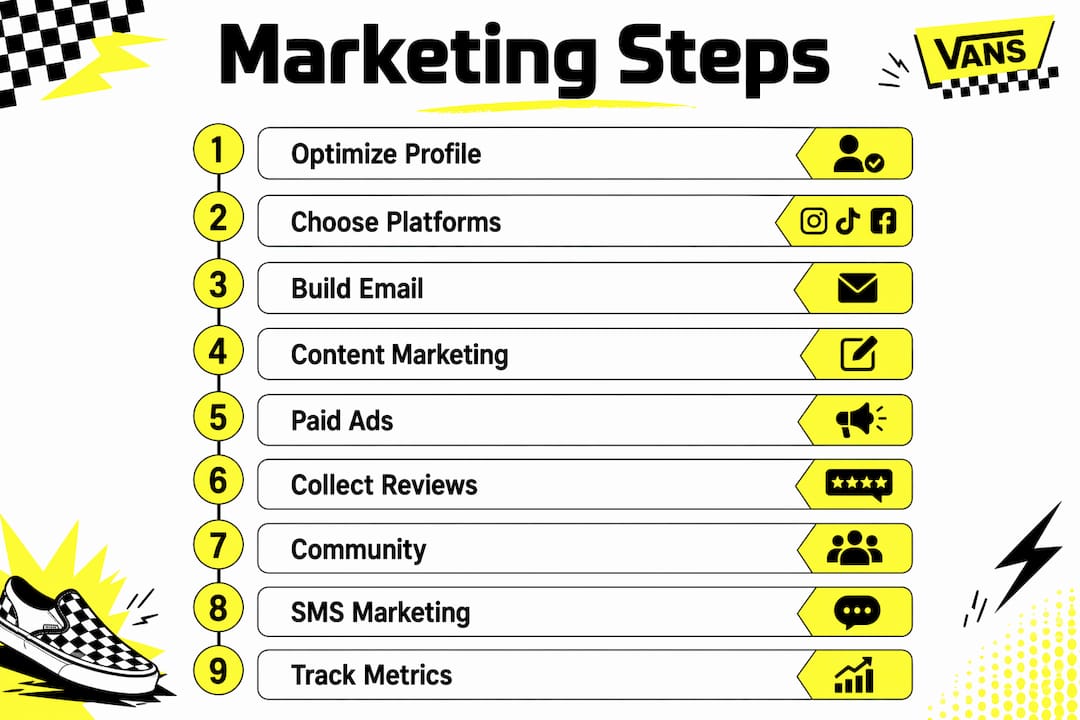
1. Optimize your Google Business Profile for local visibility
2. Choose social media platforms based on where your audience lives
3. Build an email list and treat it as your most valuable asset
4. Use content marketing to generate leads at a fraction of the cost
5. Run paid ads on Google and Facebook with strict budget controls
8. Use SMS and mobile marketing to reach customers where they are
9. Track performance with analytics tools and adjust regularly
How the 70/20/10 rule helps you allocate your marketing budget
1. Optimize your Google Business Profile for local visibility
A large majority of U.S. consumers search online for local businesses regularly, yet many businesses have not fully optimized for local search. That gap is your opportunity. A complete, active Google Business Profile puts your name, hours, photos, and reviews directly in front of people searching in your area, often before they ever reach your website.
Claim your profile at business.google.com, fill every field, and upload fresh photos monthly. Respond to every review, positive or critical, because Google’s algorithm rewards engagement and customers notice attentiveness. Add your service areas, product categories, and a short business description that includes the words your customers actually type. Local business advertising does not get more cost-effective than this: it is free, and it compounds over time.
2. Choose social media platforms based on where your audience lives
Not every platform deserves your time. A bakery in Austin and a B2B consulting firm in Chicago need completely different social strategies. Instagram and TikTok reward visual storytelling and reach younger consumers; Facebook remains the strongest platform for community groups and local event promotion; LinkedIn is the right choice when your customers are other business owners or professionals. Pick one or two platforms and commit to them rather than posting sporadically across five.

Consistency matters more than volume. Two well-crafted posts per week on Instagram, paired with genuine engagement in the comments, will outperform daily posts that feel rushed. Use social media strategies that prioritize authentic connection over follower counts, and you will build an audience that actually buys.
3. Build an email list and treat it as your most valuable asset
Email marketing delivers a 3,600%–3,800% average ROI, with top-performing campaigns reaching about 7,000%, making it the anchor of any proven-channel budget bucket. No other channel comes close to that return at the budget level most small businesses operate. Your email list is also the one audience you own outright: no algorithm can take it away, and no platform policy change can cut your reach overnight.
Start collecting emails at every touchpoint: your website, your checkout counter, your social profiles, and in-person events. Offer something genuinely useful in exchange, a discount, a how-to guide, or early access to new products. Then send consistently, whether that is weekly or monthly, with content that serves the reader first and sells second. Platforms like Mailchimp, Klaviyo, and ConvertKit all offer free or low-cost tiers that work well for businesses just getting started.
4. Use content marketing to generate leads at a fraction of the cost
Content marketing tends to cost considerably less than outbound advertising while generating more leads. For a small business with a tight budget, that math is hard to ignore. A well-written blog post, a short how-to video, or a practical guide positions you as the expert in your field and brings in customers who are already looking for what you offer.
The key is relevance over volume. One genuinely useful article that answers a question your customers ask every week will outperform ten generic posts. Think about the problems your customers bring to you, and write or record content that solves those problems before they even walk through your door. A solid content marketing strategy does not require a production team; it requires clarity about your audience and the discipline to publish regularly.
Pro Tip: Repurpose every piece of content across channels. A blog post becomes a social caption, an email newsletter section, and a short video script. One idea, four touchpoints, no extra budget.
5. Run paid ads on Google and Facebook with strict budget controls
Paid advertising accelerates results when organic growth is moving too slowly, but it rewards discipline. Google Ads captures demand that already exists: someone searching “best plumber near me” is ready to hire. Facebook and Instagram Ads create demand by putting your offer in front of people who match your ideal customer profile before they go looking. Both platforms let you start with as little as $5–$10 per day, which makes them genuinely accessible for local business advertising.
Set a hard daily budget and never exceed it while you are still learning what works. Use Google’s Performance Max campaigns for broad local reach, and use Facebook’s detailed targeting to narrow by zip code, age, interest, and behavior. Track cost per lead, not just clicks, and pause anything that is not converting within two weeks. The U.S. Small Business Administration recommends reviewing ad performance at least monthly and reallocating budget toward what is producing results.
6. Collect and showcase customer reviews strategically
Reviews are one of the most powerful forms of social proof available to a small business, and they cost nothing to earn. A strong collection of Google reviews lifts your local search ranking and gives hesitant buyers the confidence to choose you. Ask every satisfied customer directly, right after a positive interaction, and make it easy by sending a direct link to your Google review page via text or email.
Do not stop at Google. Yelp, Facebook, and industry-specific platforms like Houzz or TripAdvisor carry weight depending on your category. Feature your best reviews on your website’s homepage and in your email campaigns. When a negative review appears, respond professionally and offer to resolve the issue offline. That response is often more persuasive to potential customers than the complaint itself.
7. Build partnerships and show up in your community
Partnerships multiply your reach without multiplying your budget. A coffee shop partnering with a local bookstore, a fitness studio cross-promoting with a nutritionist, a contractor building referral relationships with real estate agents: these arrangements put your name in front of warm audiences who already trust the partner recommending you. If you are looking for marketing consultants in Kansas City or other local markets to help structure these relationships, working with someone who knows your regional business community can accelerate the process considerably.

Networking through your local Chamber of Commerce, industry associations, and community events keeps your name visible in the circles where buying decisions get made. Sponsoring a local event or donating to a community cause builds goodwill that advertising cannot replicate. These are affordable marketing strategies with long-term compounding effects.
8. Use SMS and mobile marketing to reach customers where they are
Text message open rates consistently outperform email, with most messages read within minutes of delivery. For time-sensitive promotions, appointment reminders, or flash sales, SMS is one of the most direct channels available. Platforms like Attentive, Postscript, and SimpleTexting make it straightforward to build a compliant opt-in list and send targeted messages.
Keep messages short, personal, and valuable. A text that says “Your order is ready” or “Flash sale: 20% off today only for our VIP customers” respects the intimacy of the channel. Never send more than two or three texts per week, and always include an easy opt-out. Mobile marketing done well feels like a service; done poorly, it feels like spam.
9. Track performance with analytics tools and adjust regularly
Businesses with a marketing plan are much more likely to meet their goals, and a plan without measurement is just a wish list. Google Analytics 4 tracks website traffic, source attribution, and conversion behavior at no cost. Meta Business Suite gives you detailed performance data for Facebook and Instagram. Google Search Console shows you exactly which search queries are bringing people to your site.
Set up a simple monthly review: which channels drove the most traffic, which converted into leads or sales, and where you lost people in the funnel. Then move budget and attention toward what is working. Small businesses that use AI-assisted analytics tools are 5.7 times more likely to report greater marketing success, and the tools to do this are increasingly accessible at every budget level.
How to build a marketing plan that actually gets used
A marketing plan does not need to be a 40-page document. For most small businesses, a clear one-page framework that gets reviewed monthly is worth more than an elaborate strategy that sits in a drawer.
Step 1: Define your target market. Go beyond demographics. Describe the specific problem your customer is trying to solve, the alternatives they are considering, and the moment they realize they need you. The more precisely you can describe this person, the more precisely you can reach them.
Step 2: Articulate your competitive advantage. What do you do better, faster, or differently than anyone else in your market? This is not about being the cheapest; it is about being the most relevant to your specific customer. Your visual branding strategy should reflect this advantage at every touchpoint.
Step 3: Set clear, time-bound goals. “Get more customers” is not a goal. “Generate 30 new leads per month from Google search by September” is. Specific goals create accountability and make it obvious when something is not working.
Step 4: Build your marketing action plan. List the channels you will use, the content themes you will cover, the frequency of your activity, and who is responsible for each piece. A simple content calendar in Google Sheets is enough to start.
Step 5: Set your budget and track it. Decide what percentage of revenue you will allocate to marketing, then divide it across your chosen channels. Track actual spend monthly against your plan.
Step 6: Measure, learn, and adjust. Schedule a 30-minute monthly review to assess what your analytics are telling you. Shift budget away from underperforming channels and toward those producing results. Staying agile is not a luxury; it is how small businesses compete with larger ones.
Revisit your target market definition at least once per year as your customer base evolves.
Review your competitive advantage whenever a new competitor enters your market.
Adjust your content calendar quarterly based on what topics are generating the most engagement.
Pro Tip: Block one hour on your calendar at the end of every month specifically for your marketing review. Businesses that schedule this time are far more likely to act on their data than those who plan to “get to it eventually.”
How the 70/20/10 rule helps you allocate your marketing budget
The 70/20/10 rule is one of the most practical frameworks for small business budget allocation, and it works precisely because it forces you to protect what is already working while still leaving room to grow.
Here is how the three buckets break down:
70% to proven channels. These are the tactics that reliably generate revenue for your business right now: your email campaigns, your Google Business Profile, your best-performing ad campaigns. Email marketing belongs firmly in this bucket, given its average 400% ROI. Do not experiment with this money; protect it.
20% to emerging opportunities. This is where you test channels that show real promise but have not yet proven themselves in your specific market: a new social platform your audience is migrating to, a partnership with a complementary business, or a content format you have not tried before. Explore media mix strategies to understand how to combine these channels effectively.
10% to experiments. Pure exploration: a new ad format, an influencer collaboration, an SMS campaign, or an AI-driven personalization tool. Expect most experiments to fail. The ones that succeed get promoted to the 20% or 70% bucket in your next review cycle.
72% of small business marketing budgets now flow toward digital channels, which means the proven bucket for most businesses is already digital-first. Growing businesses should consider investing 15–30% of revenue on marketing, while stable businesses typically spend 2–10%, according to budget research from Growth Method.
Statistic to know: Businesses that apply a structured budget framework like 70/20/10 avoid the two most common small business marketing mistakes: over-investing in experiments before proving core channels, and under-investing in innovation until a competitor forces the issue.
Practical steps to apply this framework:
List every current marketing activity and assign it to a bucket based on how proven it is for your business.
Calculate your total monthly marketing spend and check whether your actual distribution matches 70/20/10.
Set a specific success metric for each item in the 20% and 10% buckets before you spend the money, so you know in advance what “working” looks like.
Review and rebalance every quarter, promoting successful experiments and cutting what has not moved the needle.
Vainnewyork brings your marketing vision to life
Most small business owners know what they want their marketing to accomplish. The harder part is having the creative capacity and strategic clarity to make it happen consistently, without hiring a full agency or building an in-house team.
Vainnewyork is a creative media and technology company built for exactly this moment. We work as a consultancy and production partner, bringing together content creation, brand development, marketing strategy, and audience growth under one collaborative roof. Whether you need a content engine that runs without you having to manage every piece, a brand identity that finally reflects the quality of what you offer, or a digital marketing strategy grounded in the kind of data-driven thinking this article has outlined, Vainnewyork brings the creative and strategic craft to make it real. We are not a one-size-fits-all agency; we are a network of collaborators who care about the work as much as you do about your business. Ready to build something worth talking about? Start the conversation and let us show you what focused, creative marketing looks like in practice.
Key Takeaways
Small businesses that combine a written marketing plan with structured budget allocation and consistent measurement are the ones most likely to grow their customer base and sustain that growth over time.
Point | Details |
Customer acquisition is the core challenge | 60% of small businesses name customer acquisition as their top marketing challenge, making focused strategy non-negotiable. |
Email marketing leads on ROI | Email delivers 3,600%–3,800% average ROI, with top-performing campaigns reaching about 7,000%, making it the anchor of any proven-channel budget bucket. |
A marketing plan multiplies success | Businesses with a marketing plan are much more likely to meet their goals than those without one. |
The 70/20/10 rule protects and grows | Allocate 70% to proven channels, 20% to emerging ones, and 10% to experiments to balance stability with innovation. |
Vainnewyork as your creative partner | Vainnewyork offers content creation, brand development, and marketing strategy for small businesses ready to grow with intention. |
Recommended
Comments