90 Day Branded Podcast Plan for Marketers That Proves ROI


A branded podcast strategy is a documented business plan that ties a show to one specific business outcome and a measurable timeline, not a content calendar dressed up in fancier language. The design rule that separates the shows that survive year two from the ones that quietly disappear: build every editorial decision around a single metric, whether that’s pipeline influence on a named list of target accounts or a lift in branded search. A B2B software company that measures how many target accounts listened to at least three episodes, then tracks those accounts through the sales funnel, is running a strategy. A show that just wants “more downloads” is running a hobby with a production budget attached.
TL;DR:
Most successful branded podcasts focus on a clear business goal with measurable KPIs and a fixed deadline, rather than vague objectives like brand awareness.
Choosing a format that aligns with team capacity, such as solo, interview, or research series, is critical to avoid production burnout and ensure sustainability.
Effective audience growth relies on targeting two channels intensively over at least a quarter, with emphasis on owned and platform-native discovery rather than scattered promotion.
Tracking success requires linking podcast engagement to business impact through CRM matching, account-level analytics, and branded search volume, not just download counts.
Building a detailed, one-page strategy before launching, including content repurposing and legal considerations, significantly increases the chances of long-term impact.
Table of Contents
What Is a Branded Podcast Strategy, and How Is It Different From Other Content?
How Does a Podcast Fit Into Your Broader Marketing Strategy?
What Do Successful Branded Podcast Strategies Look Like in Practice?
When Should You Hire a Production Partner Instead of Building In-House?
How Vain. Helps Brands Build a Podcast That Actually Moves the Needle
What Is a Branded Podcast Strategy, and How Is It Different From Other Content?
A branded podcast strategy is a written plan, not a vibe. According to the framework outlined by Cohost’s branded podcast strategy guide, the document needs to define the business purpose, the target listener, the content focus, the production format, the growth approach, and the measurement plan before a single microphone gets switched on.
Here’s what belongs in that document:
Business goal: the one metric the show exists to move, with a date attached.
Target listener persona: who the show serves, described in job title, company size, or life stage, not “curious professionals.”
Content focus: the two or three pillars every episode has to fit inside.
Production format: solo, interview, or research series (more on this tradeoff below).
Distribution plan: where the show lives and how new listeners find it.
KPIs: the specific numbers that prove the goal moved.
A branded podcast differs from an independent podcast because the company, not a host’s personal brand, owns the asset and the outcome. It differs from a paid ad campaign because the value compounds. Each episode becomes a page with a transcript, and those pages build a lasting search footprint that keeps working long after the ad budget runs out. That repurposing advantage, turning one recording into a landing page, a transcript, a newsletter section, and six social clips, is what makes podcasts a genuinely different animal from most paid channels.
Why Do Most Branded Podcast Strategies Fail?
Most branded podcasts don’t die from bad audio. They die from bad planning, and the failure pattern repeats across industries with almost eerie consistency.
No single measurable goal. Teams launch to “build thought leadership” or “stay relevant,” which sounds fine in a meeting and means nothing when a budget review comes around six months later.
Unsustainable format choices. A weekly interview show sounds ambitious in the kickoff deck and becomes a scheduling nightmare by episode twelve, once the guest pipeline dries up and the host burns out chasing bookings.
Promotion treated as an afterthought. Recording and publishing take priority; distribution gets whatever energy is left over, which is usually none.
Vanity metrics standing in for business proof. Total downloads look good on a slide. They tell leadership nothing about whether the right people listened or whether the show influenced a single deal.
The shows that make it past their first anniversary almost always avoid all four traps at once, not just one or two.
The 7-Part Branded Podcast Strategy Framework
This is the operational core of any corporate podcasting strategy worth running, condensed into a sequence you can turn into a one-page document your leadership will actually approve.
1. Define one business goal, with a metric and a date. Not “grow awareness.” Something like “generate 25 qualified sales conversations attributable to the podcast by Q3.” Write it down. Commit to it publicly inside the team, because a private goal is easy to quietly abandon.
2. Identify the listener persona and set ICP match rules. Define your audience with firmographic filters, company size, industry, and role filters, job title, seniority. If you’re a B2B brand, this step is where a lot of shows quietly go wrong: they chase reach instead of relevance, and end up with ten thousand downloads and zero pipeline influence.
3. Audit the category fast. Spend a focused afternoon reviewing the top 10 to 15 shows in your space for topic overlap, repeat guests, and format saturation. The output should be one sentence: the gap nobody else is filling. If you can’t write that sentence, you don’t have an angle yet.
4. Choose a format that matches your actual team capacity. This is where ambition and reality collide most often.
Format | Production overhead | Main risk |
Solo monologue | Lowest | Single-person dependency; show stalls if the host is unavailable |
Interview series | Moderate to high | Guest pipeline and scheduling become a constant grind |
Research series | High upfront, lower ongoing | Requires reporting investment before episode one airs |
Format choice maps directly to production reality, and picking the wrong one is the single most common reason a promising show goes dark by episode fifteen.
5. Build the content engine. Set your topic pillars, build a guest pipeline if you’re running an interview format, lock a production calendar, and design the repurposing flow before launch, not after episode ten when someone finally asks “should we be clipping this for social?” One efficient shortcut: convert existing reports, webinars, and customer interviews into episodes so the team isn’t inventing new research for every single release.
6. Engineer audience growth across four layers. Owned (your email list, website, episode pages), earned (guest appearances, press, cross-promotion), paid (targeted ads once packaging is proven), and platform-native discovery (podcast app algorithms and search). Pick two channels and run them at real volume for a full quarter, rather than dabbling across six channels at low intensity.
7. Measure with a one-page plan and a monthly check. One document. One metric. Two channels. A standing monthly review. This structure alone reduces the odds that your strategy becomes a slide nobody revisits after launch week.
Pro Tip: Write your one-page plan before you record a single episode, not after. Teams that build the measurement plan retroactively almost always discover they never set up tracking links or CRM matching, and by the time they notice, three months of attribution data is gone for good.
The 90-Day Branded Podcast Launch Playbook
A phased timeline keeps the team honest and gives leadership checkpoints instead of a single high-stakes launch date.
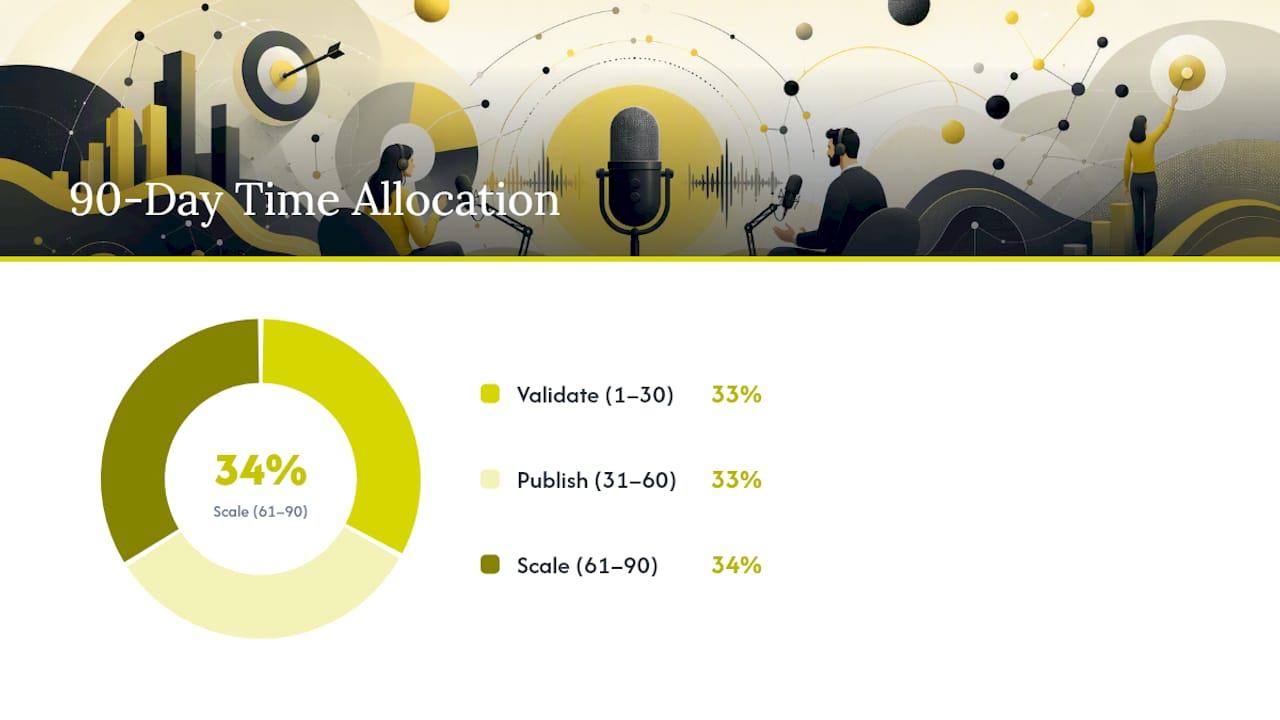
Days 1 to 30: Validate before you publish. Confirm the concept against your category audit, produce three to five genuinely polished episodes before going live, build out episode landing pages, and set up tracking links and CRM matching now, while it’s still cheap to fix mistakes.
Days 31 to 60: Publish and run your primary channels. Launch on a consistent cadence, activate your chosen borrowing channel (guest swaps, cross-promotion with an aligned brand), and build your owning channel simultaneously (episode pages, an email list). Repurpose clips daily. This validate, package, promote, repurpose sequence is the backbone of nearly every successful launch.
Days 61 to 90: Scale what’s working, cut what isn’t. If early data shows promise, test paid distribution behind proven hooks and packaging. Review retention numbers and business signals, not just download counts, and adjust your content pillars based on what the data actually says.
Your tactical checklist for this window should include guest assets and talking points, short-form video clips, ready-to-post social copy, email templates, dedicated landing pages, and unique tracking links per channel.
The channel rule is simple and worth repeating to anyone who wants to spread the show across every platform at once: pick one borrowing channel and one owning channel, then run both at real volume for a full quarter before you judge results. A weak concept limits any paid campaign’s return no matter how much budget you throw behind it, so validate packaging and hooks before you scale spend, not after.
What Should You Measure to Prove Business Impact?
Downloads answer one question: how many files got requested. They cannot tell you whether the right person listened, whether a target account engaged, or whether the show influenced a single dollar of revenue. That gap is why download counts function as a noisy proxy at best.
Map your KPIs to your actual goal:
Pipeline goals: ICP match rate (are the right accounts listening?) and CRM influence (did the podcast touch a deal that closed?).
Demand generation goals: episode page visits, CTA response rates, email signups from show notes.
Retention goals: returning listener rate and consumption rate (how much of each episode people actually finish).
For B2B shows specifically, account-level analytics and CRM matching reveal influence that raw downloads hide entirely; a tightly targeted audience of 300 listeners at the right companies can outperform 30,000 anonymous downloads on every metric that matters to a CFO.
Set your one-page plan with a monthly check that reviews the metric, the two active channels, and a short execution checklist. Practical attribution tools include unique tracking links per channel, dedicated episode landing pages, CRM matching against your target account list, and tracking branded search volume over time. This shift toward buyer self-education isn’t happening in a vacuum, either. Gartner’s own survey of B2B buyers found that a majority now prefer a rep-free buying experience, which is exactly the kind of self-directed research a well-targeted podcast is built to support.
The Fastest Fixes for a Struggling Show
If a show feels stuck, the fix is rarely “record more episodes.” It’s almost always one of these four issues, and each has a fast corrective action.
No single goal: Pick one metric this week. Write it down. Attach a date.
Unsustainable format: Simplify. Drop the weekly interview cadence to biweekly, or shift to a solo or research format that doesn’t depend on a guest pipeline you can’t sustain.
No repurposing: Go back through your last five episodes and pull clips, quotes, and a landing page for each one before you record anything new.
Weak episode packaging: Rewrite your titles and descriptions around the listener’s problem, not your company’s product name.
When a show is struggling, separate a retention problem (people start but don’t finish episodes) from a distribution problem (nobody’s finding the show at all). Retention issues point to content and pacing; distribution issues point to your channel mix and promotion cadence. Treating one as the other wastes months.
Build Your One-Page Plan and Launch Checklist
Copy this into your planning doc today. The one-page plan needs six fields: your metric, your deadline, your primary borrowing channel, your primary owning channel, weekly actions, and monthly checks.
The launch checklist:
Validate the concept against your category audit.
Record three to five episodes before publishing any of them.
Build episode landing pages with transcripts.
Set tracking links and CRM matching rules.
Assemble a guest launch kit (talking points, promotion assets, timeline).
Schedule the first monthly review at day 30, not day 90.
Guest kits should include suggested talking points, a short brand brief, and pre-written social copy so guests actually promote the episode instead of forgetting it exists.
How Does a Podcast Fit Into Your Broader Marketing Strategy?
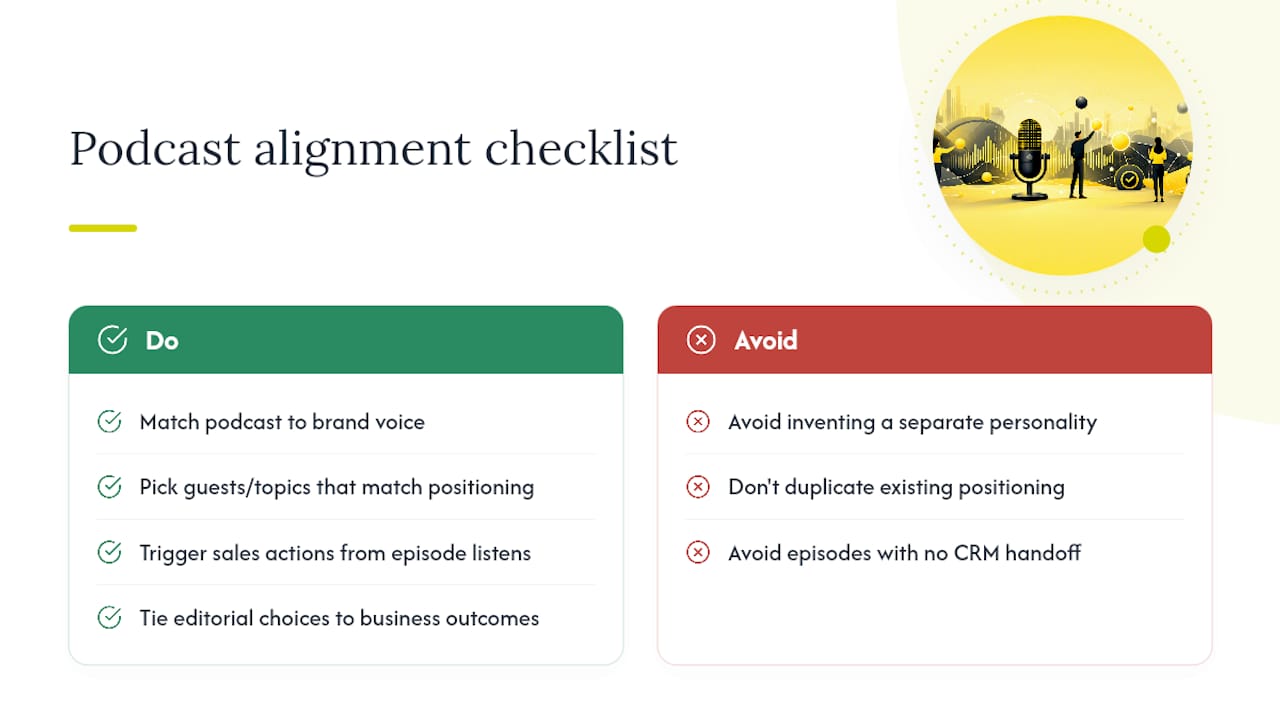
A branded podcast that lives in isolation from the rest of your marketing plan is a wasted asset. The show should reinforce, not duplicate, the positioning work already happening across your website, sales enablement, and campaigns.
Start with brand voice. If your brand strategy already defines a specific tone and set of themes, the podcast should sound like an audio extension of that positioning, not a separate personality the marketing team invented for the sake of variety. Guest selection and episode topics both need to reflect the same market position you’re building everywhere else. A show interviewing “innovation leaders” while your website talks about being the reliable, no-surprises option sends two different signals to the same prospect within the same week.
The podcast also needs a formal handoff point into sales enablement. If a target account listens to three episodes, does that trigger anything in your CRM? Does a sales rep get a nudge to reference the specific episode in outreach? Shows that integrate cleanly treat every episode as a piece of the broader content marketing strategy, not a side project running on its own calendar.
Editorial decisions, who you interview, what you ask, which CTA closes the episode, should all trace back to the same business outcome driving your other channels. That alignment is what separates a podcast that reinforces your brand from one that just adds noise next to it.
What Should You Budget for a Branded Podcast?
Budget follows format choice, and format choice should follow team capacity, not ambition. A solo monologue show recorded on decent equipment can run lean: a microphone, editing software, and a few hours of a single person’s time each week. An interview series carries real hidden costs, guest coordination, more editing complexity, and often a producer role that didn’t exist on the org chart before.
Research series sit at the other end. They demand upfront investment in reporting or data collection before episode one ever airs, but that investment often pays off in content depth and differentiation that solo or interview formats can’t match.
Budget in three buckets: production (recording, editing, hosting), promotion (paid amplification once packaging is validated, plus any tools for tracking links and landing pages), and repurposing (turning each episode into clips, posts, and email content). Teams that fund only production and skip repurposing tend to end up with technically solid episodes that almost nobody outside the existing audience ever discovers.
If budget is tight, resist the instinct to cut corners on measurement tools to protect the production budget. A polished show with no tracking infrastructure can’t prove it worked, and an unprovable show is the first line item cut in the next budget review.
Who Should Own What on a Branded Podcast Team?
Clear ownership prevents the slow drift where “everyone’s responsible” quietly becomes “no one’s responsible” by episode eight.
A strategy lead owns the one-page plan, the metric, and the monthly review, and reports results up to leadership. A producer owns the production calendar, guest scheduling if applicable, and the actual recording and editing workflow. A distribution lead owns the two active growth channels, tracking links, and the repurposing pipeline that turns each episode into supporting assets. A host, whether an executive, a subject-matter expert, or a dedicated media personality, owns the on-air voice and consistency episode to episode.
Smaller teams often collapse these into two people. That’s fine, as long as the metric ownership stays crystal clear even when responsibilities blur elsewhere.
What Legal and Rights Issues Should You Plan For?
Guest release forms matter more than most first-time podcast teams expect. Get written consent covering how an interview can be used, edited, and distributed, including on social platforms and in ad creative, before you hit record, not after the episode is already published.
Music licensing deserves the same care. Stock or royalty-free tracks with clear commercial licenses are worth the small fee; using a popular song without clearance is a real liability, especially once clips start circulating on social platforms with their own content-matching systems.
If your show discusses another company by name, whether a competitor, a partner, or a client, know your jurisdiction’s rules on fair comment and defamation before you air the episode, not after a legal team asks about it. And if a guest shares proprietary information, confirm in writing what can and can’t be repeated on air. A short pre-interview checklist covering these points takes ten minutes and prevents most problems before they start.
What Do Successful Branded Podcast Strategies Look Like in Practice?
The pattern across the shows that actually move a business metric is consistent: a narrow audience, a clear content pillar, and a measurement plan that existed before launch, not one bolted on after leadership asked “so is this working?”
A B2B software company targeting enterprise IT buyers built a research series around industry benchmark data it already had internally. It skipped the interview format entirely, avoiding the guest-scheduling grind, and instead repurposed its own existing reports into scripted episodes. Within two quarters, the marketing team could show CRM-matched listening data tied to accounts already in active sales conversations, proof the show influenced real pipeline, not just downloads.
A consumer brand aiming for broader awareness took the opposite format path: a loosely structured interview show with adjacent creators in its category. Its growth engine ran on two channels only, guest cross-promotion and an owned email newsletter, run consistently for a full quarter before the team even considered paid amplification.
Both examples share the same underlying discipline: one goal, one primary format suited to actual team capacity, and a measurement plan that answered a real business question instead of just counting listens.
When Should You Hire a Production Partner Instead of Building In-House?
The honest lesson from watching branded podcasts succeed and fail: in-house teams underestimate production overhead almost every time, and that miscalculation is what kills otherwise strong concepts by episode ten. An agency partner earns its cost when a team has a clear business goal but lacks the production bandwidth, editing skill, or guest-booking capacity to execute consistently. Before hiring, check for a partner’s actual production reel, ask how they handle repurposing (not just recording), and confirm they’ll work from your one-page plan rather than pushing their own generic template.
— Vain.
How Vain. Helps Brands Build a Podcast That Actually Moves the Needle
If you’ve read this far, you already know the hard part of a branded podcast isn’t the microphone. It’s the strategy, the content engine, and the repurposing discipline that keeps a show alive past episode ten. Vain. exists to make that ordinary grind extraordinary, working as a creative consultancy and production partner rather than another vendor handing you a generic template.
Vain.'s Video, Audio, Animation and Strategy services map directly onto the one-page plan outlined above: strategy work to define your metric and audience, audio and video production to build your launch kit, and animation and repurposing support to turn each episode into the clips, quote cards, and social assets a show needs to actually grow. Through a curated network of collaborators, Vain. builds each project with the same intentional, collaborative process it applies to every client, whether that’s a full podcast launch or a single production sprint.
If you’re weighing whether to build in-house or bring in support, start with a conversation. Book a consultation with Vain. to walk through your one-page plan and figure out where a production partner actually accelerates your timeline.
Sources
FAQ
What Is a Branded Podcast Strategy?
A branded podcast strategy is a documented plan that ties a company podcast to one specific business outcome, a target listener persona, and a measurement framework. It covers goals, audience, format, distribution, and KPIs, defined by Cohost’s framework, before a single episode gets recorded.
How Long Does It Take to Launch a Branded Podcast?
Most teams can validate a concept, produce initial episodes, and launch within 30 days, following the 90-day phased plan that runs validation, publishing, and scaling in three distinct stages. Full results typically take a full quarter to assess.
Should You Measure Downloads or Business Outcomes?
Business outcomes matter far more than raw downloads, which function as a noisy proxy for actual impact. For B2B shows, CRM matching and account-level analytics reveal pipeline influence that download counts can’t show at all.
What Podcast Format Is Best for a Small Marketing Team?
Solo monologue formats carry the lowest production overhead and suit teams without a guest-booking pipeline. Research series built from existing company reports and webinars work well for teams that want content depth without weekly scheduling headaches.
Does Vain. Help With Branded Podcast Production?
Yes. Vain.'s Audio, Video, and Strategy services cover production, repurposing, and audience growth planning for branded podcasts, built around the same one-page framework outlined in this guide.
Recommended
Comments