60–90 Seconds: Explainer Video Length That Holds Viewers


Sixty to ninety seconds is the working default for most explainer videos, and the exceptions are simple to memorize. Trim to 15 to 30 seconds for paid social ads, where thumbs move fast, and patience is scarce. Extend past two minutes only when the viewer already chose to be there, as with a product demo, a training module, or a YouTube tutorial. Retention studies back both ends of that range, and the reasoning behind it is worth understanding before you write a single line of script.
TL;DR:
Most explainer videos should be between 60 and 90 seconds to maximize viewer retention and ensure the core message and call to action are seen.
Viewer retention drops sharply after two minutes, with only about 50% remaining at that point, making longer videos less effective.
Scripts should be limited to about 150 words per minute of narration, with three main points to keep content clear and digestible.
Tailor video length to platform and purpose: 15 to 30 seconds for social ads, 60 to 90 seconds for homepage explainers, and up to several minutes for detailed product demos.
Thorough preproduction planning and building multiple cutdowns from a master video can improve on-time delivery and performance across channels.
Table of Contents
How Long Should an Explainer Video Be, According to Retention Data?
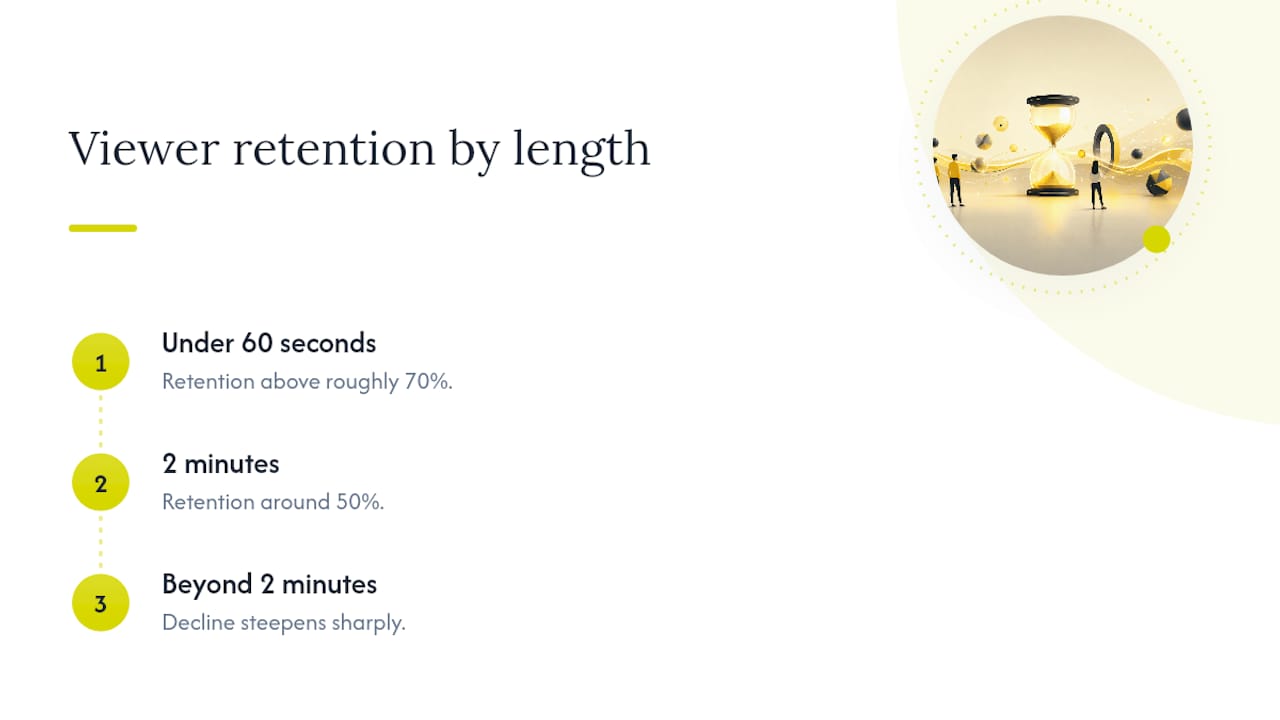
The honest answer starts with what happens to viewers, not what marketers wish would happen. Wistia’s retention analysis tracked how audiences behave across video lengths and found retention holds above roughly 70% for videos under 60 seconds. That number tells you something concrete: the first minute is forgiving. People will ride out a slow open, a mediocre transition, even a clunky line of voiceover, as long as the payoff arrives before the 60 second mark.
The picture changes fast after that. Retention drops to around 50% by the two minute mark, and the decline steepens from there. That’s not a gentle slope. It’s a cliff, and it explains why so many “brand story” explainers with beautiful production values still underperform on completion rate. Length, more than polish, decides whether anyone sees the ending.
Industry guidance converges on the same window from a different angle. Pexo’s length guide synthesizes practitioner data and lands on 60 to 90 seconds as the practical default for product and service explainers, with shorter cuts reserved for paid placements. That consensus isn’t a coincidence. It reflects how little uninterrupted attention most digital contexts actually offer.
The completion rate is the whole game. Every additional second past your viewer’s patience threshold is a second where your call to action never gets seen. A brilliant CTA at 2:45 in a video that loses half its audience by 2:00 is a CTA that reaches a shrinking room. That’s why the practical fix isn’t better closing lines. It’s ruthless trimming everywhere else, so the CTA lands while attention is still intact.
Completion also compounds. A video that holds viewers to the end tends to earn more shares, more comments, and more repeat views, because finishing something creates a small sense of investment that a half-watched clip never builds. Length discipline isn’t just about not losing people. It’s about giving the people who stay a reason to pass the video along.
Explainer Video Length by Platform and Purpose
Runtime isn’t one-size-fits-all, and treating a homepage video and a cold social ad the same way wastes both. The table below reflects how attention budgets and viewer intent shift by placement.
Two practical notes cut across every row. First, the hook has to land inside the first three seconds for anything feed based, because front-loading the payoff is what earns the rest of the watch. Second, most teams are better served producing one 60 to 90 second master explainer and cutting it down for social and ads, rather than scripting a separate video for every channel.
Turning Runtime Into a Script: The Word-Count Math
Every second of runtime has a word budget, and ignoring that math is how scripts end up rushed. Standard voiceover pacing runs close to 150 words per minute, which works out to roughly 2 to 2.5 words per second when you account for natural pauses. That gives you a reliable conversion table for planning:
15 seconds: 35 to 40 words
30 seconds: 70 to 80 words
60 seconds: 140 to 150 words
90 seconds: 210 to 225 words
2 minutes: 280 to 300 words
Speeding up the read to cram in more content is the single most common mistake in explainer scripting, and it’s almost always the wrong fix. A voiceover artist reading at 180 words per minute to squeeze in an extra sentence doesn’t sound urgent. It sounds rushed, and rushed narration measurably hurts comprehension. If your script runs long, cut content. Don’t speed up delivery.
The discipline that actually works: one core message, one proof point, and one call to action for a standard 60 to 90 second explainer, as explained in our visual storytelling tips to boost your brand’s impact. That’s it. Script discipline that limits a video to three core points consistently earns better message retention than a longer video trying to cover five. Fewer ideas, held longer, beat more ideas, rushed.
How to Choose the Right Runtime for Your Brief
Picking a target length doesn’t require guesswork. It requires answering three questions before you write anything.
Where will this video live? A cold social feed demands 15 to 30 seconds. A homepage or landing page supports 60 to 90. A YouTube search result can sustain several minutes.
Why is the viewer watching? Someone scrolling past an ad has near-zero intent and needs an instant hook. Someone who clicked into a product demo already wants detail, and cutting that video short wastes their goodwill.
How many ideas does the message actually require? One core benefit fits in 60 seconds. A multi-step workflow or a technical differentiator often needs 90 seconds to two minutes to land without feeling thin.
Map the answers directly: a cold social ad becomes a 15 to 30 second cutdown. A homepage explainer becomes 60 to 90 seconds. A product demo for a sales call becomes 90 seconds to 3 minutes, because the viewer opted in.
Pro Tip: Build your testing plan before production starts, not after launch. Produce two cutdowns of your master video, track watch-through analytics for both, and if completion falls below 50% before the CTA appears, move the CTA earlier and cut supporting detail rather than the offer itself.
Building the Right Timeline: A 15-Minute Preproduction Checklist
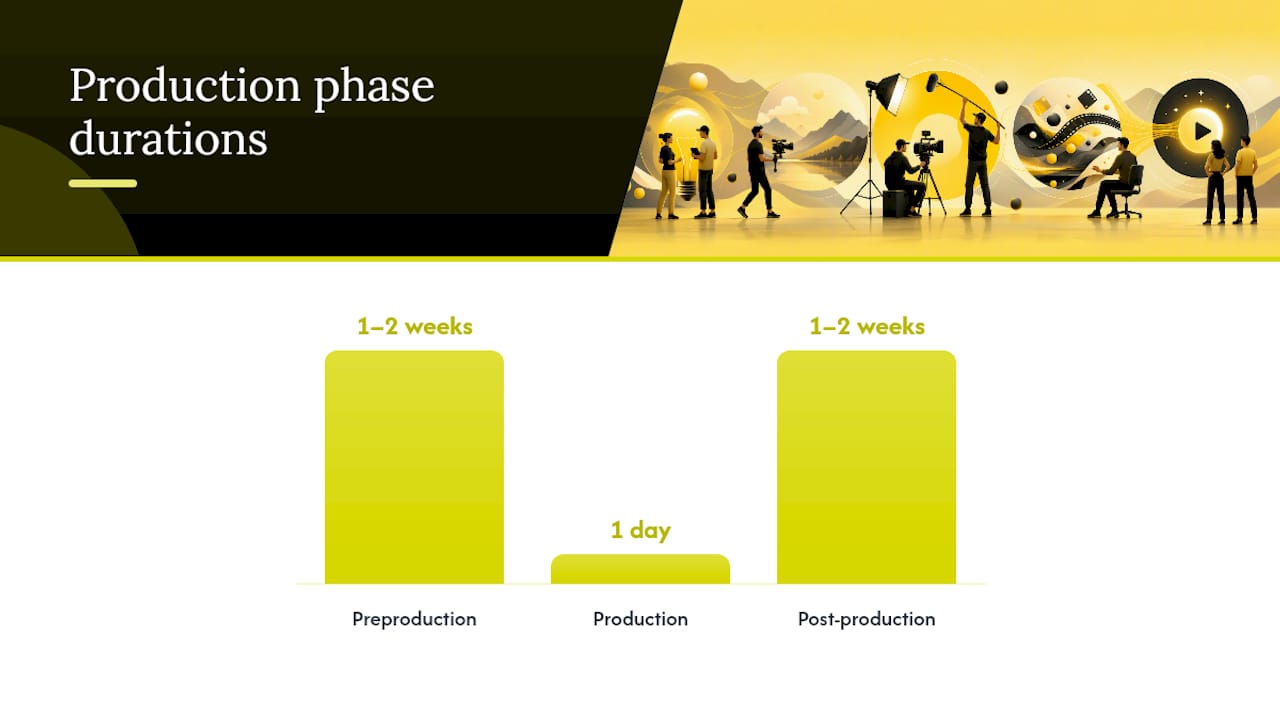
Runtime doesn’t just shape the finished video. It shapes the whole production calendar. A simple 60 to 90 second explainer typically needs one to two weeks of preproduction for brief development, scripting, and storyboarding, one day of production or a comparable animation scheduling window, and another one to two weeks of post-production for editing, revisions, and cutdowns. Longer or more complex videos stretch every phase, and the increase in editing hours is rarely proportional. Descript’s production guidance notes that 5 minutes of raw footage can translate into 1.5 to 2 hours of editing time, which is why an 8 minute YouTube video costs meaningfully more than double what a 90 second explainer costs.
A tight preproduction checklist prevents most of that overrun before it starts:
Who: confirm the decision-maker for approvals and the primary point of contact
What: lock the core message, the proof point, and the exact deliverables (script, storyboard, cutdowns)
Where: define format, aspect ratio, and every platform the video needs to fit
When: set hard deadlines for script signoff, first cut, and final delivery
How: gather brand assets, footage or animation references, and backup files before day one
Research on preproject planning found that projects with thorough upfront planning are meaningfully more likely to land on budget and on schedule. Treat brief signoff and script approval as gating steps, not formalities. A clear review workflow with a fixed number of revision rounds does more to protect your timeline than any amount of editing speed later.
Vain.'s Practical Default for Explainer Length
We default every explainer brief to 60 to 90 seconds, then build platform cutdowns from that master rather than scripting separately for each channel. Longer runtimes are recommended only when the context clearly calls for it: a demo the prospect requested, a training module, or a creative brief already approved with eyes open. Our full production breakdown covers how we scope those exceptions.
— Vain.
Get an Explainer Built to the Right Length From the Start
A creative media and technology company approaches explainer length with intention, not a template. Strategy and scripting, animation, voiceover direction, and social cutdowns are handled to turn one master video into a full distribution set, all made to order rather than pulled off a shelf.
That means your brief doesn’t stop at “make a video.” It becomes a script draft sized to your actual runtime target, a storyboard your team signs off on before production starts, and 15 second, 30 second, and 60 second cutdowns built for the specific platforms your video needs to work on. If you’ve read this far, you already know the difference between a video that gets watched and one that gets skipped comes down to decisions made before a single frame is shot. Visit Vainnewyork’s services page to start a conversation about your explainer brief and get a plan scoped to the length your goal actually requires.
Sources
FAQ
Is a 9 Minute Educational Video Too Long?
Not necessarily, if it’s hosted on YouTube or an internal training platform where viewers already intend to learn something specific. Retention on feed-based platforms drops sharply after two minutes, but YouTube’s own viewing behavior rewards longer watch time when the content matches search intent.
Is a 3 Minute Video Too Long for LinkedIn?
For organic LinkedIn posts, yes. LinkedIn’s feed behaves like other social platforms, and 30 to 60 seconds performs far better than three minutes for organic reach. Save longer runtimes for content viewers click into deliberately, like a video attached to a job post or a downloadable resource.
How Long Should a Vlog Video Be?
Vlogs don’t follow explainer rules because the format trades on personality and story, not a single core message. Most successful vlogs run 5 to 15 minutes, matching YouTube’s long-form viewing patterns rather than the 60 to 90 second window that fits product and service explainers.
Is a 30 Second Intro Too Long?
For a paid ad or a cold social placement, yes. Viewers decide whether to keep watching within the first three seconds, so a 30 second intro before your core message risks losing most of the audience before the video’s argument even starts. For a homepage explainer where the intro doubles as your hook and message, 30 seconds can work if it’s doing real work, not just building atmosphere.
Recommended
Comments