Production Management for Creative Teams: A Practical Playbook

Updated: 4 days ago

Production management is the disciplined practice of turning creative briefs into predictable, on-time content through planning, resourcing, and continuous measurement. Teams that master it deliver more reliably and free up creative energy that would otherwise get swallowed by avoidable chaos.
At a glance:
Map every project to three phases: pre-production, production, and post-production, with a named owner for each.
Use a Master Production Schedule (MPS) to anchor timelines and surface resource conflicts early.
Track at least four KPIs: on-time delivery rate, cost variance, rework rate, and schedule adherence.
Tools like StudioBinder, ShotGrid, ftrack, Airtable, and Vainnewyork’s production network each solve a distinct piece of the puzzle.
Table of Contents
What production management actually covers across a creative team
A repeatable production process you can run from brief to delivery
How to anticipate and manage production risks before they become crises
Essential templates every production team should have from day one
In-house vs. outsourced production management: how to decide
Why most production problems are planning problems in disguise
What Vainnewyork does for clients who need production leadership now
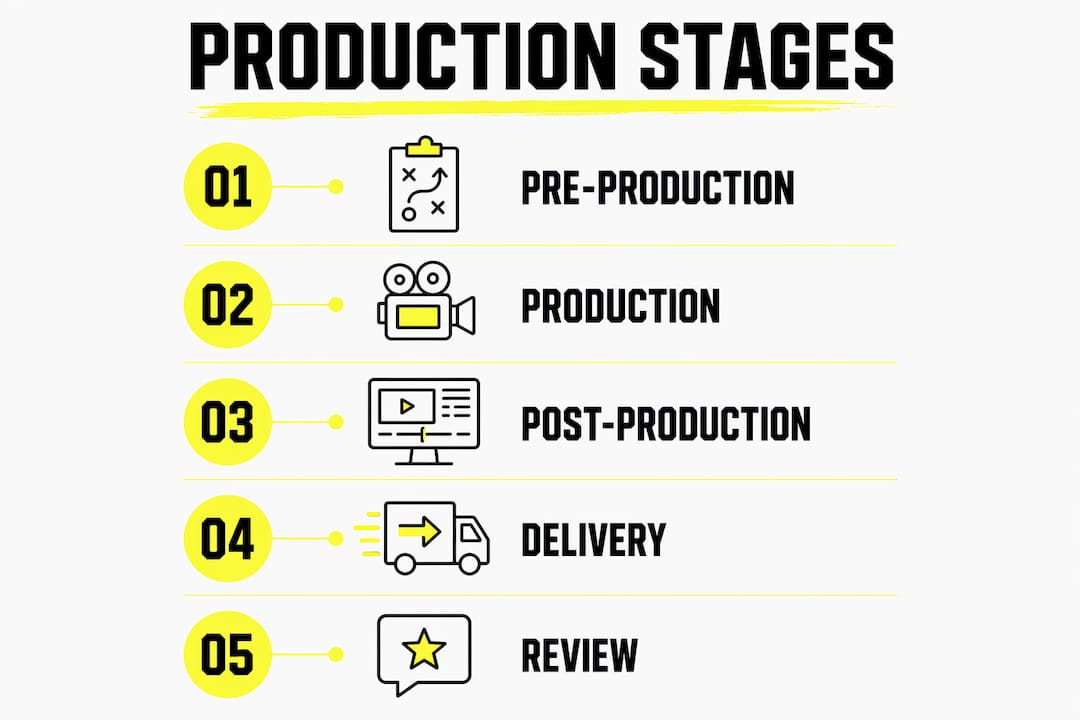
What production management actually covers across a creative team
Production management coordinates capital, labor, and materials to achieve desired outputs at the right quality and cost. For creative teams, those inputs are crew, gear, locations, and time. Responsibilities shift meaningfully across the three phases.
Pre-production is where the production manager earns their keep. This phase covers brief interpretation, budget drafting, crew and vendor sourcing, location scouting, permit applications, and schedule building. The primary deliverable is a locked production plan with a signed-off budget and call sheet template.
Production shifts ownership to the line producer and on-set coordinator. Their job is executing the plan, tracking daily actuals against the schedule, managing crew welfare, and flagging deviations before they compound. Every shoot day produces a daily report that feeds back into the budget tracker.
Post-production is owned by the post supervisor, who manages editorial timelines, asset handoffs to color and sound, client review rounds, and final delivery. The deliverable here is a completed, approved asset that matches the original brief, on time and within the approved budget.
A repeatable production process you can run from brief to delivery
Planning and scheduling are distinct disciplines: planning is strategic (what to produce and when), while scheduling is tactical (who does what and when). Conflating them is one of the most common reasons creative projects stall. The process below keeps them separate.
Brief intake (Day 1): Capture scope, deliverables, format specs, and approval chain in writing. Ambiguity here costs ten times as much to fix later.
Production plan (Days 2–3): Build a Master Production Schedule that defines finished outputs, quantities, and timing, then feed it into capacity and materials planning.
Crew and resource scheduling (Days 3–5): Assign specific people, equipment, and locations to specific dates. Insert a schedule buffer suitable for project length to manage unexpected delays.
Stakeholder approval checkpoint (Day 5): Lock the budget and schedule with a signed approval before any money moves.
Execution and daily tracking: Run daily production reports. Flag any significant cost or schedule variance immediately to the line producer.
Quality control review: Before delivery, run a QC checklist against the original brief: format, resolution, audio levels, brand compliance, and legal clearances.
Delivery and wrap report: Deliver assets, archive project files, and document lessons learned for the next production cycle.
Production planning must be dynamic, not static. High variability in client requests makes rigid plans fragile; build in formal re-planning moments at steps 4 and 6.
Which tools actually help you manage production day to day
The right tech stack connects strategy to the studio floor. Moving from intuition to data-backed workflows is what separates teams that scale from those that scramble. Here is how the main tools divide the work:
StudioBinder: Call sheets, shot lists, and shooting schedules in one place. Purpose-built for film and video, so the learning curve is short for creative crews. Explore more about production technology choices to see how it fits a broader stack.
ShotGrid (Autodesk): Review-and-approval pipelines and asset tracking for larger productions. Strong for VFX-heavy or multi-department projects where version control matters.
ftrack: Project management and media review combined. Particularly well suited to post-production teams managing multiple simultaneous deliverables.
Airtable: Flexible database-style tracking for budgets, vendor lists, and content calendars. Works best as the connective tissue between specialized tools.
Vainnewyork: Rather than a single platform, Vainnewyork operates as a production network, bringing together crew, creative direction, and delivery infrastructure for clients who need end-to-end support without building an in-house team.
For team approval workflows, integrating a dedicated collaboration layer prevents the version-control chaos that derails post-production timelines.
Pro Tip: Keep your planning tool (Airtable, StudioBinder) separate from your real-time execution tracker (ftrack, ShotGrid). Solving execution problems with planning tools creates decision paralysis on the floor.

KPIs and reporting: what to measure and how to show it
A production schedule and control plan should define KPIs, monitoring frequency, and the procedures to adjust when deviations occur. Six metrics cover most creative production needs:
KPI | Definition | Calculation example | Update frequency |
On-time delivery rate | % of deliverables delivered by agreed date | (On-time deliveries ÷ total deliveries) × 100 | Weekly |
Cost variance | Difference between budgeted and actual spend | Actual cost minus budgeted cost | Per project milestone |
Schedule adherence | % of shoot days completed on schedule | (Days on schedule ÷ total shoot days) × 100 | Daily during production |
Rework rate | % of deliverables requiring revision after first review | (Rework items ÷ total deliverables) × 100 | Per review round |
Throughput | Number of finished assets produced per week | Count of approved deliverables per period | Weekly |
Crew utilization | % of available crew hours actively billed | (Billed hours ÷ available hours) × 100 | Weekly |
Show on-time delivery rate, cost variance, and throughput to clients and executives. Reserve rework rate, schedule adherence, and utilization for internal creative and production teams. Update the client-facing dashboard at each project milestone; the internal view should refresh daily during active production.
Hiring, contracts, and onboarding crew the right way
Creative production runs on people. The 5 Ms framework (Men, Machines, Materials, Methods, Money) reminds us that misaligning labor availability with equipment capacity is the most common source of production bottlenecks. Getting the team structure right prevents most of them.
Core roles and their scope:
Production manager: Owns the budget, schedule, and vendor relationships from pre-production through wrap.
Line producer: Manages day-to-day execution on set, including crew welfare and daily cost tracking.
Production coordinator: Handles logistics, travel, permits, and communications between departments.
Post supervisor: Manages editorial, review rounds, and final delivery in post-production.
Freelance specialists: Cinematographers, editors, colorists, and sound designers hired per project.
Every contract should include: defined scope and deliverables, payment milestones tied to production phases, IP and copyright assignment (all work-for-hire language must comply with U.S. Copyright Act requirements), cancellation terms with kill fees, and a change-order clause for scope additions.
For onboarding, send crew a single document covering call times, parking, safety protocols, NDA requirements, and payment submission instructions before Day 1. U.S. productions shooting on public property require location permits from the relevant city or county film office. Union productions must comply with applicable guild agreements (SAG-AFTRA, IATSE, DGA), and all music and archival footage must be cleared for the intended distribution channels before post-production begins. See departmental role guides for a deeper breakdown of crew responsibilities.
How to anticipate and manage production risks before they become crises
The approach is straightforward: identify risks, prioritize by likelihood and impact, mitigate proactively, and verify that mitigations are holding during execution. Most creative production failures trace back to a small set of recurring risks:
Crew no-shows: Maintain a backup roster of pre-vetted freelancers for every key role. A single confirmed replacement contact per role costs nothing upfront.
Equipment failure: Require vendors to carry backup units for critical gear, or budget a rental contingency line to cover unexpected equipment costs.
Weather (exterior shoots): Build a weather day into every exterior schedule and confirm a covered backup location before the shoot date.
Client change requests mid-production: A signed change-order clause in the contract is the only reliable mitigation. Verbal approvals do not protect the budget.
Scope creep in post: Lock deliverable specs in writing at the brief stage. Every format addition after lock costs real time and money.
For contingency budgets, a reasonable guideline is to allocate a percentage of the total budget based on project size and complexity to cover unforeseen expenses. Escalation goes to the production manager first, then the line producer, then the executive producer or client stakeholder if the issue affects delivery date or total cost.
Pro Tip: Review your risk register at the start of every production week, not just at kickoff. Risks that were low-probability on Day 1 can become near-certain by Week 2 if early warning signs go unaddressed.
Essential templates every production team should have from day one
Good templates reduce setup time and catch omissions before they become problems. These are the five worth building or downloading before your next project:
Call sheet: Date, call times by role, location address, parking, emergency contacts, and the day’s shot list. Every crew member receives it the evening before each shoot day.
Production budget: Line items for crew, equipment, locations, travel, catering, post-production, music licensing, and a contingency line. Lock it at the stakeholder approval checkpoint.
Production schedule: A day-by-day breakdown of shoot days, post milestones, review rounds, and delivery dates, mapped against the MPS.
Approval log: A running record of who approved what and when, covering budget, creative, and legal sign-offs. Protects everyone when questions arise later.
QC checklist: Format specs, resolution, audio levels, color profile, brand compliance, legal clearances, and subtitle/caption requirements. Run it before every delivery.
For creator workflow templates and automation patterns that slot into these documents, Vainnewyork’s resource library is a practical starting point.
In-house vs. outsourced production management: how to decide
The primary deciding factors are volume, variability, available capital, speed-to-market requirements, and how much direct control the organization needs over day-to-day decisions.
Factor | In-house | Outsourced |
Cost shape | Higher fixed costs (salaries, benefits, equipment) | Variable cost tied to project volume |
Control | Full visibility and direct oversight | Dependent on vendor communication cadence |
Scalability | Slow to scale up or down | Scales with project load |
Speed to market | Faster for recurring, predictable formats | Faster for complex or unfamiliar formats |
Hidden costs | Turnover, training, idle time between projects | Scope creep if briefs are underspecified |
Teams producing more than four projects per month with consistent formats generally benefit from an in-house coordinator. Teams with irregular volume, specialized format needs, or limited capital tend to get better outcomes by partnering with a production firm. For a broader view of provider capabilities, the digital product agency landscape offers useful context.
Key Takeaways
Effective production management for creative teams requires clear phase ownership, a dynamic production plan, measurable KPIs, and the right tool stack connecting strategy to daily execution.
Point | Details |
Phase ownership matters | Assign a named owner for pre-production, production, and post-production to prevent handoff failures. |
Dynamic planning beats static plans | Revisit and adjust the production schedule at every major milestone, not just at kickoff. |
Six KPIs cover most needs | Track on-time delivery rate, cost variance, schedule adherence, rework rate, throughput, and crew utilization. |
Contracts protect everyone | Include scope, payment milestones, IP assignment, kill fees, and a change-order clause in every crew agreement. |
Vainnewyork as a production partner | For teams needing end-to-end production leadership without building in-house, Vainnewyork provides crew sourcing, creative direction, and delivery infrastructure. |
Why most production problems are planning problems in disguise
Here is an opinion worth sitting with: the vast majority of creative production failures we see are not execution failures. They are planning failures that show up during execution. A crew member who does not know their call time, a client who changes the deliverable format on Day 3, a budget that never had a contingency line — these are not surprises. They are the predictable result of treating production planning as a formality rather than the foundation of the work.
The tools matter less than the discipline. StudioBinder, ftrack, and Airtable are genuinely useful, but a team that does not have a signed brief, a locked budget, and a named decision-maker before Day 1 will find ways to fail regardless of the software they use. The shop floor, whether that is a studio or a location, only runs as well as the plan behind it.
One pattern we have seen repeatedly: teams that invest in a proper approval log and a QC checklist cut their rework rate significantly, often within the first two or three projects. Not because the checklist is magic, but because it forces the conversation about deliverable specs to happen before production rather than after. That single shift changes the entire rhythm of a project.
Three heuristics worth keeping close: First, if the brief cannot be summarized in two sentences, it is not ready to produce. Second, any scope addition that arrives after the production plan is locked is a change order, not a favor. Third, the contingency budget is not a slush fund — it exists for genuine risk events, and spending it on avoidable problems is a planning failure, not bad luck.
What Vainnewyork does for clients who need production leadership now
Vainnewyork brings production leadership, crew sourcing, and end-to-end delivery to creative teams and brands that need results without the overhead of building an in-house operation. The contrast with a traditional agency is real: no long-term retainer, no idle overhead between projects, and a network of collaborators who are selected for the specific format and scale of each engagement.
Core services:
End-to-end production management from brief intake through final delivery
Crew and vendor sourcing across the U.S. creative production network
Brand content, marketing video, and multi-platform content creation
Three questions to ask before hiring any production partner:
Can they show a production schedule and budget from a comparable past project?
Who is the named production manager, and what is their direct line of communication?
What is their change-order and cancellation policy in writing?
If you are ready to move from planning to production, start your engagement with Vainnewyork today.
Useful sources and further reading
These are the primary sources and tools referenced throughout this article, each worth bookmarking for your own production practice:
Coursera: What Is Production Management? — A solid foundational overview of how production management coordinates inputs to achieve quality outputs. Good starting point for anyone new to the discipline.
Epicor: What Is Production Management? — Covers the competitive benefits of proper production management, including delivery reliability and waste reduction.
KAIZEN™: Production Planning — The best available resource on dynamic vs. static planning and why continuous adjustment is the only reliable approach.
NetSuite: What Is Production Planning? — Clear explanation of the Master Production Schedule and how it feeds capacity and materials planning.
ProjectManager.com: Production Planning 101 — Practical guidance on KPIs, monitoring frequency, and production control plans.
Siemens: Production Management — The 5 Ms framework explained with context on how misalignment creates bottlenecks.
SAP Digital Manufacturing — Authoritative source on connecting strategic goals to daily execution through data-backed workflows.
Cin7: Production Planning Key Concepts — The clearest explanation of the planning vs. scheduling distinction available online.
Vainnewyork: Media Production Guide — A practical primer on media production fundamentals for teams building their first production framework.
Recommended
Comments