Online Communities: A Beginner's Complete Guide


An online community is a group of people who connect through the internet to share interests, exchange knowledge, or pursue common goals. They range from sprawling public forums like Reddit to tightly managed branded spaces built by organizations on platforms like Higher Logic. As internet pioneer Howard Rheingold observed decades ago, these spaces become genuine places in people’s lives, not just feeds to scroll past.
Here is what you need to know at a glance:
Online communities serve social, professional, and business purposes simultaneously.
They exist across forums, social networks, chat apps, virtual worlds, and branded platforms.
Organizations that invest in them see measurable gains in member loyalty and product feedback.
Vainnewyork works with brands and creators to build the kind of audience culture that makes communities thrive.
Table of Contents
What counts as an online community?
Online communities are more than a comment section under a post. They are groups whose members engage repeatedly through computer-mediated communication, share a common purpose or interest, and operate under some set of norms, whether written or understood. The sustained, reciprocal interaction is what separates a community from an audience.
Five core features define a genuine online community:
Sustained interaction: — People return over time. A single viral post does not make a community.
A brand’s Instagram page with a large follower count is not a community. A private Facebook Group where those same followers discuss their experiences, answer each other’s questions, and show up weekly? That is. The distinction matters because communities generate loyalty and data that passive audiences never will.
What are the main types of online communities?
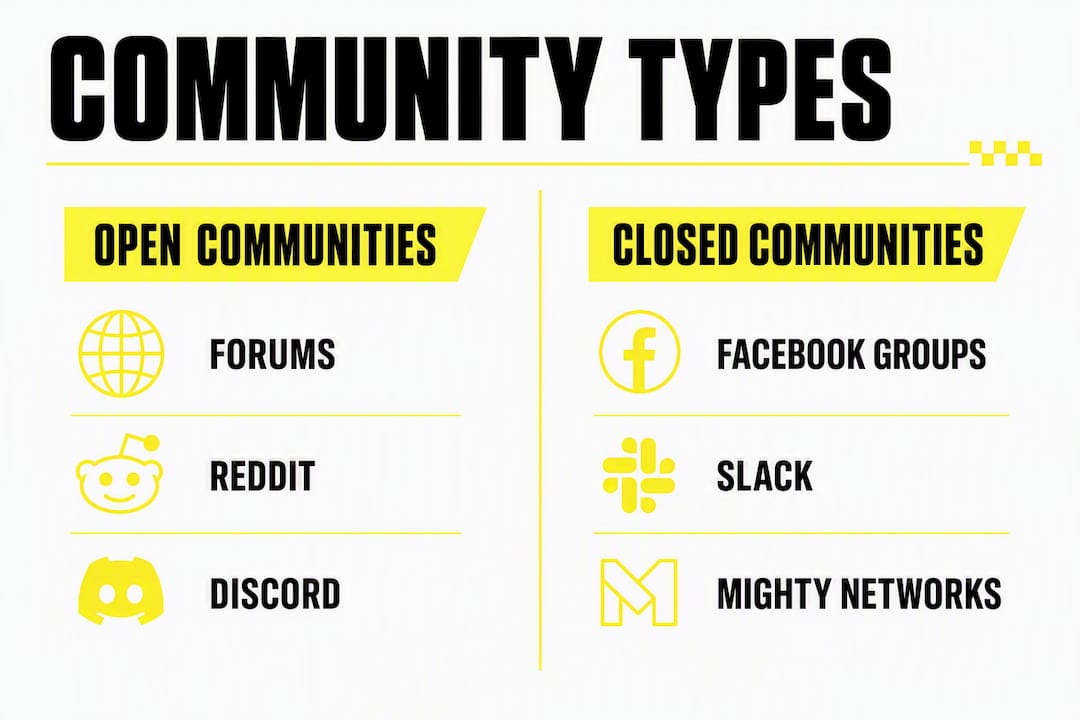
Virtual communities come in several distinct shapes, and knowing the difference helps you find the right fit or build the right structure.
Discussion forums: — Threaded, topic-organized conversations. Reddit is the most prominent example, organizing millions of topic-specific “subreddits” where members post, vote, and reply asynchronously.
Community type | Typical size | Moderation complexity | Best use case |
Discussion forum | Large to massive | High | Broad interest, Q&A, news |
Social network group | Small to large | Medium | Local, hobby, fan groups |
Real-time chat | Small to medium | Medium | Teams, creators, gaming |
Branded/association | Small to large | High | Member orgs, B2B, support |
Creator/membership | Small to medium | Low to medium | Courses, fan subscriptions |
Virtual world | Large | High | Gaming, immersive experience |
Learning/cohort | Small | Low | Education, professional dev |
The moderation complexity column is worth pausing on. Larger, more open communities require more infrastructure, not just more rules.
Why do people and organizations build or join online communities?
The reasons split cleanly between what individual members gain and what organizations get in return.
For individual members:
Access to peer support from people who share the same challenge, hobby, or identity, often more immediately useful than a professional resource.
Networking across geography, connecting with professionals, mentors, or collaborators they would never meet locally.
Continuous learning through shared resources, tutorials, and lived experience from practitioners.
A sense of belonging, which research consistently links to well-being and long-term engagement.
For organizations:
Member retention: research cited by Nimble AMS reports that members who actively use an online community show higher loyalty metrics, with one practitioner summary noting 52% usage correlating with stronger retention measures.
Direct product feedback from the people who use the product daily, without the lag of a formal survey cycle.
Reduced support costs when community members answer each other’s questions before a ticket is ever opened.
Discoverability and earned media, as active communities generate content that surfaces in search results and social feeds organically.
The business case is clearest for associations and membership organizations, but it applies equally to software companies, media brands, and creative agencies. A community is both a retention engine and a listening post.
Which platforms should you know about?
Each major platform has a distinct personality, and matching that personality to your purpose is the first real decision in internet community building.

Reddit is the world’s largest collection of topic-specific forums, called subreddits. It is public, searchable, and governed by both platform-wide rules and community-specific moderators. The upvote system surfaces quality content organically. Reddit works best for broad interest communities, Q&A, and niche enthusiast groups where discoverability matters.
Facebook Groups offer immediate access to a massive existing user base. Groups can be public, private, or hidden, giving organizers real control over who joins. The trade-off is that Facebook owns the data and the algorithm controls what members see. For local groups, hobby communities, and cause-based organizing, Facebook Groups remain one of the easiest places to start.
Discord began as a voice and text platform for gamers and has since become the default home for creator communities, NFT projects, fan groups, and professional networks. Its channel-based structure, combined with bots and role permissions, makes it highly customizable. Real-time voice and video set it apart from purely text-based forums.
Slack is the professional community platform of record. While it is primarily a workplace tool, many open Slack communities exist for developers, marketers, designers, and other professional groups. Its search and integration capabilities make it powerful for knowledge-sharing communities where members need to find past conversations quickly.
Mighty Networks is built specifically for creators and brands who want to own their community experience. It combines discussion, courses, events, and membership in one platform, without the algorithmic interference of a social network. It is particularly strong for paid membership communities and cohort-based learning.
Vanilla Forums is a hosted, open-source forum platform suited to mid-market brands and software companies that want a customizable discussion layer. It integrates with CRMs and support tools, making it a natural fit for customer communities and product feedback loops.
Higher Logic serves associations, nonprofits, and enterprises that need more than a discussion board. It combines community software with marketing automation, event management, and member data tools. For organizations where community is a core business function, not a side project, Higher Logic is the category leader.
Pro Tip: Before picking a platform, ask two questions: Where does your audience already spend time online? And how much moderation capacity do you actually have? A Discord server with 5,000 members and one moderator will deteriorate fast. Match platform complexity to your team’s real bandwidth.
How do you find and join the right online community?
Finding a digital social group that fits takes about ten minutes of deliberate searching. Here is how to do it well.
Search strategies by platform:
On Reddit, type your interest into the search bar and filter by “Communities.” A search for “film photography” surfaces r/analog, r/filmphotography, and dozens of smaller subreddits.
On Facebook, search your interest followed by “group” (e.g., “freelance writers group”) and filter results to Groups only.
On Discord, use discovery sites like Disboard or Discord’s own Explore tab, which organizes communities by category.
For professional communities, search LinkedIn Groups or look for Slack communities in your field by searching “[your industry] + Slack community” on Google.
For branded communities, check the websites of tools, associations, or brands you already use. Most link to their community from the footer or support page.
Matching community type to interest:
Professional networking fits best on LinkedIn Groups, Slack, or association platforms like Higher Logic. Hobby and creative communities tend to thrive on Reddit, Discord, or Facebook Groups. Local and cause-based groups are almost always on Facebook or Nextdoor. Learning communities often live on Mighty Networks or inside a course platform.
“The best communities are not always the biggest ones. A 200-person forum where everyone knows each other and the moderators are active is often more valuable than a 200,000-person group where your post disappears in an hour.” — EBSCO Research Starters, Virtual Community
Joining etiquette that actually matters:
Read the community rules before posting anything. Most communities pin them at the top. Lurk for a few days to understand the tone and what kinds of posts get traction. When you introduce yourself, be specific: say what brought you here and what you hope to contribute, not just consume. Members notice the difference.
How do you build and manage a community from scratch?
Starting a community is straightforward. Sustaining one takes deliberate design from day one.
A starter sequence for new community builders:
Define the purpose in one sentence. “A community for independent podcast producers to share gear reviews, booking tips, and listener growth strategies” is a community. “A community for podcast people” is not.
Choose your platform based on audience and moderation capacity. Use the platform profiles above as your guide.
Write your community guidelines before you invite anyone. Cover what is welcome, what is not, how violations are handled, and who to contact. Post them prominently.
Seed the space with 10–15 pieces of content before launch. An empty room repels people. Prepare discussion threads, welcome posts, and resource lists so early members arrive to activity.
Recruit 3–5 founding members personally. These are your super-users in waiting. Choose people who are already active in adjacent spaces and genuinely care about the topic.
Set up an onboarding flow. A welcome message, a “introduce yourself” thread, and a pinned guide to the community’s best content gives new members a path forward.
Launch small and grow intentionally. A tight, active community of 50 members is healthier than a sprawling, quiet one of 500.
Moderation best practices to set from day one:
Publish a clear, specific code of conduct. Vague rules invite arguments about interpretation.
Assign at least two moderators so coverage is consistent and no single person burns out.
Use role-based permissions to limit who can post in certain channels until members have established themselves.
Create a private moderator channel where the team can discuss edge cases without public drama.
Engagement tactics that scale:
Weekly recurring threads (e.g., “Share your work Friday” or “Questions Monday”) create the ritual and predictability that keep members returning.
Monthly AMAs with guests or founding members generate excitement and new content.
A badge or recognition system rewards contribution and signals community status.
A moderator program that promotes active members into leadership roles reduces your staffing burden and increases member investment.
For content ideas that seed community discussion, practical content creation frameworks can help you plan the first 90 days of posts.
What risks and privacy concerns should you know about?

Every community carries risks, and the ones you do not plan for are the ones that damage trust fastest.
Common risks:
Trolling and harassment: Open communities attract bad actors. Without clear rules and active moderation, a single disruptive member can derail an entire space.
Misinformation: Communities built around health, finance, or politics are especially vulnerable to false claims spreading faster than corrections.
Data leaks: Member emails, private messages, and behavioral data are valuable and vulnerable. Platforms vary widely in how they protect and monetize this data.
Legal exposure when minors are involved: If your community might include users under 13, the Children’s Online Privacy Protection Act (COPPA) applies in the United States, requiring verifiable parental consent before collecting personal data from children.
“Anonymity in online communities can encourage participation from people who would otherwise stay silent, but it also removes social accountability. The communities that handle this best combine clear identity norms with fast, consistent moderation responses.” — EBSCO Research Starters, Virtual Community
Mitigation steps for U.S.-based community operators:
Publish a privacy policy that explains what data you collect, how you use it, and how members can request deletion.
If you use a branded platform, review the platform’s data processing agreement before launch.
Set minimum age requirements and enforce them through your registration flow.
Conduct a quarterly review of your community guidelines and moderation logs to catch patterns before they become crises.
This article provides general information, not legal advice. Consult a qualified attorney or privacy professional to confirm how U.S. laws like COPPA and applicable state privacy statutes apply to your specific community.
How do you measure whether your community is working?
Metrics should follow goals, not the other way around. The table below maps common community objectives to the metrics that actually reflect progress.
Community goal | Key metrics | Reporting cadence |
Member engagement | Daily/monthly active users (DAU/MAU), posts per member | Weekly |
Retention | 30/60/90-day retention cohorts, return visit rate | Monthly |
Support deflection | Tickets opened vs. community answers, resolution rate | Monthly |
Product feedback | Idea submissions, votes, comment depth on feature threads | Quarterly |
Revenue/membership | Conversion rate, renewal rate, community-influenced pipeline | Quarterly |
Community health | Response time to new posts, moderator response rate | Weekly |
Beyond the numbers, qualitative signals tell you things a dashboard cannot. Member stories shared in the community, unsolicited thank-you posts, and the tone of conversations during a crisis all reveal whether the community has genuine emotional attachment or just transactional participation. Collect these by reading your own community regularly, not just reviewing reports.
Net Promoter Score (NPS) surveys sent to active members every six months give you a longitudinal read on sentiment. Keep them short: three questions maximum.
What do experts say about building communities that last?
The most durable insight in community design comes from Howard Rheingold, whose 1993 book The Virtual Community framed online spaces as genuine places, not just tools. Rheingold argued that communities develop “sense of place” through recurring rituals, shared history, and the social patterns that emerge when the same people interact over time. That framing holds up. Communities that survive platform migrations, algorithm changes, and leadership transitions do so because members are attached to each other and to the rituals of the space, not to the software.
The practical implication: design your recurring events and threads before you design your feature list. A weekly discussion thread costs nothing and creates more attachment than a sophisticated gamification system that members ignore.
Research cited by practitioners at Nimble AMS points to a broader strategic shift: organizations are moving away from passive social media presence toward intentional, branded community building, precisely because owned communities generate loyalty data and feedback loops that rented social channels never will. When you build on your own domain, you control the member experience, the data, and the long-term relationship.
“Successful communities treat their platform as a place: they design recurring rituals, empower super-users, and prioritize the human element over raw feature lists.” — Howard Rheingold, The Virtual Community
The super-user model deserves special attention. FeverBee’s community research consistently shows that identifying and empowering your most active members — giving them moderation tools, early access, and recognition — reduces the linear staffing costs of community management while increasing retention across the whole membership. One well-supported super-user can do more for community health than a dozen passive members.
Pro Tip: Track which members answer the most questions in your first 60 days. Those are your super-users. Reach out personally, give them a title, and ask what they need to contribute more. The investment pays back in months.
For brands thinking about how community fits into a broader media and entertainment strategy in 2026, the shift toward owned community spaces is one of the clearest signals in the market right now.
What are your next steps for finding or starting a community?
Three things you can do in the next 30 minutes:
Search Reddit or Facebook Groups for your primary interest and find one community with active recent posts.
Read that community’s rules and pinned posts before you do anything else.
Write a genuine introduction post that says who you are, what you care about, and one question you have for the group.
30-60-90 day plan for joining a community:
Days 1–30: Lurk, read, and observe. Comment on two or three posts per week. Focus on adding value, not visibility.
Days 31–60: Start your own discussion threads. Share a resource, ask a substantive question, or offer feedback on someone else’s work.
Days 61–90: Volunteer for something. Answer a newcomer’s question. Nominate yourself for a moderator role if one is open. At this point, you are a member, not just a visitor.
30-60-90 day plan for launching a community:
Days 1–30: Define purpose, choose platform, write guidelines, seed 10–15 content pieces, recruit 5 founding members.
Days 31–60: Open to a small beta group (25–50 people), run your first recurring event, identify your first super-users.
Days 61–90: Open broader invitations, establish a moderation rhythm, review your first engagement metrics, and adjust your content calendar.
For help connecting community strategy to brand awareness goals, the principles translate directly.
Key Takeaways
Online communities are defined by sustained, purposeful interaction, and the platforms, metrics, and moderation practices you choose determine whether yours grows or stalls.
Point | Details |
Definition matters | A community requires shared purpose, recurring interaction, and norms — not just a follower count. |
Platform fit is critical | Match the platform to your audience’s habits and your team’s moderation capacity before you build. |
Organizations see real returns | Members who actively use a community show measurably higher loyalty, per Nimble AMS research. |
Rituals drive retention | Weekly threads, AMAs, and recurring events create the attachment that keeps members coming back. |
Vainnewyork builds community culture | Vainnewyork helps brands and creators develop the content strategy and audience identity that make communities worth joining. |
Why online communities are the creative infrastructure of our time
We have watched the conversation about online communities shift dramatically. For years, the default advice was to grow a following on whatever platform had the most users. Post consistently, chase the algorithm, and hope the numbers went up. That approach built audiences. It rarely built communities.
The difference is not semantic. An audience watches. A community participates. And for creative brands, the distinction is everything. When your community members are actively discussing your work, sharing it with peers, and contributing ideas back to you, you have something no ad budget can replicate: genuine cultural momentum.
What we find most compelling about the current moment is that the tools for building real communities have never been more accessible. Mighty Networks, Discord, and Higher Logic have each lowered the barrier to owning a community space. The constraint is no longer technical. It is creative and strategic: knowing what your community stands for, designing the rituals that keep people coming back, and producing the content that gives members something worth gathering around.
Community merchandise is one of the clearest expressions of this. When members wear or display something that signals their belonging, the community becomes visible in the physical world. That is not a marketing tactic. It is culture.
The brands that will matter most in the next five years are the ones building communities now, not waiting until they have a large enough audience to justify it. Start small. Start with purpose. The size follows.
Vainnewyork can help you build a community worth joining
Building an audience is one thing. Building a community that generates loyalty, content, and culture around your brand is a different craft entirely. Vainnewyork brings creative production, brand strategy, and audience growth expertise together to help you design a community that reflects who you are and attracts the people you want around you.
A first consultation covers three things: what your community stands for, where your audience already gathers, and what content and creative assets will give members a reason to show up. From there, Vainnewyork can support everything from platform selection and visual identity to ongoing content production and community activation campaigns. Whether you are starting from zero or activating an existing audience, the work begins with clarity about purpose.
Start the conversation at Vainnewyork’s checkout page to scope your first community project and get a timeline that fits your goals.
Useful sources and further reading
The sources below shaped this article and offer strong next-reading options depending on where you want to go deeper.
Online community — Wikipedia: A solid neutral reference for definitions, taxonomy, and the historical development of online communities. Good starting point for anyone who wants academic framing alongside practical examples.
What Is An Online Community? Explore The Basics & Benefits — Higher Logic — Higher Logic’s practitioner-focused overview covers definitions, organizational benefits, and the case for branded communities. Particularly useful for association and enterprise readers.
Virtual Community — EBSCO Research Starters: A scholarly overview that covers both the benefits and the risks of virtual communities, including anonymity, trolling, and data privacy. Useful for anyone building a risk and moderation framework.
The Virtual Community — Howard Rheingold: The foundational text on online communities as places. Rheingold’s “sense of place” framework remains the most useful conceptual lens for community designers. Read the first chapter at minimum.
List of virtual communities with more than 1 million users — Wikipedia: Useful for understanding the scale of major platforms and identifying examples of communities that have reached significant size.
Recommended
Comments