Distribution First Music Video Budgets for Indie Artists: Five Tiers

Music video budgets in 2026 fall into five practical tiers: AI-assisted or DIY projects run $0 to $500, entry-level indie shoots cost $500 to $2,500, professional indie productions typically run a few thousand to around ten thousand dollars, mid-tier productions land between roughly ten and fifty thousand dollars, and label-level work exceeds tens of thousands of dollars. The core rule that governs all of them: only invest in a polished hero film when you pair it with multi-format deliverables or a real sync, festival, or distribution plan.
TL;DR:
A typical indie professional music video budget of around $5,000 can deliver a shoot with a small crew, basic location, color grading, and limited VFX.
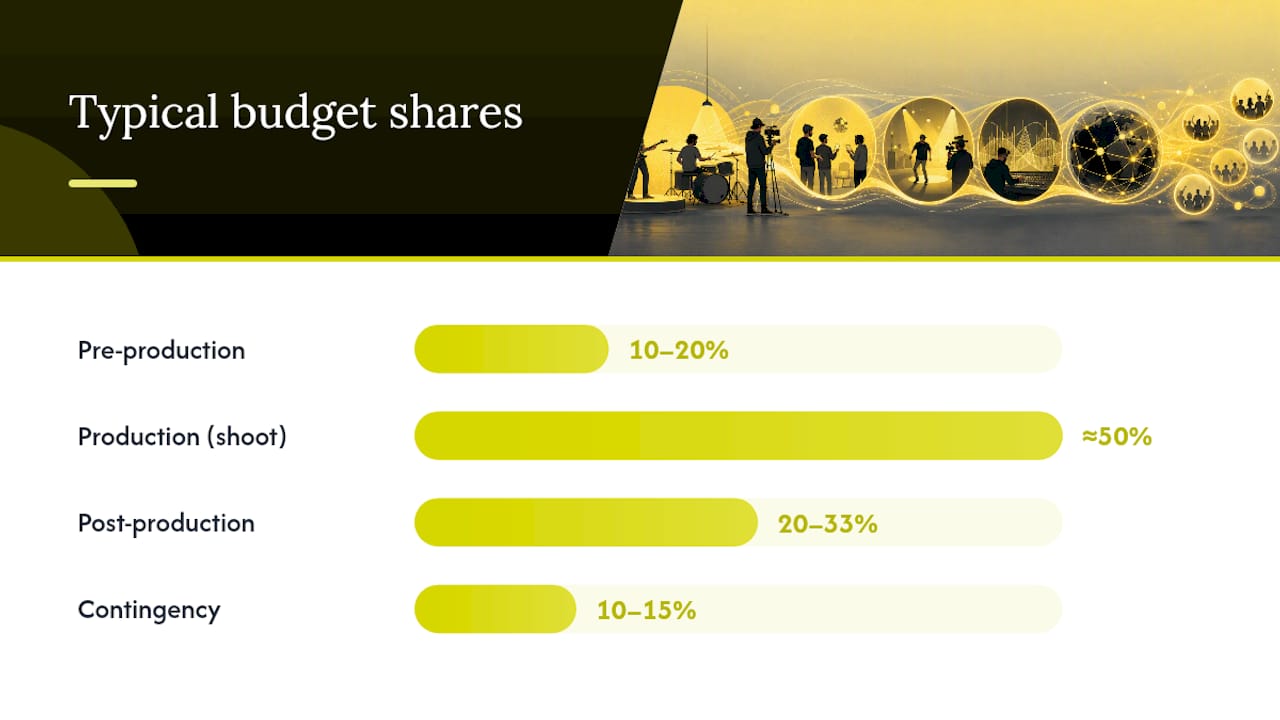
Pre-production costs usually take 10-20% of the total budget, with production accounting for 40-60%, and post-production around 20-35%.
A single-day shoot with a videographer or DP generally costs $500 to $1,250, with gear rental and editor fees adding to the overall expense.
Fragmenting a $5,000 budget across multiple assets and promotion often reaches more viewers than investing solely in a polished hero film.
Incentives vary by state and rarely significantly impact budgets at the entry or indie professional levels, but mid-scale productions may benefit from local rebates.
Table of Contents
What Does a Music Video Budget Actually Buy at Each Tier?
The dollar figure tells you less than what comes with it. A $400 AI-generated video and a $40,000 mid-production shoot both technically produce “a music video,” but the deliverables, crew, and creative control couldn’t be further apart.
AI/DIY tier ($0–$500): This tier leans on generative tools, a smartphone camera, or a friend with a decent lens. You’re the crew, director, and editor rolled into one. Expect a single output file, minimal color work, and no location fees. It’s the right call for a lyric video, a quick visualizer, or testing a concept before committing real money.
Entry-level indie ($500–$2,500): This buys a one-day shoot with a small crew, typically a videographer or DP and maybe an assistant. Independent-tier music videos commonly cost from a few hundred to several thousand dollars, and this range covers most of that band. You’ll get a hero cut plus, if you plan ahead, a couple of vertical crops for Reels and TikTok.
Indie professional ($2,000–$10,000): Here you’re hiring specialists, a director, a DP, maybe a gaffer, and budgeting for real lighting and wardrobe. Multi-day shoots become possible. This tier can realistically deliver a hero film, three or four vertical cutdowns, a teaser, and a Spotify Canvas loop from the same shoot day.
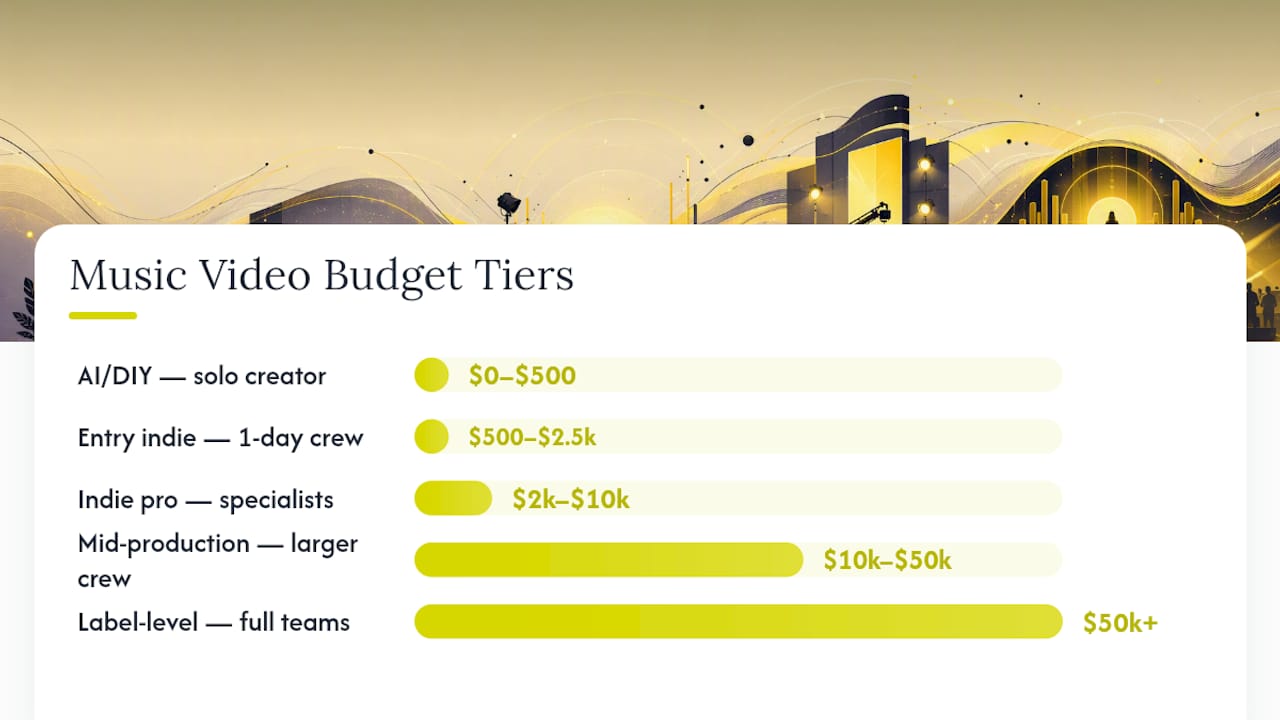
Mid-production ($10,000–$50,000): Larger crews, custom locations, possibly a small VFX pass, and a colorist working a full grading session rather than a quick pass. This is where visual ambition starts matching label-quality output.
Label-level ($50,000+): Full production teams, custom sets or elaborate locations, stunt or specialty work, and post-production teams handling color, VFX, and sound design as separate disciplines.
A useful gut check before choosing a tier:
Do you have a distribution plan that justifies a hero film, or are you making a video because it feels required?
Can this shoot generate more than one deliverable?
Would this money work harder as paid promotion or PR around existing content?
If the answer to the third question is yes, skip the mid-tier ambition and put the budget toward reach instead.
What Does a Music Video Quote Actually Break Down Into?
A vague quote is a red flag. A good one itemizes pre-production, production day rates, and post-production separately, because that’s where the real cost drivers live.
Pre-production covers the treatment (the creative concept document), location scouting and fees, permits, and insurance. Location costs vary wildly. A friend’s rooftop might be free; a permitted street shoot in a major city can run several hundred dollars just for the permit, before location rental. If you haven’t scouted before, a primer on location management is worth reading before you call a spot “free.”
Production day rates in 2026 run in fairly predictable bands. Directors bill $500 to $1,250 per day, DPs run $1,000 to $1,800, gaffers charge $325 to $400, and production assistants run $250 to $300. Editors bill hourly, typically $25 to $150 per hour depending on experience and market. Camera packages rent from a few hundred dollars a day for a mirrorless setup to several thousand for cinema cameras with lens kits.
Statistic Callout: A realistic budget split allocates roughly a tenth to a fifth to pre-production, around half the budget to the shoot itself, and a fifth to a third to post-production source, with most working producers adding a 10 to 15% contingency on top.
Post-production covers the edit, color grade, audio mix, and any VFX. This is where quality often separates from raw spending, since a strong color pass can make a modest shoot look far more expensive than it was.
Contingency isn’t optional padding. Permits get delayed, overtime happens when a location shuts down early, and gear rentals run long. Line items that look fixed on paper:
Permit fees (often billed by the day, sometimes non-refundable)
Insurance certificates (frequently required by venues and municipalities)
Overtime for crew past a 10 or 12-hour day
Rental insurance or damage waivers on camera gear
How Do You Stretch a Small Music Video Budget Further?
The single biggest budget mistake independent artists make is treating the hero video as the entire campaign instead of one asset within it.
Run the math on reallocation. Say you have $5,000. Spend all of it on one polished four-minute film, and you get one asset that lives on YouTube and maybe gets clipped for social. Split that same $5,000 across a lighter-weight shoot, a few weeks of vertical content, and modest paid promotion, and that reallocation often reaches far more listeners than a single long-form video would source. That doesn’t mean skip the video. It means the video should be sized to leave room for the campaign around it.
AI generation and hybrid workflows have become a legitimate low-cost tier rather than a novelty. AI-assisted video creation can now produce usable output for under fifty dollars to a few hundred dollars depending on subscription tiers and credit usage, and pairing AI-generated segments with a few real, human-shot moments often reads better than either extreme alone. A production guide for AI video workflows walks through what to expect from these tools in terms of speed and output quality.
For tight budgets, prioritize in this order:
Lighting first. A single good light makes cheap footage look intentional; bad lighting makes expensive gear look cheap.
Design one hero moment, a striking shot or transition, and build the rest of the edit around supporting it.
Plan asset reuse before you shoot, not after: vertical crops, a loop for Canvas, a 15-second teaser.
Recruit collaborators (photographers, editors building a reel, film students) who need portfolio work as much as you need footage.
Pro Tip: Shoot day efficiency comes down to three things: a locked shot list you don’t improvise away from, time blocks for each setup so lighting changes don’t eat your afternoon, and one person, not a committee, making final calls on set.
Low-budget concept ideas that translate directly from short filmmaking also work here. A list of horror short film concepts built for weekend shoots on a phone demonstrates the same principle: constraint breeds creativity when you stop treating budget limits as a problem to solve later.
What Should a Sample Music Video Budget Look Like?
Two working examples show how the percentages translate into real line items.
$2,000 performance shoot. A one-day shoot with a videographer or DP, a basic camera package, minimal lighting rental, simple wardrobe styling, and an editor. Total line items for this tier commonly fall in the low thousands of dollars range, leaving a small cushion for contingency.
Line item | Typical cost |
Videographer/DP (one day) | $500–$500 |
Camera and lighting rental | $250–$300 |
Wardrobe/styling | $25–$150 |
Editing | $325–$400 |
Contingency | $25–$150 |
$5,000 indie professional shoot. Adds a small crew, a proper location fee, and a dedicated color pass, roughly following the 10 to 20% pre-production, 40 to 60% production, 20 to 35% post-production split.
Before signing any quote, ask the producer or freelancer these questions:
What deliverables come with this price, and how many revision rounds are included?
Who owns the raw footage and final files, and can I repurpose clips for ads?
What’s the delivery timeline, and what happens if a location or permit falls through?
A sensible payment structure is a deposit to book the date, a milestone payment at the shoot, and the balance on delivery. If you’re new to hiring freelance crew, this guide to hiring freelancers covers what belongs in that agreement before money changes hands.
How Does a Creative Consultancy Scope a Music Video Project?
A creative consultancy approaches every music video request the same way: budget conversations come after creative scoping, not before. A brief that defines the audience, the platforms, the hero moment, and the full list of deliverables up front produces a far more accurate quote than a vague “make us a video” ask.
A single shoot day should be planned to generate more than one deliverable, the hero cut, vertical cutdowns, a teaser, a Canvas loop, because that’s what actually multiplies the value of the money spent on the day itself.
The scoping checklist we work through with artists includes:
Who is the audience, and where do they actually watch video (TikTok, YouTube, Reels, all three)?
What’s the one moment in the song the whole video should be built around?
What’s the full deliverable list, not just the hero cut?
What’s the realistic timeline from shoot to delivery?
What KPI defines success: views, saves, sync placement, playlist adds?
Balancing artistic ambition against these constraints is the actual job. A gorgeous four-minute concept that produces zero social-ready assets is a weaker use of budget than a simpler shoot engineered for reuse.
What Tax Incentives Exist for Music Video Production?
Tax credits and rebates for video production are almost always tied to the state or country where filming happens, not to the music industry specifically, and eligibility usually depends on production spend thresholds, in-state hiring requirements, or minimum shoot days.
Several U.S. states run film and video production incentive programs that music videos can qualify for if the production meets that state’s specific spend and crew requirements. These programs typically require formal applications before shooting begins, not after, and the credit usually applies against qualified in-state expenditures rather than the whole budget. Requirements and percentages vary significantly by state and change from year to year, so the only reliable step is checking the current guidelines directly with the specific state film office you’re shooting in before you lock a location.
For most independent artists working at the entry-level or indie-professional tier, these incentive programs rarely move the needle, since minimum spend thresholds often sit well above typical music video budgets. They become more relevant once a project reaches mid-production scale, where the qualifying spend and the administrative overhead of applying start to make financial sense. If you’re planning a shoot in a state with an active incentive program, ask a local production coordinator or the state film office directly rather than relying on secondhand summaries, since these programs are updated and revised often.
Why Vain. Recommends Distribution Planning Before Production Planning
Most music video advice still treats the video as the finish line. That framing is backwards. A finished hero film with no distribution plan is a file sitting on a hard drive; a modest video paired with a real rollout, vertical cuts, paid promotion, playlist pitching, is a campaign.
The conventional advice, “save up until you can afford a real video,” often wastes months an artist could have spent building an audience with cheaper, more frequent content. The evidence here points the other way: reallocating budget toward a cadence of shorter assets plus promotion tends to outperform a single polished film on reach alone. That doesn’t make the hero film worthless. It makes it one tool among several, and not always the right one to spend the whole budget on.
What we’d tell any artist before they book a single crew member: decide what happens to this video after it’s finished. If there’s no answer beyond “post it,” reconsider the plan before reconsidering the price.
— Vain.
Get a Real Quote for Your Music Video Project
Vainnewyork scopes music video projects the way this guide recommends: audience first, deliverables second, budget third. Rather than quoting a single hero film in isolation, we build packages around multi-format delivery, hero cut, vertical cuts, teasers, and Canvas loops, from one production day, so every dollar spent on the shoot works across more platforms.
A first call covers your song, your release timeline, your target platforms, and what you’re realistically working with budget-wise, no pressure to commit to a tier before we’ve talked through what actually fits your goals. If you’re weighing whether a full production makes sense right now or whether your budget is better spent on a leaner shoot plus promotion, that’s exactly the conversation worth having first. Reach out through Vainnewyork to start scoping your project.
Sources
Recommended
Comments