Brand Voice Examples for Marketers: Copy Ready Takeaways & Voice Chart


Brand voice is the recognizable personality behind everything a company writes, and the fastest way to define one is to study brands that already do it well. This article rounds up the clearest brand voice examples working today, then hands you the artifacts that turn inspiration into practice: a copy and don’t voice chart, governance steps, and templates you can adapt this week.
TL;DR:
A consistent brand voice relies on a small set of clearly defined traits with specific Do and Don’t sentences, stored in a visible, channel-specific guide.
Recognizable brand voices use repetitive rhetorical patterns and vocabulary, making them identifiable even without logos or visuals.
It is essential to adapt tone and warmth based on the channel and emotional context, maintaining core personality while flexing formality.
The strongest brand voices evolve deliberately over time, reflecting shifts in audience, channel, or positioning rather than random drift.
A short, targeted voice chart is more effective for guiding writer consistency than lengthy, theoretical brand guidelines.
Table of Contents
Brand Voice Examples Worth Studying
Every brand on this list earned its reputation by repeating the same rhetorical moves until they became recognizable. Watch for the pattern instead of the polish: each one picked a lane and stayed in it, touchpoint after touchpoint.
Nike: Bold and motivational, built on short, imperative sentences. “Just Do It” works everywhere from a jersey tag to a homepage headline because it never explains itself. Takeaway: a strong voice can survive on five words when the emotional register is unmistakable.
Mailchimp: Conversational and quirky, with a self-aware sense of humor even in transactional emails. Its onboarding copy reads like a helpful coworker, not a manual. Takeaway: warmth in the smallest interactions, a confirmation screen, a 404 page, builds more loyalty than a clever tagline ever will.
Apple: Minimalist and declarative, favoring product pages that lean on white space and short claims like “Powerful. Simply powerful.” Takeaway: cutting adjectives forces you to prove value with nouns and verbs instead of hype.
Duolingo: Playful and slightly unhinged, especially on social media, where the owl persona teases users who skip lessons. Takeaway: a mascot with a defined personality lets you be louder on social than you’d ever be in a legal disclaimer.
Microsoft: Warm, clear, and practical, guided by a documented “simple and human” standard that prioritizes getting to the point before adding color. Its style guide explicitly tells writers to lead with the answer and adjust warmth by context, support tone versus enterprise sales tone. Takeaway: clarity is not the enemy of personality; it’s the foundation for it.
Walmart: Practical and neighborly, built around value and everyday usefulness rather than aspiration. Its in-store and app copy reads like advice from someone who already knows your grocery list. Takeaway: a voice doesn’t need wit to be distinct. Consistency in plainness is its own signature.
Slack: Encouraging and slightly whimsical in-app, with empty-state messages that sound like a teammate cheering you on. Takeaway: microcopy is where B2B software brands most often forget to have a personality.
Innocent Drinks: Chatty and self-deprecating, treating packaging copy like a running joke with the customer. Takeaway: a physical product label can carry as much voice as an ad campaign, if you let it.
Old Spice: Absurdist and theatrical, using surreal humor to turn a commodity category into entertainment. Takeaway: exaggeration works when the brand commits fully instead of hedging with a wink.
Patagonia: Direct and values-driven, writing product descriptions and campaign copy with the same environmental conviction. Takeaway: a voice tied to a cause needs receipts. Patagonia backs its tone with visible action, not just language.
Wendy’s: Sharp and combative on social media, famous for roasting competitors and customers alike. Takeaway: a confrontational voice only works on the one channel built for it. Wendy’s never talks that way in its app.
Headspace: Calm and reassuring, using short, breathing-room sentences that mirror the product’s purpose. Takeaway: sentence rhythm itself can carry tone. Meditation copy that runs long defeats its own message.
What Makes a Brand Voice Actually Work
A strong voice is measurable, not just memorable. Harvard Business Review’s research on customer emotion found that emotional connection, shaped heavily by tone and language, predicts customer value more reliably than satisfaction scores alone. Tone isn’t decoration. It’s a lever tied to trust and recommendation intent.
Three signals separate a working voice from a decorative one:
Consistent vocabulary: the same words for the same ideas across email, app, and support, not three different synonyms for “sign up.”
Distinct rhetorical moves: a recognizable sentence pattern, like Nike’s imperatives or Headspace’s short breaths, that readers could identify with the logo removed.
Repeatable structure: a subject line or CTA formula that works whether a junior writer or a senior strategist drafts it.
Pro Tip: Strip the logo from five pieces of your own copy and hand them to someone outside your team. If they can’t guess the brand, the voice isn’t doing its job yet.
How to Define Your Brand Voice, Step by Step
Defining a voice is a research task before it’s a writing task. Skip the audit and you’ll end up documenting a personality nobody actually uses.
Audit existing copy across channels. Pull ten samples from email, social, and support. Flag where the tone contradicts itself.
Build audience personas around emotional context, not just demographics. A support ticket and an ad both reach the same customer in very different moods.
Select three to five voice traits with precise definitions. “Friendly” means nothing without a sentence that shows friendly instead of formal.
Draft channel-specific tone rules. Microsoft’s guidance is a useful model here: its style guide ties personality to context, staying steady on core identity while flexing warmth up for support and down for compliance copy.
Write a one-page writer checklist covering banned words, preferred sentence length, and one example rewrite per trait.
Store the artifact where writing happens, your CMS, brief templates, or AI prompt library, so contributors see it before they draft, not after.
Pro Tip: Onboard new writers with the voice chart, not the full brand bible. A 90-second read beats a 40-page PDF that nobody reopens after week one.
A Copy-Ready Voice Chart Example
A one-page chart with do and don’t examples is the single most usable brand voice artifact a team can build. Sivon HQ’s framework makes the case plainly: teams reach for short, operational charts far more often than long brand guideline documents, because a chart tells you exactly what to write, not just what to feel.
Trait | Definition | Do | Don’t |
Confident, not arrogant | States value directly without dismissing alternatives | “This plan covers your busiest month.” | “Obviously, this is the only plan that makes sense.” |
Plain-spoken, not dumbed down | Uses simple words for complex ideas without oversimplifying | “Your payment failed. Update your card to keep service active.” | “Oopsie! Something went wrong with the money thing!” |
Warm, not saccharine | Shows care without over-explaining emotion | “We’re on it. Expect an update by 3 PM.” | “We’re SO sorry and we truly, deeply care about your experience!!” |
Direct, not blunt | Leads with the point, softens delivery, not substance | “Your subscription renews Friday. Cancel anytime before then.” | “Renewal happens Friday. No exceptions.” |
Swap the example sentences for your own product language and the chart becomes a live document. Paste it into an AI prompt template as persistent context, and every generated draft inherits the same guardrails instead of drifting trait by trait.
Keeping Your Voice Consistent as the Team Grows
Voice drifts the moment more than one person writes for the brand, and long brand bibles rarely stop it. Sivon HQ’s research points to a clear reason: guidelines fail when they live somewhere writers don’t look, a shared drive folder instead of the brief template or CMS field they open daily.
Assign a voice owner, usually a brand or content lead, who reviews new copy monthly, not just at launch.
Run a quarterly sample audit: pull five recent pieces and score them against the chart’s Do column.
Feed the voice chart into AI tools as persistent context rather than a one-time prompt, so generated drafts don’t need retraining every session.
Treat the chart as a living document. Update one row when a phrase stops working instead of rewriting the whole guide.
Pro Tip: If your AI tool supports saved system prompts or custom instructions, paste the voice chart there once. You’ll stop re-explaining tone in every new conversation.
Templates and Prompts You Can Copy Today
Short samples teach tone faster than adjectives ever will, which is why Grammarly’s brand tone guidance leans on rewritten example sentences instead of abstract trait lists.
Subject line: “Your order shipped, here’s when it lands.”
Hero line: “Built for the work you actually do.”
Social caption: “New drop. Same obsession with getting it right.”
Help reply: “Got it. Fixing this now, update coming within the hour.”
CTA button: “Start free, no card needed.”
Error message: “That didn’t save. Try again?”
AI prompt pattern: “Write in a [trait] voice. Do: [example]. Don’t: [example]. Match this sentence’s rhythm: [exemplar].”
Test two versions of each against open rate or click rate before locking one in. Voice is a hypothesis until the data confirms it.
How Brand Voice Shapes Customer Perception and Loyalty
Customers form an opinion of a brand’s personality within seconds of reading a single line of copy, and that first impression compounds. A support reply written in a warm, direct voice reduces the friction a customer feels during a bad moment, service failures are where voice consistency matters most, because tone either reassures or agitates a reader who is already frustrated.
Loyalty follows recognition. When Duolingo’s owl teases a lapsed learner or Wendy’s fires back at a competitor, the brand isn’t just being funny. It’s reinforcing a personality the customer already expects, which makes the next interaction feel familiar rather than transactional. That familiarity is what turns a one-time purchase into a repeat customer: the HBR research on customer emotion ties emotional connection directly to long-term customer value, and tone is one of the cheapest, fastest levers a brand has to build that connection. A pricing page and a support email can carry the same underlying voice and produce very different feelings if the tone shifts unexpectedly between them. Consistency, not cleverness, is what customers actually notice over time.
Brand Voice vs. Brand Personality: What’s the Difference
Brand personality is the character trait; brand voice is how that trait sounds on the page. Personality answers “who are we?” Voice answers “how do we say it?” Nike’s personality is bold and competitive. Its voice is the short, imperative sentence structure that expresses that boldness in writing, “Just Do It” instead of a paragraph explaining ambition.
The distinction matters because teams often confuse the two and end up with a personality statement that never translates into usable rules. Apple’s personality centers on simplicity and craftsmanship. Its voice is the specific execution: declarative sentences, minimal adjectives, product-first phrasing. You could describe Apple’s personality as “innovative and refined” and still have no idea how to write a product page, until you see the voice rules that turn that personality into sentences.
Treat personality as the adjective list and voice as the style guide that operationalizes it. A brand messaging framework typically documents personality traits at the top level, then breaks each one into voice and tone guidelines specific enough that two different writers produce copy that reads like the same person wrote it.
How Brand Voice Shifts Across Channels
The core personality stays fixed, but tone flexes by context, exactly the principle Microsoft’s style guide builds its entire framework around: get to the point, then adjust warmth and formality to match the situation.
A support ticket calls for patience and clarity over cleverness, even for brands that are playful elsewhere. Duolingo’s push notifications can guilt-trip a user for skipping a lesson, but its billing emails stay plain and direct, because confusion over a charge erodes trust faster than a missed joke. Social media tends to carry the loosest tone rules; it’s where Wendy’s gets combative and Innocent Drinks gets chatty, because the format rewards personality over precision. Product pages sit at the opposite end, favoring clarity and proof points, which is why Apple’s homepage reads almost like technical copy with the adjectives removed.
Email sits in the middle: warm enough to feel human, structured enough to respect a reader’s inbox. The rule that holds across every channel is simple. Match the tone to the reader’s emotional state in that moment, supportive during a problem, energetic during a purchase decision, sober during anything involving money or legal terms.
How Brand Voice Evolves Over Time
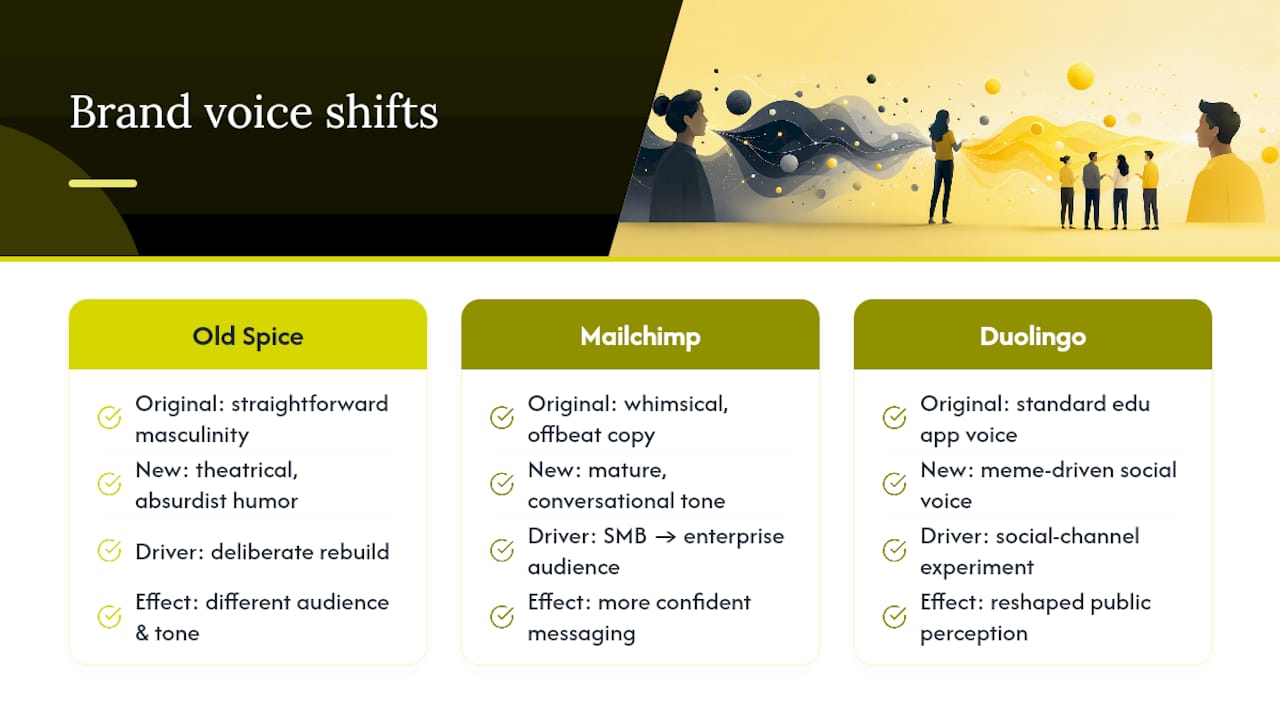
Voice isn’t static, and the strongest brands revise it deliberately rather than letting it drift. Old Spice’s transformation from a dated aftershave brand to an absurdist internet phenomenon happened because the company rebuilt its voice around theatrical humor instead of the straightforward masculinity claims it used for decades. The shift wasn’t cosmetic. It changed who the brand talked to and how.
Mailchimp offers a subtler case. Its early voice leaned harder into whimsical illustration and offbeat copy aimed at small business owners experimenting with email for the first time. As the platform expanded into enterprise marketing automation, the voice matured, still conversational, but with less slapstick and more confidence, because the audience shifted from side-hustle founders to marketing departments evaluating a serious tool.
Duolingo’s evolution ran the opposite direction: a fairly standard education app voice gave way to an aggressively meme-driven social presence once the team recognized how much engagement the unhinged owl persona generated on TikTok. That case is instructive for a different reason. The core app experience barely changed its tone, but the social channel became a separate voice experiment that eventually reshaped public perception of the whole brand. Evolution, in each case, followed a change in audience or channel, not a rebrand for its own sake.
Why Examples Beat Adjectives Every Time
Most brand voice advice stops at a list of adjectives, confident, warm, bold, and calls it done. That’s the gap this research keeps surfacing: adjectives don’t tell a writer what to type. A chart with a Do and Don’t sentence does. The brands on this list didn’t get recognizable by agreeing on three words in a workshop. They got recognizable by repeating the same sentence patterns until readers could identify them blind.
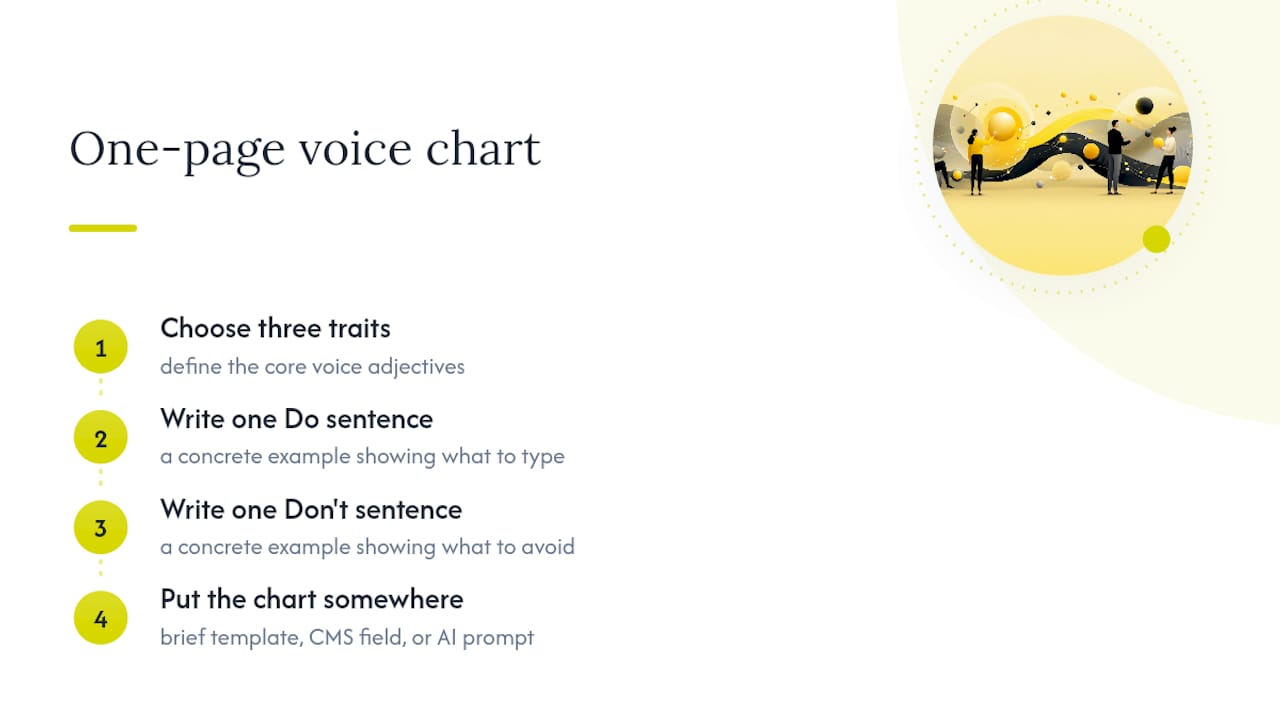
The conventional advice oversells the brand bible and undersells the one-page chart. A forty-page document with mood boards and personality wheels looks thorough in a pitch deck and gets ignored the moment a deadline hits. What actually survives contact with a production calendar is short, specific, and sitting where the writer already works, in the brief template, the CMS field, or the AI prompt.
If you take one thing from this piece, prioritize the chart before the campaign. Define three traits, write one Do and one Don’t sentence for each, and put that page somewhere every contributor sees before they draft. Inspiration from Nike or Mailchimp is worth studying, but it only pays off once your own team has rules as concrete as the examples that inspired them.
Sources
For deeper detail on the frameworks referenced throughout this piece, these sources are worth a direct read:
If you’re building voice alongside a visual identity, Vainnewyork’s visual branding strategy guide and audience-building playbook cover the adjacent groundwork.
Recommended
Comments