Prove Your Branded Content Strategy in 90 Days for Marketers


A branded content strategy is a repeatable editorial system that earns attention by delivering a specific promise to a clearly defined viewer, not by interrupting them. The single-sentence prescription: build audience-first, platform-native stories on a repeatable production and rights system, and measure them against preference and consideration, not clicks. Skip that discipline and you get expensive one-off videos that look like ads wearing a costume.
TL;DR:
Target viewers based on platform habits and behavior, not solely on demographic profiles such as buyer personas.
Choose a guide narrative stance over hero to foster trust and avoid overly polished or scripted content that feels inauthentic.
Distribute branded content first through creator channels, then extend reach via paid amplification and earned media partnerships for best results.
Measure performance using KPIs aligned with campaign objectives, such as brand lift for consideration or cohort engagement for preference, rather than click-throughs.
Build a repeatable system with clear strategy, rights management, and measurement to ensure long-term success and avoid one-off content flops.
Table of Contents
What Is a Branded Content Strategy?
Branded content is editorial material a brand commissions or produces to earn attention on its own merits, distinct from advertising that buys attention through interruption. A cooking show funded by a kitchenware company is branded content. A 15-second product demo interrupting that same show is an ad. The distinction matters because the two operate on different psychological contracts: advertising asks for a few seconds of tolerance, branded content asks for a few minutes of genuine interest.
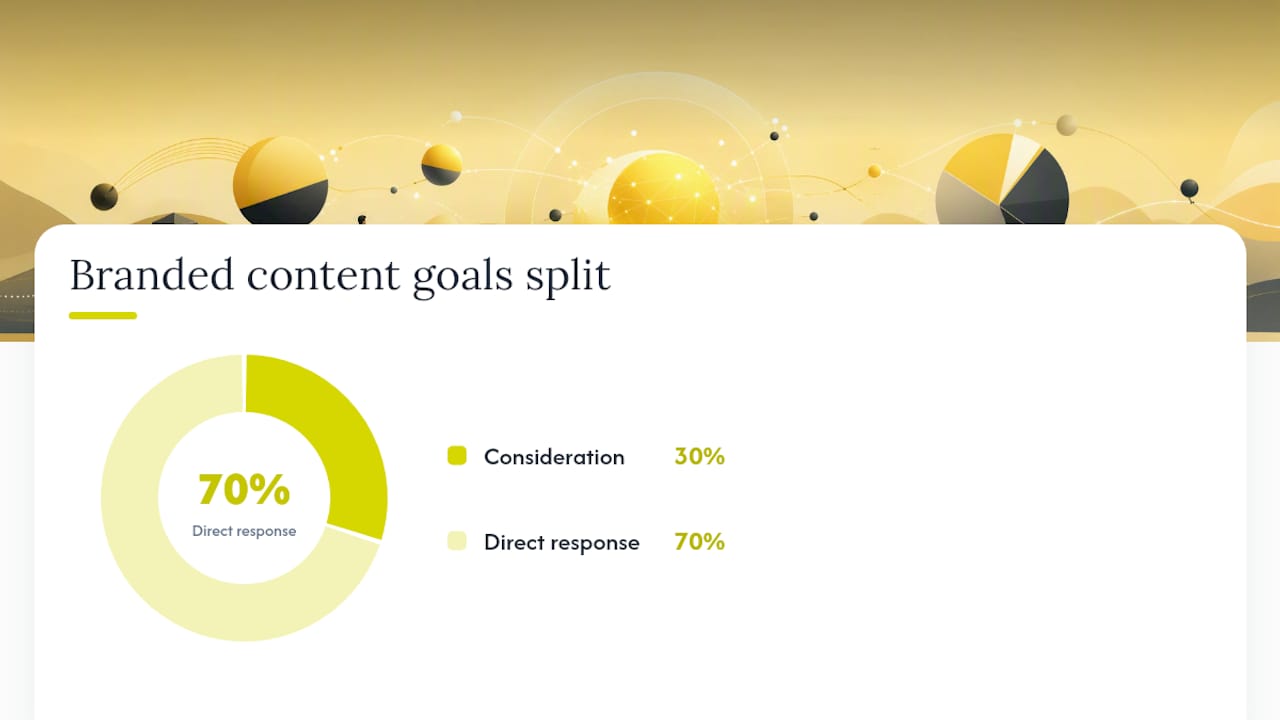
This is also where branded content splits from the broader discipline of content marketing strategy. Content marketing is the umbrella: blog posts, guides, and email nurture sequences built to move a prospect through a funnel. Branded content sits inside that umbrella as the emotional, story-driven layer, closer to entertainment than instruction. Advertiser Perceptions research found 31% of brands use branded content specifically to increase product consideration, while 29% use it for broader brand-building goals. Neither number is about immediate conversion. That’s the tell: branded content plays a longer, softer game than a performance ad ever will.
Confuse the two and you’ll brief a creator for entertainment, then judge the result on click-through rate. That mismatch kills more branded content programs than bad creative ever does.
What Makes Branded Content Actually Work?
Four principles separate branded content that earns genuine attention from content that just looks expensive.
Know your target viewer, not your buyer persona. A buyer persona describes who purchases. A target viewer describes who watches, and what platform habits govern their attention that day. Someone might fit your ideal customer profile perfectly and still never watch a branded YouTube series because their platform habit is podcasts during commutes. Map to behavior, not demographics.
Choose your narrative stance deliberately. Brands can act as the hero of their own story or as the guide helping someone else become the hero. The hero stance works for aspirational, high-production spectacle. The guide stance, where the brand plays investigator, mentor, or facilitator, tends to build more trust because it doesn’t ask the viewer to admire the brand, just to follow it somewhere interesting.
Design for the platform you’re actually publishing on. A story built for a 90-second vertical feed and a story built for a 20-minute YouTube documentary are not the same story cut to different lengths. They need different pacing, different hooks, and different resolution points.
Protect your brand constants. Visual identity, tone, and proof standards (how you back up claims) should stay consistent across every creator and format, even as the story changes. Consistency is what makes ten different pieces of content feel like one brand instead of ten random collaborations.
Target viewer over buyer persona: map to platform habits, not job titles
Guide stance over hero stance for most trust-building content
Platform-native pacing: short-form front-loads the payoff, long-form earns it
Brand constants: locked visual language, consistent tone, repeatable proof standards
Common pitfalls: over-polished production that reads as an ad in disguise, and “authentic” content that’s actually just as scripted as a commercial
Pro Tip: Test your narrative stance by covering the brand name in a rough cut. If the story falls apart without the logo, you’re leaning too hard on hero positioning instead of a story worth watching on its own.
How Do You Plan a Branded Content Program?
Every strong program starts with an editorial promise: a one-sentence commitment to what the viewer gets, independent of what the brand sells. “We’ll show you how professional chefs actually prep for a dinner rush” is an editorial promise. “Buy our knives” is not. Write the promise before you write a single script.
Draft the editorial promise and pair it with one objective. Awareness, consideration, or preference. Pick one; trying to serve all three dilutes the story.
Build target viewer profiles using actual platform behavior. This is where audience research methods and layered audience segmentation tools earn their keep, because generic demographic slices won’t tell you whether your viewer watches full episodes or skims fifteen-second clips.
Map formats to viewer behavior. Short-form creator content for discovery, serialized content for sustained attention, publisher partnerships for borrowed editorial credibility.
Allocate budget with a rough split: creator fees, production, paid distribution, and measurement should each get a defined share up front, not whatever’s left over after production runs long.
Set governance before production starts: who approves creative, who owns usage rights, and how long those rights last.
A repeatable system beats a brilliant one-off every time. PartnrUP’s branded-content playbook makes this point bluntly: programs without a defined strategy, production framework, and distribution machine tend to fail, no matter how good any single piece of content looks. One great video is a fluke. A repeatable system is a content strategy.
Editorial promise: one sentence, viewer-facing, brand-invisible
Objective: pick one per program, not three
Format: matched to platform habit, not internal preference
Budget: split across fees, production, distribution, measurement
Governance: approval chain and rights terms locked before the shoot
How Do You Produce Branded Content Without Losing Credibility?
Production is where most branded content strategies quietly fall apart. The fix starts with picking the right collaboration model.
Creator-led works when the creator’s voice is the reason the audience shows up; the trade-off is less brand control over exact messaging. Brand-directed works when message precision matters more than creator voice; the trade-off is content that can feel stiffer and less native to the platform. Most mature programs use both, depending on the format.
A tight creator brief prevents most disputes before they start. Include the editorial promise, non-negotiable mandatories (claims that must appear, claims that can’t), usage rights and duration, exact deliverables, and a realistic timeline. Vague briefs produce vague content, then expensive reshoots.
Building a reusable asset library, product shots, brand sound, motion templates, saves real money on every subsequent piece. Designkit’s guidance on scaling branded visuals points to templated systems and AI-assisted tooling as a practical way to keep output brand-compliant without re-briefing a designer for every single asset.
Creator-led: authentic voice, less message control
Brand-directed: precise messaging, less platform-native feel
Brief must include: promise, mandatories, usage rights, deliverables, timeline
Lock review gates and legal/rights checks before shoot day, not after
Confirm whitelisting rights in the contract if paid amplification is planned
Pro Tip: Negotiate usage rights in months, not “in perpetuity” boilerplate. Most creators charge less for a defined 90 or 180-day window, and you can always renew if the content performs.
Where Should Branded Content Get Distributed?
Distribution runs on four channels, and the strongest programs use all four in sequence rather than picking one.
Creator-owned channels carry the content first, because that’s where the audience already trusts the voice delivering it. Brand-owned channels (your own social accounts, email, website) extend its life after the initial push. Paid amplification, including whitelisting, where the brand runs ads through the creator’s account rather than its own, keeps the content in front of cold audiences with the creator’s credibility attached. Earned partnerships, like publisher collaborations, add third-party legitimacy no paid placement can buy.
Creator whitelisting specifically tends to lower cost-per-acquisition for consumer brands compared to running the same creative from a brand handle, because the ad shows up with the creator’s face and name attached instead of a corporate account.
Platform norms differ enough that a single cut rarely works everywhere; understanding short-form video trends is essential to tailoring content effectively. TikTok and Reels reward a hook inside the first two seconds and a payoff by the eighth. YouTube tolerates a slower build if the payoff is worth the wait. LinkedIn favors a point of view over pure entertainment. Podcasts reward integration over interruption, native-read ads outperform pre-produced spots almost every time.
Creator-owned: publish first, credibility-led
Brand-owned: repurpose and extend on your own channels
Paid/whitelisted: amplify proven performers to cold audiences
Earned: publisher and media partnerships for third-party legitimacy
Repurpose every asset at least twice, into a short clip, a static quote graphic, or an email hook, before calling it done
Track incremental reach as you repurpose, not just total views, or you’ll overcredit the same audience seeing the same idea three times.
How Do You Measure Branded Content Performance?
Match your KPI to your objective, not the other way around. Awareness campaigns should track qualified reach and watch time completion, not clicks. Consideration campaigns should track brand lift and search volume for branded terms. Preference campaigns should track cohort behavior over time, whether people exposed to the content later engage more with owned channels.
Set up your tracking before launch, not after. A clean UTM taxonomy that separates channel, creator, and asset lets you see which specific piece drove behavior. Pixel events on your own site should capture post-exposure visits, not just conversions. Define a cohort exposure window (commonly 7 to 30 days) so you’re comparing exposed versus unexposed audiences on a fair timeline.
Roughly 3 in 10 brands report using branded content for product consideration lift and broader brand-building goals rather than direct response, which is exactly why direct-response metrics undersell most branded programs.
Audit creator audience quality before you commit budget: check follower growth patterns for irregularities, compare engagement rate against view count, and ask for platform analytics screenshots rather than trusting a media kit.
Awareness: qualified reach, video completion rate
Consideration: brand lift studies, branded search volume
Preference: cohort behavior, repeat engagement on owned channels
Report monthly at minimum, and treat every campaign as a test you can improve
This is also where brand awareness strategies and branded content overlap most directly, since both ultimately get judged on whether more people choose you when it counts.
What Do Successful Branded Content Campaigns Look Like?
Three models cover most of what actually works.
Short-form creator content built for TikTok or Reels tends to run 15 to 60 seconds, distributed first through the creator’s own account, then whitelisted for paid reach once it proves itself organically. Expect to judge success on completion rate and shares before you ever look at conversions.
Publisher or media partnerships trade a defined editorial promise for co-branded distribution through an outlet’s existing audience and credibility. The Content Marketing Institute points to this model as one of the more reliable ways to combine immersive storytelling with multi-channel reach, because the publisher’s editorial standards force better creative discipline than a brand working alone.
Long-form thought leadership, documentaries, extended interviews, or founder-led series, rarely goes viral on its own, but it repurposes into dozens of smaller assets and tends to feed branded search and lead funnels months after release. StudioBinder’s case-study collection shows branded storytelling built around relatable human stories consistently outperforming direct ad formats on recall.
Short-form: fast validation, cheap to test, hard to sustain without a content engine
Publisher partnership: slower to produce, higher credibility, less brand control
Long-form: high upfront cost, long payoff tail, strong repurposing value
Match the model to your budget and patience, not just your ambition
What Does Vain.'s Branded Content Checklist Look Like?
Some companies run branded content programs as production and consulting engagements, not one-off shoots, which is why a checklist often exists as a working document rather than a slide.
Draft the editorial promise and confirm it survives without the brand name attached
Fill the creator brief: promise, mandatories, usage window, deliverables, timeline
Lock approval steps and rights before any camera rolls
Build the asset library so every shoot produces at least three repurposable formats
Track at 30 days (early engagement signal), 90 days (consideration lift), and 180 days (search and retention behavior)
Pro Tip: If a client can’t answer “what should the viewer feel by the end” in one sentence, the brief isn’t ready, regardless of how locked the shot list looks.
What Legal and Ethical Rules Apply to Branded Content?
Disclosure isn’t optional, and getting it wrong carries real regulatory risk in the United States. The Federal Trade Commission requires clear, conspicuous disclosure whenever a brand has paid for or materially influenced content, whether that’s a hashtag like #ad placed where viewers will actually see it, or a verbal disclosure early in a video rather than buried in a description nobody reads.
The ethical line runs a little deeper than the legal minimum. A disclosed sponsorship that still feels deceptive because the creator pretends to have discovered the product organically undermines trust even when it technically complies with disclosure rules. Viewers are good at detecting manufactured enthusiasm, and the backlash from a “fake authentic” moment often outlasts whatever reach the content generated.
Rights management deserves the same rigor as disclosure. Contracts should specify exactly which platforms the content can run on, for how long, and whether the brand can adapt the creator’s likeness or voice for paid amplification. A creator agreeing to an organic post is not automatically agreeing to a six-month paid whitelisting campaign, and assuming otherwise is a fast way to burn a relationship and invite a legal dispute.
Build a simple pre-publish checklist: disclosure language confirmed, usage rights scoped to actual use, claims substantiated against your proof standards, and legal sign-off on anything making a comparative or health-adjacent claim. It takes ten minutes and prevents the kind of mistake that takes months to unwind.
How Do You Get Internal Buy-In for Branded Content?
Branded content struggles internally because it’s hard to defend with the same metrics as performance marketing, and finance teams raised on cost-per-click will ask why a video with no direct conversion link deserves budget.
The fix is setting expectations before the pitch, not after the results come in. Frame branded content explicitly as a preference and consideration play, then attach the KPIs from earlier in this program (brand lift, qualified reach, cohort behavior) to the budget request itself, so nobody is surprised later when a click-through rate looks unimpressive next to a search ad.
Bring legal, brand, and performance marketing into the planning stage, not just the approval stage. A legal team that sees the disclosure plan early rarely blocks launch later. A performance team that helped set the measurement plan is far less likely to dismiss the results as unmeasurable.
Start with a pilot small enough that a mixed outcome doesn’t sink the whole program, one creator partnership or one publisher collaboration, then use that as the internal case study for a larger budget ask. Nothing builds executive confidence faster than a real result, even a modest one, measured against a KPI everyone agreed on in advance.
How Does Branded Content Fit Your Overall Brand Strategy?
Branded content works best when it’s a visible expression of a brand strategy that already exists, not a substitute for one. If your brand hasn’t defined its tone, visual identity, and point of view, branded content will surface that gap fast, because every creator collaboration will pull the brand in a slightly different direction.
Treat the visual branding strategy as the constant against which every branded content piece gets checked, and treat branded content itself as one tactic inside the wider content marketing mix rather than a separate department running its own playbook. When a performance team, a brand team, and a content team all pull from the same brief, the resulting content looks coherent even across a dozen different creators and formats.
The integration test is simple: could someone who’s never seen your logo still recognize your brand’s voice from the content alone? If yes, your branded content and your overall brand strategy are aligned. If every piece looks like it came from a different company, the branded content function is operating in isolation, and that’s a governance problem, not a creative one.
How Do You Build Real Emotional Connection Through Branded Content?
Emotional connection in branded content comes from specificity, not sentiment. A story about “the resilience of small business owners” is generic. A story about one bakery owner who rebuilt her shop after a specific flood, told through her own words rather than a narrator’s summary, earns attention because it’s concrete enough to feel real.
The guide narrative stance helps here directly: when the brand steps back and lets a real person’s story carry the emotional weight, viewers extend trust to the brand for facilitating it, rather than resisting a brand trying to claim the emotion for itself. StudioBinder’s case-study analysis backs this pattern, showing that relatable human stories tend to outperform direct ad formats on recall specifically because they don’t ask the viewer to feel something on command.
Pacing matters as much as subject matter. Emotional beats need room to land, a joke needs a beat of silence before the next line, a vulnerable admission needs a pause before the story moves on. Branded content edited at ad-speed rhythm reads as manufactured even when the underlying story is genuine.
What Should Marketers Learn From Branded Content Mistakes?
The most common mistake isn’t bad creative, it’s mismatched expectations. Teams greenlight a story-driven piece and then judge it against a performance-ad scorecard three weeks later, killing programs that were never designed to convert on that timeline.
The second mistake is over-polishing a story until it stops feeling like anything a real person would actually say. The fix is almost always structural: build in a rough cut review specifically to check whether the story survives without the brand’s name attached, before the final polish locks everything in place.
Choosing between a spectacle campaign and a serial editorial program comes down to what you’re actually trying to build. Spectacle works for a single moment, a launch, an anniversary, a cultural tie-in. Serial programs build compounding trust over months, which is why they tend to outperform one-off spectacle on preference metrics even when they get less attention in any single week.
Bringing in an outside partner makes the most sense when the gap isn’t creative talent, it’s system design: briefing discipline, rights management, and repeatable measurement. Internal teams are usually strong on brand knowledge and weak on production systems built to scale.
— Vain.
Ready to Build a Branded Content Program That Actually Works?
Some companies offer an integrated approach to branded content, combining strategy, creator collaboration, and production within one team instead of relying on multiple separate vendors. That matters most in the first ninety days, when a mismatched handoff between a strategy shop and a production house is exactly what kills a promising branded content program before it gets a fair test.
A typical engagement starts with a strategy sprint to nail down the editorial promise and target viewer, moves into a pilot with one format and one distribution channel, and scales into full production once the pilot proves the concept against real KPIs, not guesswork. That sequencing protects your budget from the single biggest risk in this category: full-scale production before anyone’s confirmed the story actually lands.
If your team is ready to move past planning documents and into an actual pilot, visit Vain.'s services page to see work samples and start a conversation about what a first branded content engagement could look like for your brand.
Sources
Recommended
Comments