54 Units to Break Even: Per Channel Merch Profit Margins for Musicians


Aim for a 50 to 70% gross margin on core apparel, but plan your finances around a much thinner net margin, often in the single digits once platform fees, shipping, and venue cuts take their bite. Stickers and pins can clear markups well above 500%, while vinyl and hoodies sit in a tighter 55 to 65% band because of pressing and material costs. Before you set a single price, calculate your true unit cost separately for each sales channel — that number changes everything downstream.
TL;DR:
Online margins typically range from 20 to 40 percent for print-on-demand services, due to shipping and base costs, making them less profitable than at-show sales.
Setting a high initial price for premium items or limited editions can significantly boost margins without adding production costs, especially when scarcity is used as a pricing lever.
Achieving a 50 percent gross margin is a good benchmark, but actual net margins often fall into the single digits after platform, shipping, and venue fees are deducted.
Properly calculating true unit costs for each sales channel and tracking them separately helps identify which channels are profitable and which are draining resources.
Larger production runs lower per-unit costs but increase inventory risk; hybrid approaches with bulk for proven sellers and print-on-demand for testing mitigate this risk while maintaining margins.
Table of Contents
Merch Profit Margin Benchmarks By Item
Every merch item carries a different margin ceiling, and the gap between an impulse buy and a premium piece is wider than most sellers assume. Hypebot’s Merch Profitability Index tracks item-level margins across the touring and D2C markets, and the spread is instructive: stickers and pins behave almost like pure profit, while hoodies and vinyl carry real production weight.
Stickers are the outlier for a reason: production cost barely moves regardless of print run, so almost every dollar past the first few cents drops to margin. Vinyl sits at the opposite end because pressing plants charge by the unit with little bulk discount below a few hundred copies, which caps how far margin can stretch even at premium pricing.
Perceived value shifts these numbers more than people expect. A limited color pressing or a numbered print run can carry a retail price 20 to 30% above the standard version with almost no added production cost, which is why smart sellers treat scarcity as a pricing lever, not just a marketing angle.
How Do You Calculate Merch Profit Margins?
Three numbers matter, and they answer three different questions. Gross margin tells you how much of each sale survives production cost: (Revenue − COGS) ÷ Revenue. Operating margin subtracts the cost of actually running the business (marketing, platform tools, labor): (Revenue − COGS − Operating Expenses) ÷ Revenue. Net margin is what’s left after everything, including taxes and one-off fees: (Revenue − All Costs) ÷ Revenue.
The real work happens before you plug numbers in, when you build your “true unit cost.” That figure needs to include:
Landed COGS (unit cost plus freight and any import duties)
Payment processing fees (typically 2.9% plus $0.30 per transaction)
Platform or marketplace fees
Packaging and fulfillment shipping
Returns and damage allowance
Venue commission, if sold at a show
Amortized setup cost (screens, dies, embroidery digitizing) spread across the run
Worked example: A $30 tee with a $7 landed cost sells online through a Bandcamp-style storefront. After a roughly 10 to 15% platform fee, $1.50 shipping contribution, and card processing, realized profit lands closer to $16 to $17, a 53 to 57% margin.
Pro Tip: Build one spreadsheet tab per channel. A single blended margin number hides which channel is actually funding your tour and which one is quietly losing money.
Why Online and At-Show Margins Look So Different
Print-on-demand and bulk printing sit at opposite ends of a risk trade-off. POD carries no inventory risk and no upfront cash outlay, but realistic POD margins often land closer to 20 to 40% once shipping and base costs are factored in.
Channel fees compound the difference. Standard card processing runs about 2.9% plus $0.30 per transaction, and venue commissions typically range from 10 to 40%, with many venues standardizing around 20 to 25%.
Practical fixes by channel:
Consider pricing show merch somewhat higher than online prices to help offset venue commissions.
Pass shipping cost to the buyer above a minimum order size rather than absorbing it.
Negotiate venue commission before the tour, not after settlement night.
Use pre-orders for large bulk runs to convert inventory risk into confirmed cash flow.
Pricing And Product Tactics That Actually Raise Margin
Bundles do more than move volume. A tee-plus-sticker bundle priced just under the sum of both items absorbs fixed costs like shipping and payment fees across two units instead of one, which lifts average order value without asking fans to pay full freight twice.
Premium blanks and tactile details are the highest-leverage tactic in the entire margin conversation. Embroidery, puff print, or a limited pressing can add $8 to $15 to retail price while barely moving production cost, which is a direct transfer from perceived value into margin. Small goods like pins and stickers work as impulse anchors and bundle fillers, pulling average order value up without requiring a new SKU decision from the buyer.
A few working heuristics worth adopting:
Treat 50% gross margin as a floor for any SKU meant to drive real revenue, pricing roughly double your landed cost.
Reserve bulk printing for proven sellers and use POD to test new designs or serve international fans without shipping risk.
Anchor premium items (embroidered hoodies, limited vinyl) at a visibly higher price point to make mid-tier items look like the smart buy.
Review bundle structures quarterly. What sold as a bundle last tour may not fit this one.
How Many Units Do You Need To Sell To Break Even?
Break-even quantity answers a simple question: how many units cover the fixed cost of the run before anything becomes profit? The formula is fixed production cost divided by net profit per unit.
Say a 100-unit tee run costs $700 in setup and printing, or $7 per unit fixed.
Add variable cost per unit (blank, ink, shipping share) of roughly $2.
At a $25 sale price with $3 in fees, net profit per unit is about $13.
Break-even lands around 54 units, just over half the run.
Larger runs lower per-unit cost, sometimes significantly, but they also lock up more cash in unsold stock if a design underperforms. Staged restocks, pre-orders, and limited runs all reduce that exposure. A hybrid approach, bulk for your top three proven sellers and POD for everything experimental, keeps cash flow flexible without sacrificing margin on the items that actually move.
Vain.'s Practical Playbook For Merch Margins
Vainnewyork works with artists and brand teams on the full arc of merch decisions, from design choices that shift perceived value to the mechanics of setting up a direct-to-consumer store. Two tools we return to constantly with clients: a pricing checklist that forces a true unit cost calculation before any retail number gets set, and a per-channel cost template that separates online math from at-show math so nobody blends the two into a false sense of profitability.
Merch economics for artists differ meaningfully from standard retail, largely because the brand carries the margin, not just the product. That distinction shapes every pricing decision that follows.
How Does Sales Tax Affect Merch Profit Margins?
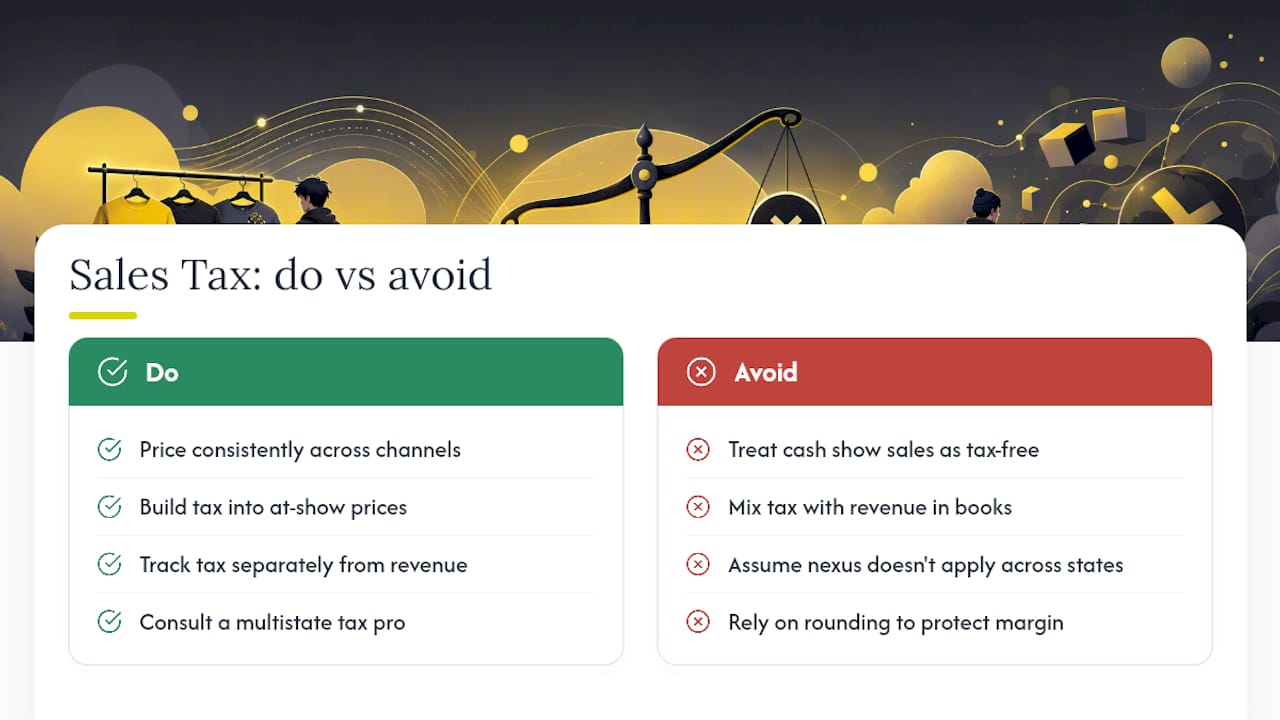
Sales tax doesn’t reduce your margin directly, since you collect it on top of the sale price and remit it to the state, but it does affect cash flow and pricing psychology in ways sellers underestimate. If you’re selling online across state lines, economic nexus rules can require you to register and collect tax in states where you hit a sales threshold, even without a physical presence there.
The real margin risk shows up when sellers price merch as a round, tax-included number at shows to keep transactions simple. That’s a real cost, not a rounding error, especially across a tour with dozens of shows.
Keep tax handling consistent across channels. If your online store adds tax at checkout automatically through your platform’s tax engine, your at-show pricing should build in the same expectation rather than treating cash sales as tax-free. Track what you collect separately from revenue in your books, because mixing the two makes your margin calculations look better than they actually are and can create a nasty surprise at filing time. If you sell in multiple states or internationally, a tax professional familiar with multistate nexus rules is worth the consultation fee before your next tour.
How Does Seasonal Timing Affect Merch Profitability?
Merch sells in bursts, not a steady drip, and pricing strategy needs to respect that rhythm. Tour announcements, album release windows, and holiday shopping periods concentrate demand into short stretches where buyers are primed to spend, which is exactly when premium pricing and limited editions perform best.
The flip side is inventory risk during quiet months. A hoodie run sized for peak holiday demand can sit as dead stock through the spring, tying up cash that would otherwise fund the next design or the next tour leg. Sizing production against a realistic sell-through curve, not the best month you can imagine, protects margin more reliably than any pricing tactic.
Event timing matters just as much as calendar season. Merch sold at a show, especially a hometown date or a tour kickoff, tends to move faster and at higher price points than the same item listed online months later, partly because the emotional context of a live show shortens the distance between seeing an item and buying it. That’s worth factoring into where you allocate your best or most limited pieces: save the highest-margin exclusives for the dates where demand is naturally strongest, and use quieter stretches of the calendar for restocks, bundle promotions, or clearing older designs before they become dead weight.

Publisher Perspective: Why Margin Discipline Wins For Creators
Margin isn’t a spreadsheet exercise, as detailed in Monetizing Music: A Step-by-Step Plan for Indie Artists, where it is shown how merch forms a crucial part of an artist’s revenue mix. It’s what funds the next tour leg, the next video shoot, the next batch of better blanks. When you track margin by SKU and by channel, you stop guessing which designs to reorder and which to retire. We’d argue the single highest-leverage habit any small merch operation can build is a monthly fifteen-minute review of exactly these numbers, before the next print order goes out, not after.
— Vain.
Get Help Pricing And Building Your Merch Store
Running these calculations SKU by SKU and channel by channel takes real hours most artists and small teams don’t have between shows, releases, and everything else on the calendar. Vainnewyork works directly with musicians and brand teams on the parts that eat that time: pricing audits that catch where margin is leaking, merch design decisions that add perceived value without inflating cost, and store builds that keep online fees from quietly eating your gross margin.

Where a general pricing guide gives you formulas, Vainnewyork gives you a second set of eyes on your actual numbers, plus the design and production judgment to act on what those numbers show. If your current merch line hasn’t had a real margin review in the past year, that’s the first place to start. Visit Vainnewyork to request a pricing audit or grab our per-channel cost template before your next print run ships.
Sources
Run your own models against Hypebot’s Merch Profitability Index for item benchmarks, the Tools4Music merch profit calculator for channel math, TrueProfit’s apparel benchmarks for industry gross-margin targets, and Sonicbids’ pricing guide for the retail pricing formula.
FAQ
Is A 30% Profit Margin Too High For Merch?
No.
How Profitable Is Selling Merch, Realistically?
Gross margin often looks strong on paper, but realized net margin after platform fees, shipping, venue cuts, and taxes frequently lands in the single digits, which is why tracking true unit cost by channel matters so much.
Is A Merch Business Worth Three Times Profit?
Valuation multiples vary widely by buyer and category, and no single multiple applies universally to a merch operation; what matters more day to day is protecting the underlying margin that makes the business worth anything at all.
Recommended
Comments