Community Building for Brands and Artists: A Practical Guide

Community building converts customers into an owned, many-to-many audience that acquires, retains, and advocates for your brand. Start here with three moves you can make this week:
Recruit a moderate number of founding members from your most engaged buyers or followers and give them a name that signals belonging.
Choose one gathering place — a private Discord server, a Circle space, or a Mighty Networks group — and make it the single home for your community.
Launch one ritual activation — a weekly challenge, a behind-the-scenes drop, or a monthly live Q&A — that gives members a reason to return.
These three moves map directly to the community flywheel: know your communities, pick hero products, craft a talkable story, fuel conversation, and make transactions effortless. Each element feeds the next, and the whole system compounds over time.
Key Takeaways
Community building is the highest-leverage growth channel available to brands and artists willing to invest in owned relationships over rented reach.
Point | Details |
Start with founding members | Recruit 50–100 high-CLV customers personally before opening the community to the public. |
Use the five-element flywheel | Know communities, hero products, talkable story, fuel conversation, and effortless transactions compound together. |
Measure participation, not size | Active participation rate and content-to-consumer ratio matter more than raw member count in the first 90 days. |
Budget varies by scope | Early-stage costs cover a community lead, content production, and platform fees before events are added. |
Vainnewyork as your partner | Vainnewyork delivers community strategy, creative production, and activation campaigns as a project engagement. |
Table of Contents
What is brand community building, and why does it matter now?
How do you identify which communities your brand should join?
How do you pick hero products and build a story worth repeating?
What content and activation tactics fuel real community conversation?
What commerce and membership models reduce friction for community members?
What is brand community building, and why does it matter now?
Brand community building is the practice of turning customers and fans into an active, interconnected group that creates value for each other and for your brand. It is not civic organizing, neighborhood development, or classroom programs. The distinction matters because the tactics, platforms, and metrics are entirely different.
Three business benefits make this worth the investment. First, a thriving community lowers customer acquisition cost because members refer friends organically. Second, community cohorts consistently show higher retention and lifetime value than non-community buyers. Third, members generate creative assets — reviews, photos, stories — that your paid media team could never produce at the same authenticity or volume.
Set Active, the activewear brand, built its community by inviting customers into product decisions before launch, which turned buyers into co-owners of the brand story. Knix deepened retention by creating a private space where customers shared personal milestones, making the brand feel like a trusted companion rather than a vendor. Waterboy drove discovery by activating a tight circle of wellness advocates who generated peer-to-peer conversation that paid ads could not replicate. Each example reflects a different benefit, but the underlying mechanic is the same: community-led growth puts customers at the center of product and marketing decisions.
How does the community flywheel actually work?
The flywheel has five reinforcing elements. When one accelerates, the others follow.
Know your communities. Map where your most valuable customers already gather, what they care about, and what vocabulary they use.
Pick hero products. Choose a few products with meaningful use cases, distinctive attributes, and natural shareability.
Craft a talkable brand story. Build a short narrative around a shared conflict, a clear value, and a repeatable ritual that members can retell.
Fuel conversation. Create content, activations, and collaborations that give members something worth sharing every week.
Make transactions effortless. Remove every friction point between community enthusiasm and a purchase or referral.
Visually, picture five segments arranged in a circle. An arrow connects each segment to the next, moving clockwise. At the center, write “compounding growth.” The segments are labeled with the five elements above. A designer can render this as a wheel with a hub-and-spoke overlay showing agile squads, martech, and analytics as the enablers sitting at the center.
XO Marshmallow, the Chicago-based confectionery brand, activated the flywheel by making their café a content set. Every visit became a shareable moment, hero products were photographed thousands of times organically, and the brand story — joy as an everyday act — was short enough for any customer to repeat. A creator-led brand like a musician building a fan community follows the same logic: the album or EP is the hero product, the backstory is the talkable narrative, and a Discord server becomes the gathering place where fans co-create the culture around the work.
Pro Tip: The flywheel stalls most often at element four. Brands invest in the story and the platform but forget to schedule recurring activations. Put a weekly content ritual on the calendar before you launch.
How do you identify which communities your brand should join?
Start with data you already own. Pull your highest customer lifetime value cohort and look at the social tags, hashtags, and interest clusters they share. Run five to ten qualitative interviews with your best customers and ask one question: “Where do you go to talk about things like this?” The answers will surface two or three community pockets you had not mapped.
Then prioritize using five criteria:
Size × engagement — a smaller, highly active community outperforms a large, passive one.
Alignment — does the community’s shared identity connect naturally to your brand’s story?
LTV potential — are members already buyers in your category, or adjacent to it?
Ease of access — can you earn credibility here without a large paid investment?
First-party data control — does the platform let you own the member relationship?
A simple community map captures: community name, platform, estimated size, engagement signal, alignment score (1–5), LTV potential (high/medium/low), and access route. Three to five rows covering your top candidate communities give you a prioritization tool you can revisit quarterly. Building a community-led growth engine that outlasts paid media depends on choosing the right pockets first, then going deep rather than wide.
How do you pick hero products and build a story worth repeating?
A hero product earns its place by satisfying three criteria: it solves a meaningful problem in a way that sparks conversation, it carries an attribute worth explaining (an ingredient, a process, an origin), and it photographs or films well enough to travel organically.
Once you have your hero product, build the story around three elements:
The conflict or shared enemy — what frustration, gap, or injustice does your brand exist to fix?
The value — what does your brand believe that others in the category do not?
The ritual — what specific behavior do members repeat that signals belonging?
Keep the story short enough to fit in a caption. If a founding member cannot retell it in thirty seconds, it is too long. Standout content and creative galvanizes community interest when it is built around a story that members feel proud to share, not just a product they happen to own.
Hero products should anchor every activation calendar entry.
The conflict should appear in your onboarding message to new members.
The ritual should be the first thing a new member is invited to do.
What content and activation tactics fuel real community conversation?
The most durable activation strategy combines an owned platform with a social amplification layer and a recurring ritual. Here is a practical channel matrix:
Channel | Best use | Cadence | Primary KPI |
Discord | Real-time conversation, drops, AMAs | Daily moderation, weekly event | Active participation rate |
Circle | Structured courses, member profiles, events | Weekly posts, monthly live | Content-to-consumer ratio |
Mighty Networks | Paid memberships, cohort programs | Weekly content, bi-weekly live | Retention rate |
Bettermode | Customer portals, branded community hubs | Ongoing, event-driven | Member activation rate |
Instagram/TikTok | UGC amplification, discovery | 3–5x per week | Referral contribution rate |
For social management across those channels, Sprout Social handles scheduling, listening, and reporting at scale, while Buffer suits leaner teams that need a clean publishing workflow without the analytics overhead. Both integrate with the owned platforms above.
Influencer and collaborator work performs best when the collaborator is already a genuine community member or a natural adjacent voice. Give them a content library, a clear brief, and a low-friction way to share — a unique link or code — rather than a rigid script. Everyday customers who generate content deserve recognition too: a monthly spotlight, early access to a drop, or a handwritten note costs almost nothing and produces loyalty that a discount cannot buy.
Pro Tip: Building an audience that converts starts with peer-to-peer interaction, not broadcast posts. Seed your owned platform with three to five discussion threads before you invite the first member.
What commerce and membership models reduce friction for community members?
Three models cover most brand situations:
One-time merch drops create urgency and generate organic content at launch, but they require a new creative investment each cycle and do not build recurring revenue.
Subscriptions or paid tiers produce predictable revenue and deepen belonging, but they require a consistent value delivery cadence or members churn quickly.
Inner-circle memberships — a small, high-engagement group with exclusive access — build the most loyal advocates and the richest first-party data, but they demand founder or team visibility to feel worth the price.
Post-purchase is the most underused moment in community commerce. A referral prompt that arrives two days after delivery, framed as an invitation to bring a friend into the community rather than a discount offer, converts at a meaningfully higher rate than a generic coupon. Merch and IRL activations — a pop-up, a members-only dinner, a collaborative product — create the kind of shared memory that members post about without being asked. For drop mechanics and collaboration strategy, a 2026 merch drop guide covers the sequencing in detail.
Pro Tip: Frame your checkout confirmation page as a community welcome. Replace “Your order is confirmed” with the community’s name and a single next step — join the Discord, introduce yourself, claim your founding-member badge.
What team, tools, and KPIs do you need to scale community?
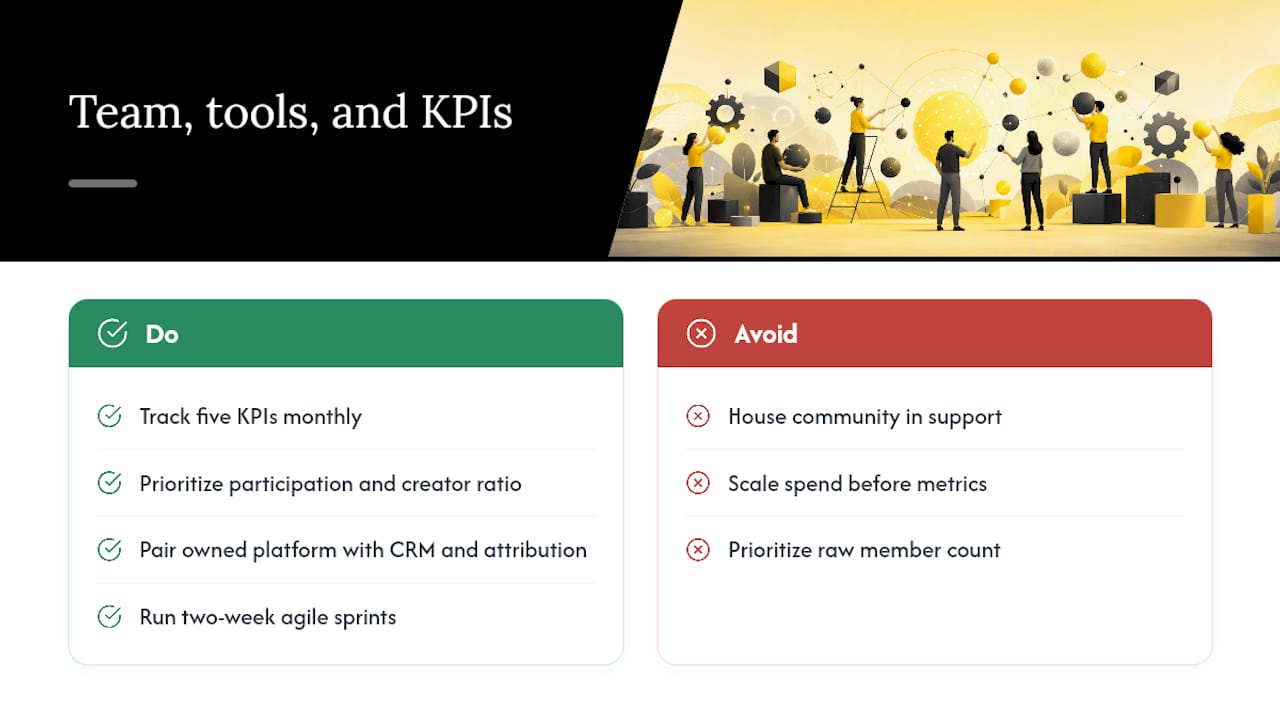
The five KPIs that matter most: active participation rate (members who post or react in a given period), content-to-consumer ratio (members who create vs. those who only consume), referral contribution rate (new customers attributed to community), retention lift (community cohort vs. non-community cohort), and community LTV uplift (average order value and purchase frequency delta). Track these monthly before scaling spend.
For the martech stack, pair Circle, Mighty Networks, Bettermode, or Discord as the owned platform with Sprout Social or Buffer for social publishing and listening, a CRM for cohort tagging, and a lightweight attribution tool that supports unique referral links. Community leadership belongs in the growth or CMO function — not in customer service — because the metrics it drives are acquisition and retention, not ticket resolution.
Early-stage budgets typically cover part-time leadership, content production, and platform fees, with costs varying by scope. Months 7–12 often double that as events and paid amplification are added. The D2C Times community playbook notes that community-led growth compounds slowly at first; early metrics to watch are active participation rate and content-to-consumer ratio rather than raw member count.
Pro Tip: Run two-week agile sprints. Each sprint has one activation hypothesis, one measurable outcome, and a go/no-go decision. This keeps the team moving without over-investing in tactics that have not yet proven themselves.
What does a practical 90-day starter plan look like?
Weeks 1–2 (Foundation)
Community lead maps top CLV cohort and identifies three community pockets.
Founder/CMO approves hero product, brand story draft, and platform choice.
Growth analyst sets up attribution links and baseline cohort tags in CRM.
Weeks 3–4 (Recruit)
Community lead personally invites 50–100 founding members via DM or email.
Creative producer builds onboarding sequence: welcome message, community rules, first ritual prompt.
Platform goes live with three seeded discussion threads.
Weeks 5–8 (Activate)
First weekly ritual runs (challenge, AMA, or behind-the-scenes drop).
Events coordinator plans first IRL or virtual gathering for founding members.
Growth analyst reports week-4 active participation rate; go/no-go on ritual format.
Weeks 9–12 (Measure and expand)
First referral prompt deployed post-purchase.
UGC from founding members amplified on social channels via Buffer or Sprout Social.
90-day review: active participation rate target 30%+, at least 10 community-sourced referrals, retention cohort comparison showing positive delta.
Milestone | Success criterion | Owner |
Founding members recruited | 50–100 members onboarded | Community lead |
First ritual completed | 30%+ participation in week 1 | Community lead + creative producer |
First referrals attributed | 10+ community-sourced new customers | Growth analyst |
Retention delta positive | Community cohort retains at higher rate than control | Growth analyst |
Vain.'s perspective on community-led growth
The most common mistake we see brands make is treating community as a content farm. They build a Discord, ask members to post photos, and then go quiet. Members notice the extraction immediately, and the community dies within sixty days.
What actually works is founder visibility in the first thirty days. When the person behind the brand shows up — answers questions, shares something unpolished, names a founding member publicly — it signals that the community is real. That signal is worth more than any activation calendar entry in month one.
Do: Start with twenty members, not two thousand. A small group that feels genuinely seen will recruit the next hundred faster than any paid campaign.
Do: Name the shared enemy in your onboarding message. Shared opposition creates identity faster than shared enthusiasm.
Don’t: Measure success by member count in the first ninety days. A small community with a high active participation rate is more valuable than a large community with low engagement.
Don’t: Outsource moderation entirely in the early stage. The tone of the first thirty conversations sets the culture for the next three years.
Vainnewyork helps brands build communities that last
Most brands know they need a community. Few have the creative production capacity and strategic clarity to build one that compounds. Vainnewyork brings both: a creative consultancy and production company that turns community strategy into executed campaigns, content systems, and owned audience infrastructure.
Our work covers community strategy, hero-product creative, activation calendars, UGC playbooks, and measurement frameworks — delivered as a project engagement, not a long-term retainer lock-in. Sample deliverables include a founding-member recruitment plan, a 90-day activation calendar, launch creative for your hero product, and a referral attribution setup. Whether you are a brand launching your first owned community or an artist converting fans into a paying inner circle, the process starts with a single conversation.
Start that conversation at Vainnewyork — book a discovery call and we will map your community opportunity in the first session.
Sources
Recommended
Comments