Brand Awareness Strategies That Drive Real Growth


Brand awareness is defined as the degree to which consumers recognize and recall your brand when making a purchase decision. It is the foundation of every marketing funnel, and without it, even the best product sits invisible on the shelf. Companies with documented brand strategies grow 20% faster and reduce customer acquisition costs by 20–40%. That single fact reframes brand awareness from a soft marketing concept into a hard business asset.
What are the key types of brand awareness?
Brand awareness divides into two core forms: brand recognition and brand recall. Recognition is aided awareness. A consumer sees your logo, hears your jingle, or reads your tagline and connects it to your company. Recall is unaided awareness. A consumer thinks of your brand without any prompt, purely from memory. Recall is the harder and more valuable of the two.
Above both sits top-of-mind awareness. This is the state where your brand is the first name a consumer thinks of in your category. Unaided brand recall reflects top-of-mind status that boosts market share by over 70%. Reaching that position takes time, consistency, and deliberate strategy.
Two additional concepts help frame the full spectrum:
Brand dominance: Your brand is the only one a consumer recalls in a category. This is the goal for market leaders.
Brand ignorance: Consumers have zero awareness of your brand. This is the starting point for every new business.
Understanding where your brand sits on this spectrum tells you which tactics to prioritize. A brand fighting ignorance needs reach and frequency. A brand chasing dominance needs depth of association and emotional resonance.
Consumers typically hold 3 to 7 brands in their consideration set and are most likely to buy a top-3 recognized brand. That means if your brand is not in the top three recalled names in your category, you are effectively competing for scraps. The goal of every awareness campaign is to earn a seat in that consideration set.
How is brand awareness measured?
Measuring brand recognition accurately requires combining quantitative metrics with qualitative research. No single number tells the full story.
Survey methods are the most direct approach. Aided recall surveys show respondents a brand name or logo and ask if they recognize it. Unaided recall surveys ask respondents to name brands in a category without any prompts. Unaided surveys produce the most honest data because they reflect real memory, not just familiarity.
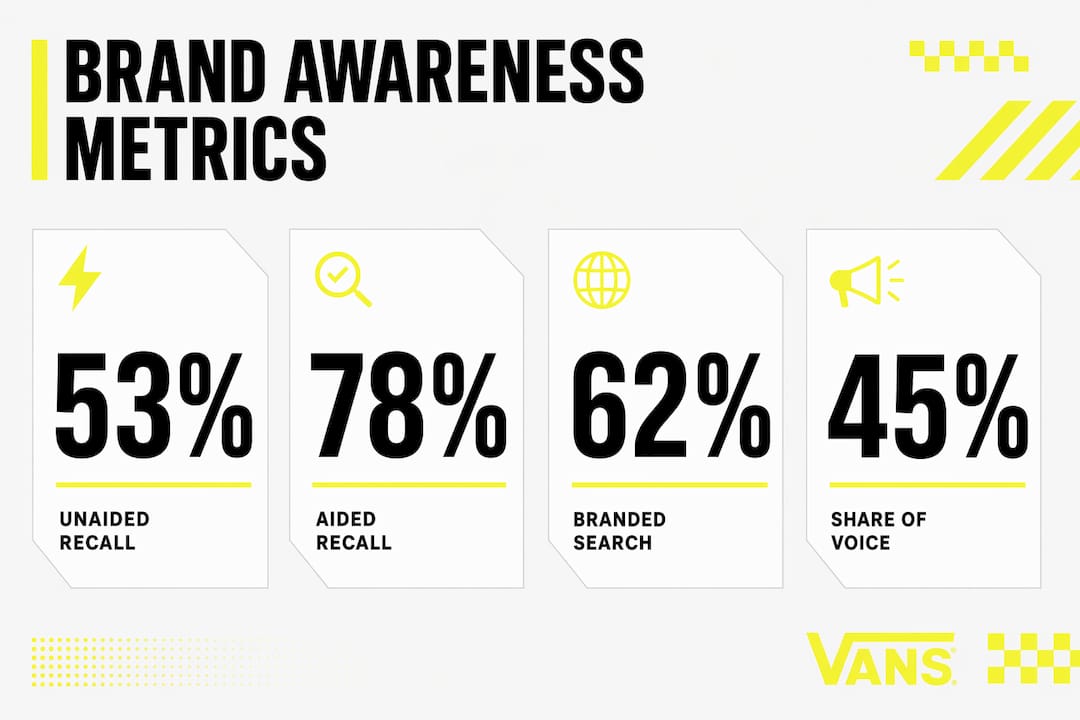
Digital metrics provide continuous, real-time signals:
Metric | What it measures |
Branded search volume | How often people search your brand name directly |
Share of voice | Your brand’s presence relative to competitors in media |
Direct website traffic | Visitors who type your URL without a referral |
Social media reach | Total unique accounts exposed to your content |
AI citation frequency | How often AI tools mention your brand in answers |
The critical mistake most marketers make is treating reach and impressions as awareness metrics. Reach measures exposure. Awareness measures memory. A campaign can reach millions and move awareness by almost nothing if the message does not stick. Brand visibility metrics like share of AI visibility and branded search volume correlate strongly with revenue share after a 6–12 month lag. That lag is the reason so many brands underinvest. The results feel invisible until they suddenly are not.
Pro Tip: Run unaided recall surveys with your exact target audience every quarter. Compare results to your branded search volume trends. When both move together, your campaigns are working. When they diverge, something in your messaging is breaking down.
What is the difference between brand visibility and brand awareness?
Brand visibility and brand awareness are not the same thing, and confusing them leads to wasted budget. Visibility is the frequency and prominence of your brand’s appearance across channels. Awareness is the mental imprint that visibility creates over time. Visibility is the input. Awareness is the output.
A brand can have high visibility through paid ads and still have low awareness if the creative is forgettable or the targeting is off. Conversely, a brand with modest visibility but exceptional creative can build strong awareness faster than a brand spending ten times more.
The distinction matters even more in 2026 because of Generative Engine Optimization, known as GEO. GEO is now essential because AI tools cite brands structured with FAQ schemas and strong entity presence, directly impacting which brands get named in AI-generated answers. A brand that ranks on Google but lacks structured content for AI tools risks complete invisibility in the fastest-growing discovery channel.
Practical steps to build AI-ready brand visibility:
Structure key pages with FAQ schema markup so AI tools can extract clear answers.
Maintain consistent entity presence: use the same brand name, description, and category language across your website, social profiles, and press mentions.
Build topical authority by publishing depth content on your core subject areas, not scattered posts on unrelated topics.
Monitor your brand’s citation frequency monthly across platforms like ChatGPT and Perplexity.
Pro Tip: Search your brand name in three AI tools right now. If the answers are thin, inaccurate, or missing entirely, your GEO foundation needs work before your next paid campaign launches.
What are effective strategies to build brand awareness in 2026?
Building lasting brand recognition is a long-term investment. Meaningful visibility and pipeline influence occur months after steady investment begins, typically requiring 12–24 months of consistent effort. Brands that treat awareness as a campaign rather than a program restart from zero every time the budget stops.
The most effective approach combines multiple channels working in parallel:
Consistent visual and verbal branding. Every touchpoint, from your website to your email signature, should use the same colors, fonts, tone, and messaging. Consistent brand presentation across channels increases revenue by up to 23%. Consistency compounds. Each repeated exposure reinforces the last.
Content marketing as a long-term asset. Publishing depth content on topics your audience actively searches builds authority and organic reach simultaneously. A well-crafted content marketing strategy generates awareness long after the publish date, unlike paid ads that stop the moment the budget runs out.
Paid media as an amplifier. Paid channels accelerate reach but work best when organic credibility already exists. Retargeting engaged audiences increases conversion likelihood 2–5x compared to cold audiences. A smart media mix strategy balances brand-building spend with performance spend rather than treating them as separate budgets.
PR and earned media. Third-party coverage carries credibility that paid placements cannot replicate. A single feature in a respected publication can move brand recall in a target segment faster than months of display advertising.
Employee advocacy and referral programs. Your team is your most credible distribution channel. Employees who share authentic content reach networks that paid ads cannot buy. Referral programs turn satisfied customers into active promoters.
Influencer collaborations and community building. Partnerships with creators who already hold trust in your target market transfer credibility to your brand. The key is alignment: the creator’s audience must overlap with your ideal customer, not just their follower count.
The 60:40 rule from media planning research offers a useful allocation framework. Spending 60% on long-term brand building and 40% on short-term activation produces the best combined results. Short-term activation captures demand. Long-term brand building creates it.
Pro Tip: Branded merchandise is one of the most underused awareness tools for small and mid-size brands. Physical objects with your brand on them travel into spaces no digital ad can reach. Explore how branded merchandise builds real-world presence in ways that digital alone cannot.

How does strong brand awareness translate into business performance?
Brand awareness is not a vanity metric. It produces measurable financial outcomes that compound over time.
“Brands with high awareness command 20–40% higher pricing power and capture larger market shares than less-known competitors with equivalent products. Companies with documented brand strategies grow 20% faster and reduce customer acquisition costs by 20–40%, commanding 13–25% price premiums.”
The mechanism behind these numbers is straightforward. Strong brand awareness reduces customer acquisition cost and increases sales conversions because sales teams spend less time proving credibility when prospects already recognize the brand. Trust is pre-built. The sales conversation starts further down the funnel.
The compounding effects extend beyond individual transactions:
Lower funnel friction. Recognized brands convert at higher rates at every stage of the funnel, from click to purchase.
Higher customer lifetime value. Customers who chose you based on awareness tend to have stronger brand affinity and repeat purchase rates.
Competitive insulation. A brand with strong recall creates a moat. Competitors must spend significantly more to displace a brand that already lives in the consumer’s memory.
Pricing power. Recognized brands can charge more for the same product. Consumers pay a premium for the confidence that recognition provides.
A visual branding strategy that maintains consistency across every channel accelerates all of these outcomes by making each exposure more memorable and more reinforcing than the last.
Key Takeaways
Brand awareness is the single most leveraged investment a marketer can make because it reduces acquisition costs, increases pricing power, and compounds in value over time.
Point | Details |
Awareness drives pricing power | Brands with high awareness command 13–25% price premiums over unknown competitors. |
Recall beats recognition | Unaided brand recall correlates with top-of-mind status and over 70% market share gains. |
Visibility is the input | Brand visibility creates awareness; measure both separately to diagnose campaign performance. |
GEO is now required | Brands must structure content for AI tools or risk invisibility in AI-generated answers. |
Consistency compounds | Consistent brand presentation across channels increases revenue by up to 23% over time. |
The long game nobody wants to play
We have worked with enough brands to know the most common mistake: treating awareness like a campaign you run once and then measure. The brands that win are the ones that commit to 12–24 months of consistent presence before they expect the numbers to move. That patience is genuinely rare, and it is exactly why it creates competitive advantage.
The arrival of GEO changes the tactical picture but not the underlying truth. Whether a consumer discovers your brand through a Google search, a ChatGPT answer, or a friend’s recommendation, the same principle applies: repeated, consistent, credible exposure builds the memory that drives purchase. AI tools simply add a new surface where that memory needs to exist.
What I find most underappreciated is the relationship between awareness and pricing power. Marketers often fight for budget by promising leads and conversions. The stronger argument is that awareness lets you charge more for the same product, permanently. That is a financial return that outlasts any single campaign.
The brands we admire most did not get there through a single viral moment. They got there through years of coherent storytelling, consistent visual identity, and showing up in the right places at the right frequency. That work is less exciting than a launch campaign. It is also far more durable.
— Vain.
How Vainnewyork supports your brand’s growth
Building awareness that actually sticks requires more than a logo refresh or a single content push. It requires consistent production, clear messaging, and presence across the channels where your audience lives.
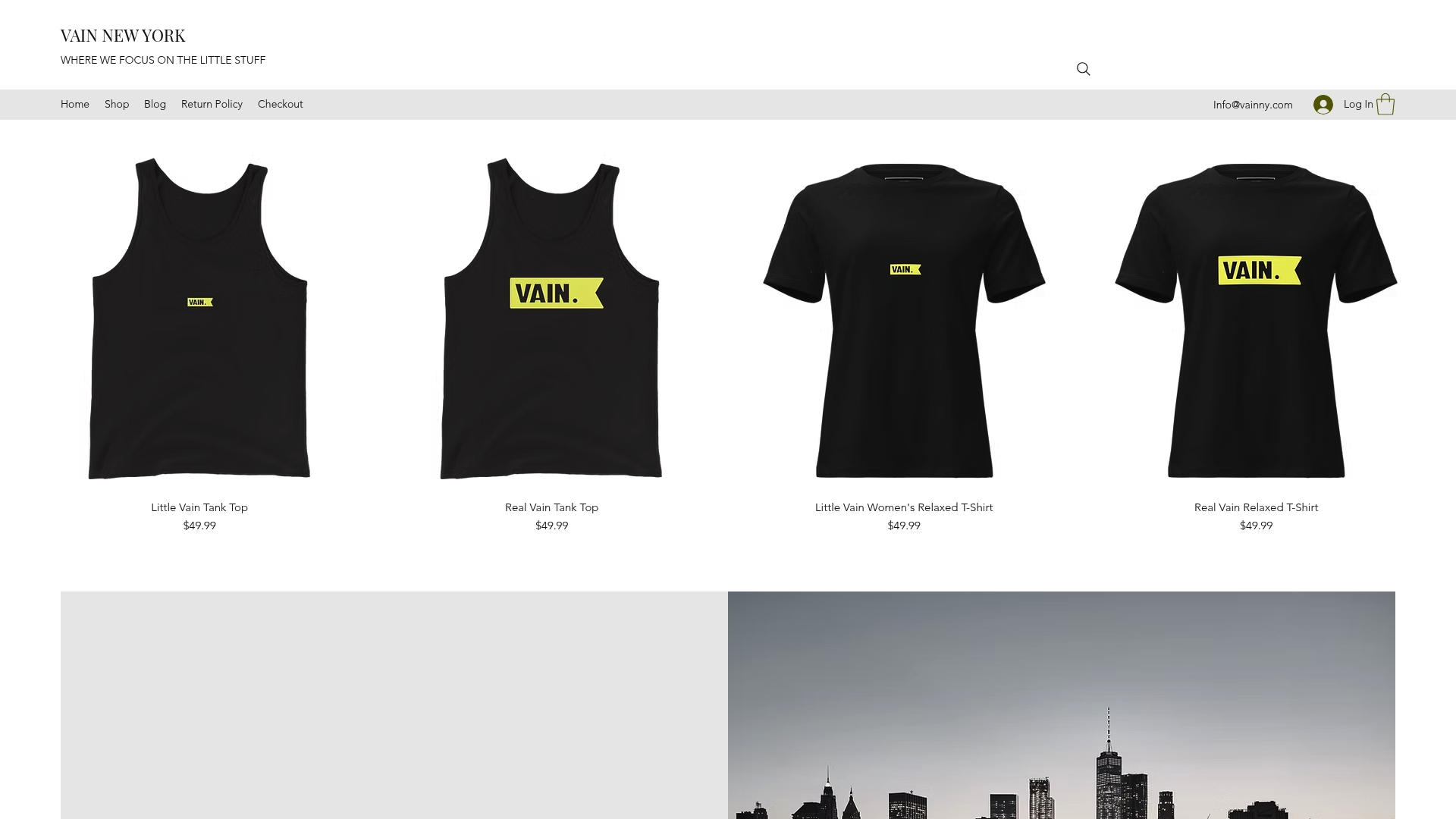
Vainnewyork works as a creative consultancy and production partner, helping brands develop the content, strategy, and visual identity needed to build recognition over time. From brand development to multi-channel content creation, the work is built around the principle that every touchpoint is an opportunity to deepen the impression your brand leaves. Browse the Vainnewyork shop to see how branded creative assets translate strategy into something your audience can see, hold, and remember.
FAQ
What is brand awareness in simple terms?
Brand awareness is how well consumers recognize and remember your brand without being prompted. It is the foundation of trust and the first step in every purchase decision.
How long does it take to build brand awareness?
Building meaningful brand awareness typically requires 12–24 months of consistent effort. Short, sporadic campaigns rarely sustain visibility once the spend stops.
What metrics measure brand awareness most accurately?
Unaided recall surveys, branded search volume, share of voice, and direct website traffic are the most reliable indicators. AI citation frequency is becoming a critical metric in 2026.
What is Generative Engine Optimization and why does it matter?
Generative Engine Optimization, or GEO, is the practice of structuring content so AI tools like ChatGPT cite your brand in their answers. Brands not optimized for AI risk invisibility even when they rank well on traditional search engines.
How does brand awareness affect pricing?
Brands with strong awareness command 13–25% price premiums over competitors with equivalent products. Consumers pay more for brands they recognize because recognition reduces perceived risk.
Recommended
Comments