5 Steps to License AI Music Safely for U.S. Campaigns

U.S. copyright law still requires human authorship for registration, which means fully AI-generated tracks generally cannot be copyrighted outright. Commercial use is safest when the music comes from a licensed platform, a label-backed deal, or a documented rights agreement. Training on copyrighted catalogs without permission remains legally exposed, so the smart move right now is simple: demand provenance, insist on a license, and treat watermarking as a feature, not an afterthought.
TL;DR:
Licensing for AI-generated music requires proof of proper training data rights, non-negotiable watermarking, and clear attribution to stay compliant.
Fully AI-created tracks without human input are unlikely to qualify for copyright protection, affecting enforcement options.
Recent deals like Suno’s partnership with BMG set industry benchmarks, but training on copyrighted catalogs without permission remains legally risky.
Collectives like STIM and guidance from organizations like ASCAP are moving toward licensing frameworks that include royalties and attribution for AI music.
Always verify training licenses, secure provenance data, and negotiate rights before using AI tracks in commercial projects to avoid infringement claims.
Table of Contents
Where U.S. Copyright Law Stands on AI-Generated Music
The U.S. Copyright Office has spent the past several years studying how artificial intelligence intersects with creative ownership, and its position remains genuinely unsettled. Human authorship is still the anchor requirement for registration, which draws a real line between AI-assisted music (a producer using AI to generate a stem, then arranging and mixing it with creative judgment) and fully AI-generated output with no meaningful human input. The former often qualifies for protection; the latter typically does not.
That gap has practical teeth. A track you can’t register can’t be enforced the same way against infringers, and platforms know it. This is why many labels, music supervisors, and sync agencies are taking a conservative stance. Federal agencies including the Copyright Office and the U.S. Patent and Trademark Office continue publishing guidance and soliciting comment on training data and scope of protection, so the rules governing AI in music copyright will keep shifting through 2026 and beyond.
How AI Music Licensing Actually Works
Licensing for AI-generated music splits into layers that get conflated constantly, and confusing them is where most legal exposure starts. A training-data license covers whether the model itself was legally trained on copyrighted recordings. An output or commercial-use license governs what you can do with a specific generated track. Performance and distribution rights sit on top of both, controlling where and how the finished piece can be broadcast, synced, or sold.
Before signing anything, check these contract elements:
Territory and term define where and how long your usage rights apply.
Royalty flow clarifies who gets paid when the track earns money downstream.
Indemnity clauses determine who absorbs liability if the output infringes someone else’s work.
Audit rights let you verify the vendor’s training claims if a dispute arises.
Attribution and watermarking requirements confirm the track’s origin and licensing status.
Some platforms are already building technical controls into the product itself. Suno, for instance, added watermarking and tiered usage limits directly in response to legal pressure, a sign that provenance tracking is becoming standard rather than optional. Treat the absence of these controls as a warning sign, not a minor omission.
What Recent Deals and Lawsuits Reveal About Market Direction
The clearest signal of where AI music licensing is heading came when Suno struck a licensing deal with BMG, part of a broader push toward label-backed models that pair AI generation tools with legitimately licensed catalogs. These deals matter because they set pricing benchmarks and signal to the market what “licensed” actually looks like in practice, even though the structures are still experimental.
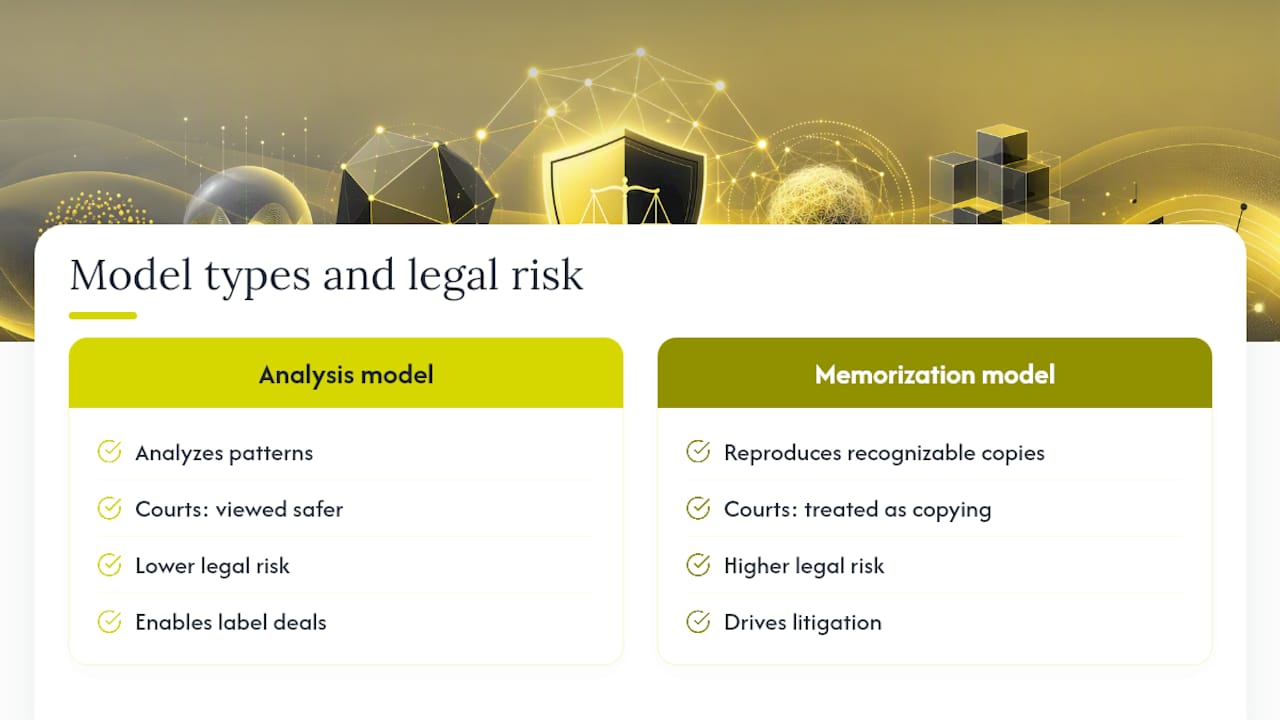
Litigation is drawing sharper legal lines in the meantime. A Munich regional court recently distinguished between a model analyzing music patterns and a model that memorizes and reproduces recognizable copies of existing recordings. Analysis tends to fall on safer legal ground; memorization looks a lot more like straightforward infringement. That distinction is spreading into U.S. arguments too, since courts here are wrestling with nearly identical questions about what a model actually “learned” versus what it copied outright. European rulings won’t bind American courts, but they’re shaping the arguments both sides are making here.
How ASCAP, BMI, and Global Collectives Are Responding
Performing-rights organizations aren’t sitting this one out. ASCAP and BMI have both issued guidance urging members to understand how AI tools use their catalogs, and both are actively exploring licensing frameworks rather than waiting for courts to settle every question. Internationally, CISAC has warned that unlicensed AI training could meaningfully erode creator revenue if left unaddressed, which is pushing collectives toward action instead of observation.
The most concrete example so far comes from Sweden, where STIM launched what it calls the world’s first collective AI license for music. Songwriters opt in voluntarily and receive royalties for both training and downstream generative use, with attribution technology tracking usage to make payment distribution possible.
For U.S. creators, this points toward a near future built on:
Opt-in decisions rather than blanket, non-negotiable terms.
Reciprocal royalty distribution once AI generation crosses borders.
Growing pressure on domestic collectives to build comparable frameworks.
How to License AI Music Safely for Commercial Projects
Clearing AI-generated music for a commercial project doesn’t have to be guesswork if you work through it in order.
Confirm the training license. Ask the platform directly whether its training data covers U.S. rights, and get that answer in writing, not just in marketing copy.
Require provenance metadata. Every track should carry a traceable record of its generation process, and watermarking should be non-negotiable for anything used commercially.
Verify audit rights. You want contractual language allowing you to review training claims if a dispute surfaces later.
Lock down downstream usage rights. Confirm sync, performance, and distribution rights explicitly cover your intended use, and negotiate indemnities before a single deliverable ships.
Structure royalties or fees clearly. Decide upfront whether you’re paying a flat license fee or ongoing royalties, and put it in the contract rather than a verbal understanding.
A checklist for content usage rights built for traditional media licensing applies almost line for line here, since the underlying legal risks (unauthorized reproduction, unclear scope, missing indemnities) haven’t actually changed just because a machine generated the track.
Pro Tip: If a vendor can’t answer a direct question about training data provenance within one email, treat that silence as your answer. Walk away before you build a campaign on unlicensed audio.
When in doubt, get counsel involved before launch, not after a takedown notice arrives. Unlicensed outputs used in a paid commercial context carry real exposure, and it’s far cheaper to pay a lawyer for an hour than to rebuild a campaign around infringement claims.
How Vain. Vets AI Music Vendors for Client Campaigns
Some production companies treat AI music licensing the same way as any rights question in production: verifying licensing before production. A vetting checklist may require documented licensing proof, active watermarking, clear attribution trails, and indemnity language before AI-generated tracks enter client deliverables.
On the production side, we map every use case (social cut, broadcast spot, in-store playback) against the license’s actual scope, because a track cleared for one channel isn’t automatically cleared for another. Metadata standards and rights tracking stay attached to the file through final delivery, not just at the pitch stage.
Pro Tip: Ask any production partner how they document AI music provenance before a campaign launches. If the answer is vague, the risk sits with you, not them.
What Happens Next in AI Music Licensing
Expect more label-backed deals like the Suno-BMG arrangement, alongside expanded collective licensing pilots following STIM’s lead. Attribution technology will keep maturing as the default expectation rather than a differentiator. Watch upcoming U.S. rulings on memorization versus analysis closely. Until courts settle that question domestically, contract protections and transparent provenance remain your best defense.
— Vain.
Vain. Helps Brands Produce Campaigns With Licensing-Safe AI Music
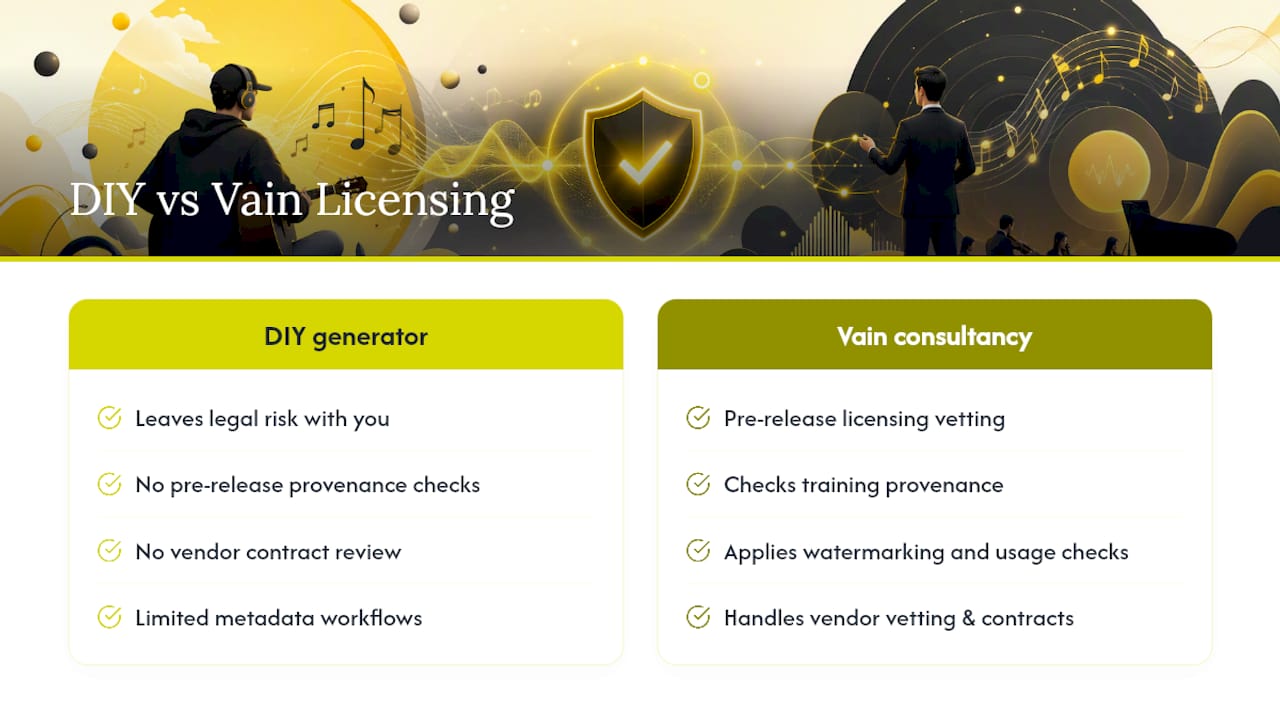
Vainnewyork gives creators and brands something most AI music platforms can’t: a production partner who vets the licensing before the track ever touches your campaign. Where a DIY generator leaves you holding the legal risk alone, working with our consultancy means someone is already checking training provenance, watermarking, and usage rights against your specific deliverables.
Some teams handle vendor vetting, contract review, and metadata workflows as part of broader creative production and strategy work for artists and brands, so licensing-aware sourcing can integrate with video, audio, and brand development. If you’re weighing artist partnerships or need help structuring rights language around AI-assisted work, our guide to artist brand development covers the contract fundamentals we build campaigns on. For attribution and traceability specifics, tools like Ilena’s AI transparency resources pair well with the provenance standards we require from vendors.
Ready to build a campaign on music you can actually defend? Reach out to Vain. and let’s map your production and licensing needs before you record a single track.
This article is general information, not a substitute for advice from a qualified lawyer. Consult a qualified legal professional about your own circumstances before acting on anything here.
Sources
FAQ
What Is the 30% Rule in AI?
There’s no single, universally recognized “30% rule” governing AI music or copyright in U.S. law. If you’ve seen the term used, it’s likely referring to informal industry shorthand rather than a Copyright Office standard, so don’t rely on it for legal decisions.
Can You Use AI Music Commercially?
Yes, but only safely when the track comes from a properly licensed platform, a label-backed deal, or documented rights clearance. Unlicensed AI output used commercially carries real infringement risk, particularly if the model memorized rather than analyzed source material.
Does ASCAP Accept AI-Generated Music?
ASCAP has issued guidance on AI and continues developing licensing frameworks rather than issuing a blanket acceptance or rejection. Human-authored or human-directed works generally fare better for registration and royalty distribution than fully autonomous AI output.
Is Suno Being Sued?
Suno has faced litigation pressure tied to unlicensed training data, which is part of why the company has added watermarking and usage limits and pursued label-backed deals like its BMG partnership. The legal landscape around the company continues to evolve alongside broader AI music litigation.
Recommended
Comments