What Does Media Mix Mean for Your Ad Strategy?


A media mix is defined as the strategic combination of channels used to reach target audiences efficiently and maximize return on investment. Understanding what does media mix mean gives marketing professionals and business owners a foundation for every advertising decision they make. The industry term “media mix” covers everything from TV spots and print ads to paid social and programmatic display. Media Mix Modeling (MMM) is the scientific method used to measure how each channel contributes to results. Together, these concepts form the backbone of modern advertising planning.
What does media mix mean and how is it defined?
A media mix is the deliberate allocation of your advertising budget across multiple channels to reach the right audience at the right moment. The formula is straightforward: Channel Percentage = (Channel Budget ÷ Total Media Budget) × 100. That calculation tells you exactly how much weight each channel carries in your overall plan. A brand spending $200,000 total with $50,000 on paid search is running a 25% paid search allocation.

The media mix definition goes beyond a simple list of platforms. It is a risk diversification strategy that keeps your brand visible even when one channel underperforms. Think of it the way a financial advisor thinks about a portfolio. Concentrating everything in one asset is a gamble, not a plan.
What are the main types of media channels in a mix?
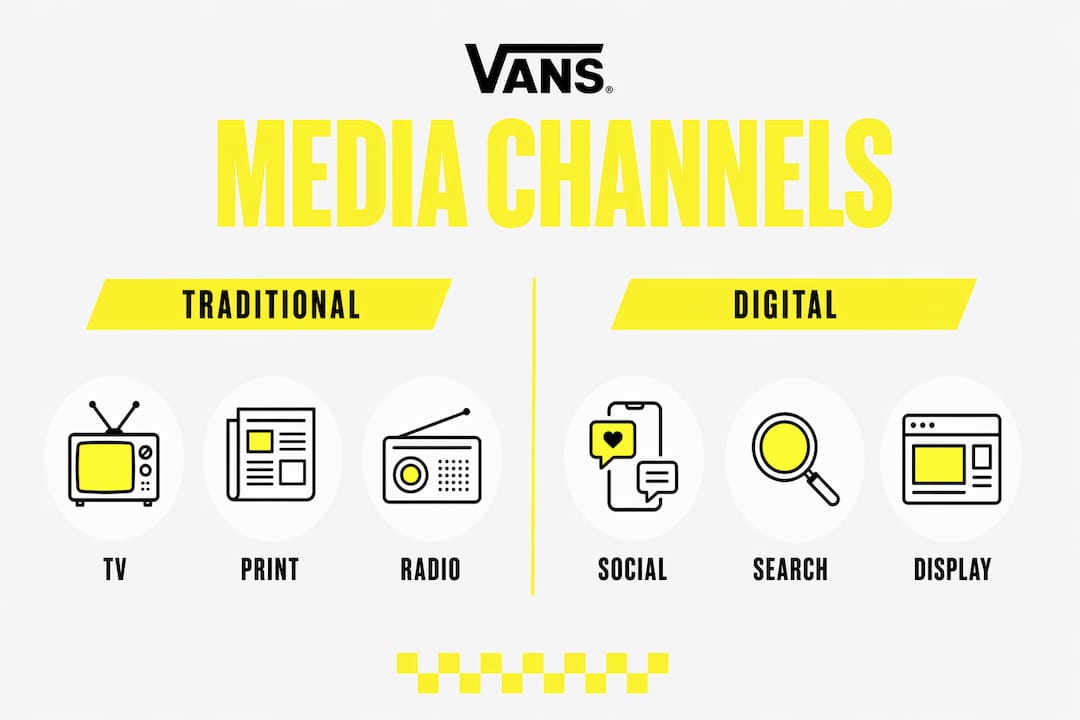
Media channels split into two broad families: traditional and digital. Each serves a distinct role in reaching buyers at different stages of their journey.
Traditional media channels include:
Television: builds mass awareness and emotional connection at scale
Radio: delivers frequency and local targeting at relatively low cost
Print (newspapers, magazines): reaches engaged, niche audiences with longer attention spans
Out-of-home (billboards, transit): provides geographic saturation and brand reinforcement
Digital media channels include:
Paid search (Google Ads, Microsoft Advertising): captures demand at the moment of intent
Paid social (Meta, TikTok, LinkedIn): targets by behavior, interest, and demographic profile
Programmatic display and video: automates buying across thousands of publisher sites
Email marketing: re-engages existing audiences with high conversion efficiency
Connected TV (CTV) and streaming audio: bridges the gap between traditional broadcast and digital targeting
A media mix strategy integrates these types to create synergy across the full customer journey. A practical example: TV builds awareness, YouTube review content deepens consideration, and Instagram ads close the sale. No single channel does all three jobs equally well. Channel synergy is what separates a coordinated campaign from a collection of disconnected ads.
How does media mix modeling measure channel effectiveness?
Media Mix Modeling (MMM) uses aggregated historical time-series data and regression analysis to estimate the incremental contribution of each channel to overall business outcomes. It does not rely on cookies or user-level tracking, which makes it durable in a privacy-first advertising environment. MMM answers the question every CFO asks: “Which channels are actually driving revenue?”
The methodology works through four core steps:
Collect historical data. Gather weekly or monthly spend, impressions, and sales data across all channels, typically covering two or more years.
Build the regression model. The model isolates each channel’s contribution while controlling for seasonality, pricing changes, and external market factors like economic shifts.
Identify diminishing returns. As channel spend increases, incremental return typically declines. MMM maps the saturation point for each channel so you know when additional spend stops paying off.
Calibrate with incrementality tests. Running controlled experiments, such as geo-based holdout tests, validates that the model captures true causation rather than coincidence.
Advanced MMM frameworks integrate data from over 300 media platforms to calibrate results. That breadth matters because a model built on incomplete data produces incomplete recommendations.
MMM also outperforms multi-touch attribution (MTA) for portfolio-level budget guidance because it captures long-term brand effects and external market impacts that MTA simply cannot see. MTA is granular and session-level. MMM is strategic and longitudinal. Both have a place, but MMM drives the big budget decisions.
Pro Tip: Distinguish between correlation-based MMM and causal MMM. Causal MMM replaces correlation with causation by integrating incrementality testing, producing far more reliable budget recommendations. Correlation-based models can tell you two things move together. Causal models tell you which one is actually driving the other.
Why does balancing your media mix matter for campaign success?
A well-balanced media mix is a risk mitigation tactic that prevents overdependence on any single channel. When one platform changes its algorithm, raises its CPMs, or suffers an outage, a diversified mix keeps your campaigns running. Brands that concentrate 80% or more of their budget in one channel are one policy change away from a serious revenue problem.
Diminishing returns are the hidden cost of imbalance. Every channel has a saturation point where additional spend produces progressively smaller gains. Incrementality tests and MMM help you map those saturation curves and shift budget to channels with higher marginal ROI before you waste money on the flat part of the curve.
Scenario | Risk level | Likely outcome |
90% budget on one channel | High | Vulnerable to platform disruption and rapid CPM inflation |
60/40 split across two channels | Moderate | Better resilience but still limited audience coverage |
Diversified mix across 4+ channels | Low | Consistent brand presence and stable blended ROAS |
MMM-guided allocation with testing | Lowest | Data-driven spend with diminishing returns accounted for |
Optimization is not a one-time event. Baseline allocation is adjusted by performance data over time, using metrics like cost per acquisition (CPA) and return on ad spend (ROAS) as the primary dials. A media mix that worked in Q1 may need rebalancing by Q3 as competitive pressure and consumer behavior shift.
Pro Tip: Set a quarterly review cadence for your media mix. Pull ROAS and CPA by channel, compare against your MMM benchmarks, and reallocate budget away from saturated channels before the next flight launches. Waiting for annual planning cycles means leaving money on the table for months.
How to create a media mix strategy that actually works
Building an effective media mix strategy starts with defining your campaign objective before touching a budget spreadsheet. Awareness campaigns weight reach and frequency. Conversion campaigns weight cost efficiency and intent signals. The objective determines the channel weighting, not the other way around.
A practical framework for developing your media mix:
Start with industry benchmarks. Research how brands in your category typically allocate spend across channels. These benchmarks give you a defensible starting point and a baseline to beat.
Define your audience segments. Different segments live on different platforms. A B2B audience skews toward LinkedIn and industry publications. A Gen Z consumer audience skews toward TikTok and YouTube.
Allocate budget using the channel percentage formula. Assign initial weights based on your objective, then stress-test each allocation against historical performance data.
Integrate traditional and digital channels. TV and digital video together consistently outperform either channel alone in awareness metrics. Print and paid search together can reinforce consideration for high-consideration purchases.
Run incrementality tests on your top two or three channels. Geo-based holdout experiments confirm which channels are genuinely driving conversions versus simply appearing in the path.
Align creative messaging across channels. A media mix with mismatched creative undermines the synergy you built through channel selection. The message must feel coherent whether a buyer sees it on a billboard or an Instagram Story.
Competitor activity belongs in your planning process too. If a major competitor is saturating paid search, your marginal return on that channel drops. Monitoring share of voice by channel helps you find gaps where your budget works harder. Tools like brand collaborator strategies can also extend your media reach without proportionally increasing your paid spend.
MMM insights and incrementality testing should feed directly into your next planning cycle. The benefits of media mix modeling compound over time as your historical dataset grows and your model becomes more accurate. A brand running MMM for three years has a significant analytical advantage over one starting fresh.
Key Takeaways
A well-executed media mix combines channel diversification, causal measurement through MMM, and continuous budget reallocation to produce the most reliable advertising ROI.
Point | Details |
Core definition | A media mix is the percentage-based allocation of budget across multiple channels to maximize reach and ROI. |
Channel synergy | Combining TV, digital, and social channels covers the full buyer journey in ways no single channel can. |
MMM advantage | Media Mix Modeling uses historical data and regression analysis to isolate each channel’s true incremental contribution. |
Causal over correlation | Causal MMM calibrated with incrementality tests produces more reliable budget decisions than correlation-based models. |
Continuous optimization | Quarterly reviews using CPA and ROAS data keep your media mix aligned with current market conditions and saturation points. |
Why causal MMM changed how I think about media planning
The honest truth about media mix strategy is that most brands are still flying partially blind. They look at last-click attribution, see that paid search converts well, and pour budget into it. What they miss is that the TV campaign running upstream is doing the heavy lifting on brand awareness, and without it, the paid search conversion rate would collapse. I have seen this pattern repeatedly, and it is one of the most expensive misreadings in advertising.
Causal MMM is what finally gives marketers a credible answer to the question of what is actually driving growth. The shift from correlation to causation sounds academic, but the budget implications are real. When you know that a channel is genuinely incremental, you can defend that spend to a CFO with confidence. When you discover a channel is riding the coattails of another, you can reallocate without fear.
The future of media mix planning belongs to teams that integrate machine learning into their MMM frameworks while keeping the fundamentals intact: clean time-series data, proper incrementality calibration, and a willingness to act on what the model tells you even when it contradicts intuition. Branding agencies that specialize in data-driven media planning are increasingly building these capabilities in-house, which raises the bar for everyone.
The biggest pitfall I see is ignoring diminishing returns until it is too late. Brands ride a channel past its saturation point because the absolute numbers still look good, even as the marginal return quietly collapses. Build saturation curve reviews into your quarterly cadence and you will catch this before it costs you.
— Neville
How Vainnewyork supports your media mix execution
Vainnewyork is built for brands that take their creative and marketing strategy seriously. We understand that a great media mix needs more than a spreadsheet. It needs content that performs across every channel in the plan, from social assets to brand-defining visual work that holds attention wherever your audience finds it.
Our shop carries creative brand assets and merchandise designed to extend your brand presence beyond the screen. Whether you are building awareness through physical touchpoints or reinforcing your identity across digital channels, the right branded materials make your media mix work harder. Explore the Vainnewyork shop and find what your next campaign is missing. Every piece we create is made to make the ordinary extraordinary.
FAQ
What is a media mix in simple terms?
A media mix is the combination of advertising channels, such as TV, social media, search, and print, that a brand uses together to reach its audience. Each channel is assigned a percentage of the total media budget based on campaign goals.
How is media mix different from marketing mix?
The marketing mix covers the four Ps: product, price, place, and promotion. The media mix is a subset of the promotion element, focusing specifically on which channels carry the advertising message.
What does media mix modeling do?
Media Mix Modeling uses historical spend and sales data to calculate how much each channel contributed to business outcomes. It accounts for seasonality, diminishing returns, and external market factors that simpler attribution tools miss.
Why is a balanced media mix important?
A balanced media mix prevents overdependence on one channel, which protects campaigns from platform disruptions and CPM spikes. It also ensures consistent brand presence across every stage of the buyer journey.
How often should you update your media mix strategy?
A quarterly review cadence is the standard best practice. Reviewing CPA and ROAS by channel every quarter lets you reallocate budget away from saturated channels before performance declines become costly.
Recommended
Comments