Film Production: A Complete Stage-by-Stage Guide

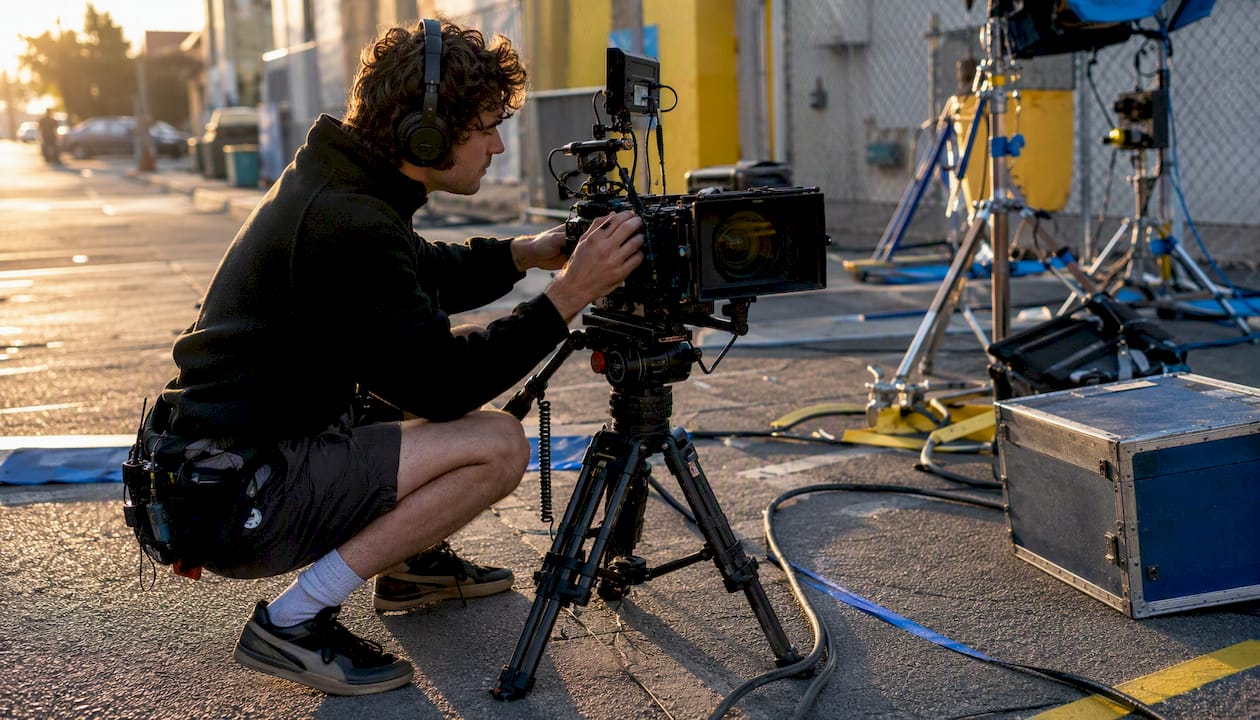
Film production is the structured process of turning a script or idea into a finished motion picture through a sequence of stages: Development, Financing, Pre-production, Production (principal photography), Post-production, and Distribution/Marketing. According to Britannica, each stage produces distinct deliverables that feed directly into the next. Here is the process at a glance:
Development — producer and writer; deliverable: polished screenplay and market strategy
Financing — producer and executive producer; deliverable: locked budget and funding agreements
Pre-production — production manager and 1st AD; deliverable: shooting schedule, cast, and crew
Production — director and DP; deliverable: camera footage and production reports
Post-production — editor and post supervisor; deliverable: picture lock and final masters
Distribution/Marketing — distributor and sales agent; deliverable: released film and audience
The producer drives the business logic across every stage. The director owns the creative vision from pre-production through post. The 1st AD runs the set. The editor assembles the picture. The distributor gets it to audiences.
Table of Contents
What actually happens at each stage of the movie making process
Understanding what each stage produces — and which decisions become expensive to reverse — is the most practical thing a new producer or filmmaker can learn. The NYFA’s 7-stage model adds “Exhibition” as a final stage after distribution, but the five-to-six stage framework below reflects the standard working model across US productions.
Development
Development is where the idea becomes a viable project. The producer or writer identifies a concept, secures the underlying rights or intellectual property (optioning a novel, for example, or registering an original script), and develops the material through treatments and successive script drafts. Attaching a director or a name actor at this stage can make the project financeable. Early budget estimates and a market strategy — who is the audience, what platform or distributor would want this — are drafted here, not later.
The critical deliverable is a polished, production-ready screenplay paired with a one-page pitch document and a preliminary budget range. Without those, financing conversations stall.
Financing
Financing is where the project becomes real money. Common US sources include private equity investors, film tax incentives (many states offer production tax credits that can cover 20–30% of qualifying spend), pre-sales to distributors, grants from organizations like the Sundance Institute or the IDA for documentary work, and crowdfunding platforms. The producer’s job is to stack these sources until the budget is covered, then lock the financing before committing to a shoot date.
The deliverable here is a signed financing agreement or a collection of them, alongside a chain-of-title document proving the producer controls the rights to the material.
Pre-production
Pre-production commonly takes three to six months on feature productions, and that investment pays off during the shoot. This is where the script is broken down scene by scene, storyboards are drawn, the shooting schedule is built, and every department head is hired. Casting is finalized, locations are scouted and agreements signed, and production insurance is placed. The 1st AD builds the shooting schedule around location availability, actor availability, and equipment needs rather than script order — a discipline that demands precise continuity planning.
Nothing should be ambiguous on day one of principal photography. If it is, the production pays for that ambiguity in overtime, reshoots, and post-production fixes. Investing in prep reduces costs and errors downstream — this is one of the most consistent findings across production guides and practitioner accounts.
Key pre-production deliverables:
Locked shooting schedule and call sheets template
Signed cast and crew contracts
Location agreements and permits
Production design package (sets, props, wardrobe breakdown)
Shot list and storyboards per scene
Insurance certificates and completion bond (if required)
Production (principal photography)
Production is the most expensive stage per day, and every hour on set costs money whether or not the camera is rolling. The daily workflow runs on call sheets issued the night before, which tell every department where to be and when. The director and DP work through the shot list while the 1st AD manages time. A script supervisor tracks continuity across takes and setups. At the end of each day, dailies (raw footage) are reviewed by the director and producer.
Filming is almost always nonlinear: scenes are shot in the order that makes logistical sense, not script order. All the scenes in one location are shot together, regardless of where they fall in the story. Coverage — shooting a scene from multiple angles and distances — gives the editor the material to build the scene in post.
One scheduling reality that surprises newcomers: a one-minute scene often requires multiple hours to film because of lighting setups, multiple takes, and coverage requirements. Budget your shoot days accordingly.
Production deliverables include camera reports, sound reports, script supervisor notes, production reports, and all raw media properly labeled and backed up.
Post-production
Post begins with the assembly cut, where the editor places every selected take in script order. From there, the cut is refined through rough cut, fine cut, and eventually picture lock — the point at which no further editorial changes are made. After picture lock, sound editing begins in earnest: dialogue editing, Foley (recreating ambient and physical sounds), ADR (automated dialogue replacement for lines that did not record cleanly), sound design, and the final mix. Music is scored or licensed and mixed into the soundtrack. Color grading shapes the film’s visual tone. VFX shots are completed and composited. The final deliverables are mastered to the specs required by the distributor or platform.
Post timelines vary widely. A micro-budget short might wrap post in weeks. A mid-range feature with moderate VFX typically takes six to twelve months. A studio film with extensive visual effects can take two years or more.
Distribution and marketing
Major studios today function primarily as financiers and distributors; most actual production work is handled by independent production companies or project-specific production units. For independent films, the distribution path typically runs through film festivals (Sundance, Tribeca, SXSW) to attract sales agents, who then negotiate deals with theatrical distributors, streaming platforms (SVOD), or ad-supported platforms (AVOD).
Marketing deliverables required by most platforms include a trailer, a key art package (poster, thumbnail images), a press kit, closed captions, and metadata files. Theatrical delivery requires a DCP (Digital Cinema Package). Streaming platforms typically require a ProRes or IMF master with specific audio and subtitle specs.
Stage-by-stage deliverables at a glance
Stage | Primary deliverables |
Development | Screenplay, pitch deck, preliminary budget, chain-of-title |
Financing | Financing agreements, investor decks, rights documentation |
Pre-production | Shooting schedule, signed contracts, location permits, shot list |
Production | Raw footage, camera/sound reports, script supervisor notes, production reports |
Post-production | Picture lock, final mix, color grade, VFX composites, delivery masters |
Distribution/Marketing | DCP or digital master, trailer, key art, press kit, platform metadata |
Who does what: core departments and roles on a production
Every department on a film set maps to a specific set of deliverables. Producers handle business and contracts. The director owns the creative vision. The DP (director of photography) builds the image. The editor assembles the picture. Understanding that map before you staff a production saves you from expensive gaps and overlapping authority.
The production office
The production office is the administrative backbone of the project. The UPM (Unit Production Manager) controls the budget and schedule on behalf of the producer. The 1st AD runs the set and is responsible for keeping the day on schedule. The 2nd AD manages the talent, coordinates background performers, and issues call sheets. Production assistants (PAs) support every department.
Camera, lighting, and grip
The DP makes every visual decision about camera placement, lens choice, and lighting approach. The gaffer (chief lighting technician) executes the DP’s lighting design with the electrical crew. The key grip manages the camera support and rigging equipment. Together, the G&E (grip and electric) department shapes the film’s visual language, from chiaroscuro shadows to bright naturalistic exteriors.
Sound
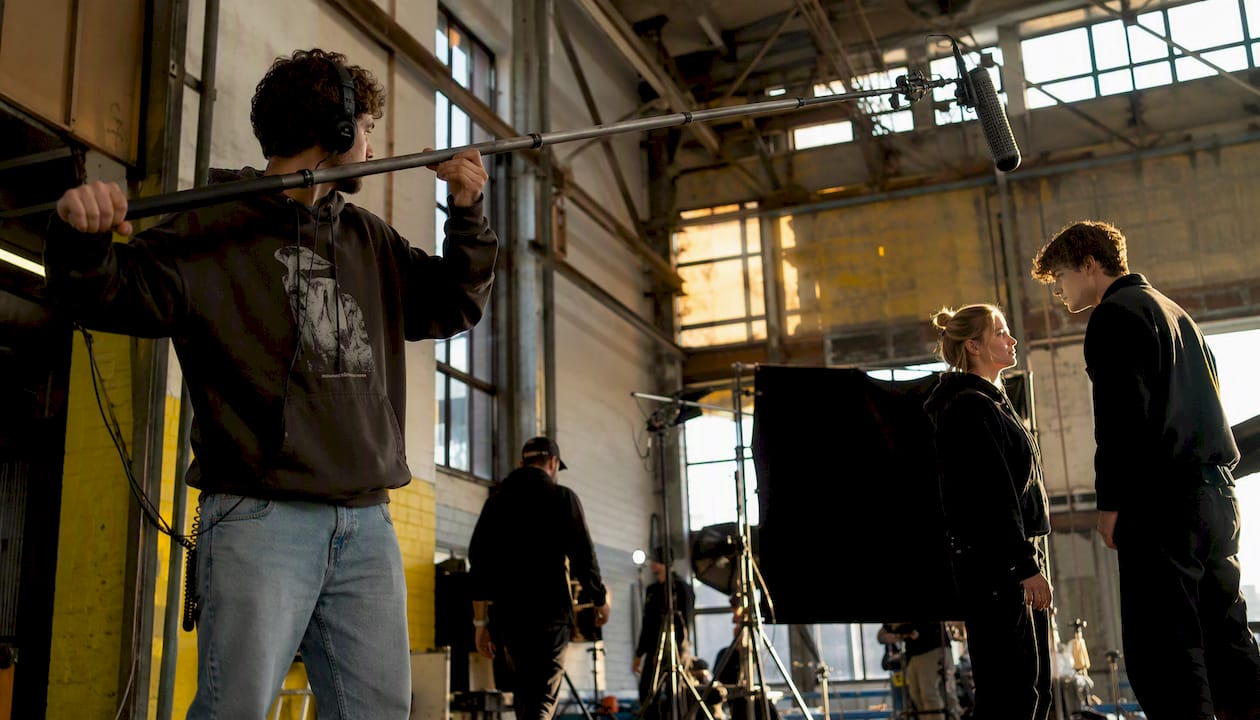
The production sound mixer records clean dialogue and room tone on set. The boom operator places the microphone. Clean production sound is one of the most cost-effective investments a low-budget production can make — bad audio is far more noticeable to audiences than imperfect visuals, and ADR is expensive.
Art, production design, and wardrobe
The production designer creates the visual world of the film: sets, locations dressed to period or concept, and the overall aesthetic. The art director executes that vision. Wardrobe, hair, and makeup departments handle character appearance and continuity across shooting days.
Editorial and post departments
The editor is the film’s final storyteller, shaping performance and pacing from the raw footage. The post supervisor manages the technical pipeline from picture lock through delivery. VFX supervisors work on set during production and in post during compositing. Sound post includes the supervising sound editor, sound designers, Foley artists, and the re-recording mixer who delivers the final mix.
The chain of command matters as much as the talent. On set, the 1st AD is the director’s operational partner — every department head reports through the AD during the shooting day. Off set, department heads report to the UPM. The producer sits above both and is the final authority on budget and schedule decisions. Knowing who has authority over what prevents the costly confusion that derails productions.
For a deeper look at how these departments interact, Vainnewyork’s breakdown of film production departments is worth reading alongside this guide.
Priority hires for a new producer, in order:
Director (if not already attached)
UPM / Line Producer
1st AD
DP
Production Designer
Production Sound Mixer
Editor (ideally involved from pre-production)
How budgets are built and what timelines look like by production scale
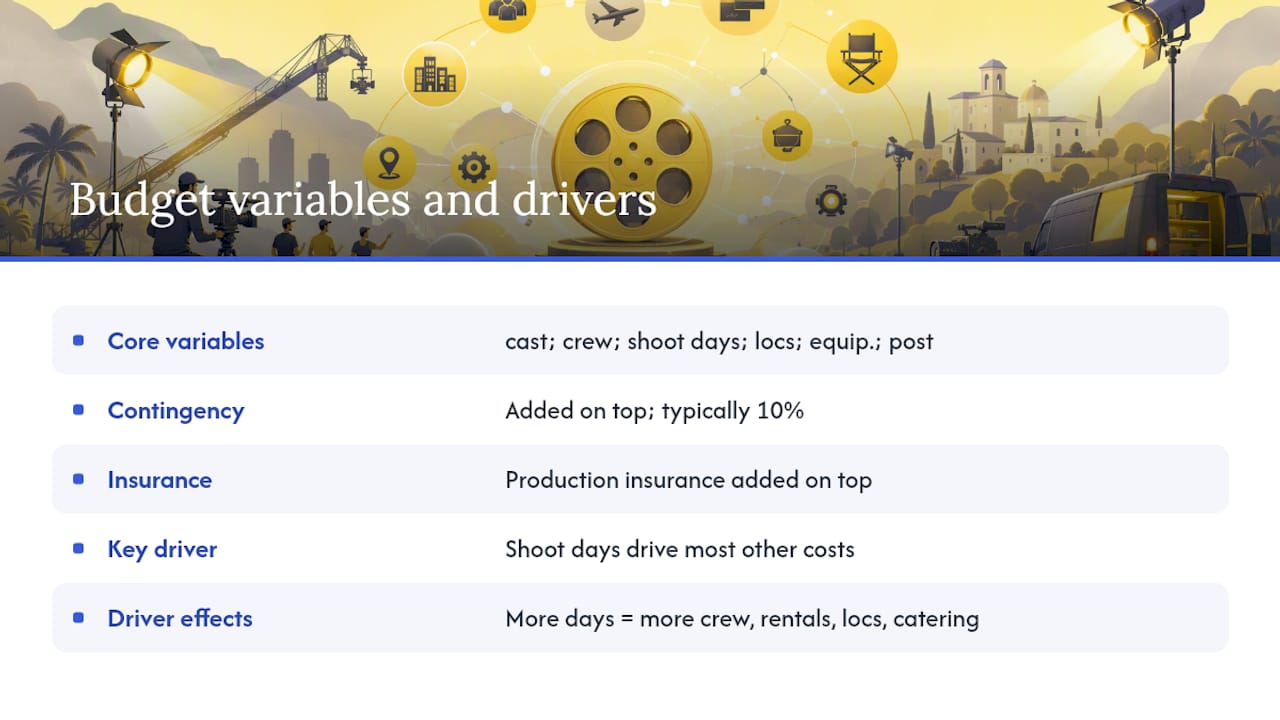
Budgets are built around six core variables: cast, crew, shoot days, locations, equipment, and post. Add contingency (typically 10%) and production insurance on top. The order matters because shoot days drive almost everything else — more days mean more crew, more equipment rentals, more location fees, and more catering.
Budget tiers
Tier | Typical range | Defining characteristics |
Micro-budget | — | Skeleton crew, deferred pay, owned or borrowed equipment, minimal post |
Low-budget indie | — | Small union or non-union crew, limited locations, basic VFX |
Mid-range | $1 million–$20 million | Full union crew, multiple locations, moderate VFX, completion bond |
Studio / major | $20 million and above | Full studio infrastructure, star cast, extensive VFX, global P&A spend |
Timeline by production scale
Stage | Micro-budget | Low-budget indie | Mid-range feature | Studio film |
Development | 1–3 months | 3–6 months | 6–12 months | 1–3 years |
Pre-production | 2–4 weeks | 6 weeks | 3–6 months | 6–12 months |
Production | 1–2 weeks | 3–5 weeks | — | 10–20 weeks |
Post-production | — | — | 6–12 months | two years or more |
Distribution | Ongoing | Ongoing | Ongoing | Ongoing |
These ranges align with the Wikipedia filmmaking overview’s documented norms for pre-production (3–6 months on many features) and production (weeks to months depending on scale).
Pro Tip: Two budget choices that most reliably reduce total cost without harming production value: shoot fewer days with a tighter schedule (requires more prep), and hire your editor before production ends so they can flag coverage gaps while reshoots are still possible.
For practical guidance on managing the production office and budget controls, Vainnewyork’s production management playbook covers scheduling and cost-tracking in detail.
Technical workflows and the deliverables distributors actually expect
Plan your technical workflow before you choose a camera. The codec you shoot in and the audio format you record determine your entire post pipeline — and changing either mid-production is expensive and disruptive.
Picture lock, stems, and final masters
Picture lock is the editorial milestone after which no changes are made to the cut. Everything downstream — sound mix, color grade, VFX compositing, music spotting — is built on the locked picture. Changing the cut after picture lock requires redoing work in every downstream department, which is why locking the picture before post begins in earnest is a hard professional standard.
After picture lock, the sound team works from an AAF or OMF export from the editing system (Avid Media Composer, Adobe Premiere Pro, or DaVinci Resolve are the standard US tools). The colorist works from an EDL or XML that references the original camera files. Final audio deliverables include a 5.1 surround mix, a stereo mix, and M&E stems (music and effects without dialogue, required for international distribution).
Common codecs and containers
Format | Use case | Notes |
ProRes or IMF master | Editing and delivery master | Apple’s standard; widely accepted by US streaming platforms |
DNxHR | Editing and archival | Avid’s equivalent to ProRes; common in broadcast workflows |
— | Streaming delivery and screeners | Compressed; not ideal for mastering but standard for online distribution |
IMF (Interoperable Master Format) | Studio and major platform delivery | Netflix, Amazon, and major studios require IMF packages for high-end content |
DCP (Digital Cinema Package) | Theatrical delivery | Required for cinema exhibition; encoded in JPEG |
Pre-delivery checklist
Picture lock confirmed and signed off by director and producer
Final mix delivered in all required formats (5.1, stereo, M&E)
Color grade completed and approved
Closed captions and subtitles prepared
Textless backgrounds (title cards without text, for international versioning)
Chain-of-title and E&O insurance certificate
Music cue sheet with all licensing documentation
Pro Tip: Adopt one disciplined file-naming convention on day one of production — scene number, camera, take, date — and enforce it across every department. Productions that skip this spend days in post reconstructing what was shot where.
For a deeper look at the tools shaping modern workflows, Vainnewyork’s production technology guide covers the software and hardware landscape in practical terms.
Key Takeaways
Film production succeeds when creative vision and commercial planning run together from development through distribution, with each stage producing locked deliverables that feed the next.
Point | Details |
Stage sequence is non-negotiable | Development, Financing, Pre-production, Production, Post-production, and Distribution each produce deliverables the next stage depends on. |
Prep time pays for itself | Pre-production on features commonly runs 3–6 months; time invested there reduces expensive fixes during the shoot and in post. |
Shoot days drive the budget | Cutting one shoot day often saves more than any other single budget decision across cast, crew, equipment, and locations. |
Picture lock is a hard milestone | Every downstream department (sound, color, VFX) builds on the locked cut; changing it after lock multiplies costs across all of them. |
Vainnewyork covers the full pipeline | Vainnewyork offers creative development, production management, post supervision, and distribution strategy for projects at any scale. |
What we actually believe about how films get made
The conventional wisdom in most filmmaking guides is that the director is the film. The auteur theory has its place, but from a production standpoint, it can be genuinely misleading for anyone trying to get a project made and seen.
The most underestimated figure in film production is the producer. Not the executive producer whose name appears because of a financing relationship, but the working producer who locks the script, builds the budget, hires the team, manages the shoot, and then navigates distribution. That person is the reason the film exists at all. The director shapes what it looks like. The producer determines whether it gets finished.
We also think the industry underestimates how much the distribution decision should shape the production decision. Too many independent filmmakers spend their entire budget making the film and have nothing left for marketing, festival submissions, or the deliverables a distributor requires. A film that cannot afford its DCP or its E&O insurance cannot get into theaters. A film that was not shot to streaming platform specs requires expensive remediation before delivery. These are not afterthoughts; they are production decisions that belong in the development stage.
The other thing worth saying plainly: modern digital tools have genuinely lowered the barrier to production. Small teams can now handle end-to-end production at a quality level that was impossible a decade ago. But financing, distribution, and marketing remain the hard problems. The camera is the easy part.
Vainnewyork brings creative vision and production discipline together
When you are ready to move a project from idea to finished picture, the gap between creative ambition and commercial execution is where most productions struggle. Vainnewyork closes that gap by combining creative development, production management, and distribution strategy under one roof — so you are not assembling three separate teams and hoping they communicate.
Our services span the full production pipeline: creative development and script consulting, production management and scheduling, post-production supervision, distribution strategy, and marketing and audience growth. Whether you are producing a branded content series, an independent feature, or a documentary, we bring the same producer-first discipline to every project — defining the audience, mapping the revenue model, and building the production plan before a dollar is committed to the shoot.
Visit Vainnewyork to start a conversation about your project and find out how we approach production from development through delivery.
Further reading and authoritative sources
These are the sources and internal resources worth bookmarking for deeper study, organized by the follow-up task they serve best.
For canonical stage definitions and deliverables:
For stage-by-stage teaching and the 7-stage model:
Mastering the 7 Stages of Film Production | NYFA — adds exhibition as a distinct stage; useful for educational and festival-track projects
The Beginner’s Guide to the Filmmaking Process | NYFA — practical scheduling reality, including the five-plus hours per screen minute benchmark
For pre-production planning and the cost of skipping prep:
Pre-Production vs Production vs Post-Production | Storyflow — the most direct treatment of why prep investment reduces downstream cost
For production workflow and practical set guidance:
The World of Film Production | LA Film School — covers coverage, dailies, and the nonlinear shooting workflow
Film Production | ScienceDirect — frames film as an integrated economic and creative system
For studio and distribution context:
Major Film Studios | Wikipedia — explains the modern studio model and the role of independent production companies
Vainnewyork internal resources:
What Does Media Production Mean? — foundational overview of media and film production as art and business
Video Production: A Complete Guide for Professionals — technical and workflow depth for the production and post stages
Creator Workflows: Your 2026 Guide to Smarter Production — practical process templates for independent and small-team productions
Recommended
Comments