Startup Growth: A Practical Playbook for Founders


Startup growth is the sustained increase in paying customers or revenue that validates product-market fit and unlocks repeatable scale. Before you read another framework, act on these three priorities: measure your weekly growth rate today, confirm you have 12–18 months of runway in the bank, and design one high-probability experiment to run this week.
Your 24–72 hour checklist:
Calculate last week’s revenue or active-customer count and compare it to the week before. That number is your compass.
Open your burn model and confirm your runway. If it’s under 12 months, fundraising moves to the top of your agenda.
Write a one-sentence hypothesis for your next growth experiment and assign an owner before end of day.
Everything else in this guide builds on those three moves.
Key Takeaways
Startup growth is the sustained increase in paying customers or revenue that validates product-market fit, and the founders who grow fastest are those who measure weekly, experiment deliberately, and scale only what’s already proven.
Point | Details |
Measure weekly growth rate | Paul Graham cites 5–7% weekly as solid and 10% as exceptional for early-stage startups. |
Plan runway of 18–24 months | Carta data shows longer runway planning (24–30 months) has become more common as fundraising timelines lengthen. |
Validate before scaling | Confirm retention flattens and LTV:CAC exceeds 3:1 before increasing acquisition spend. |
Run disciplined experiments | Use the hypothesis-metric-sample-timeline template to produce reliable learning, not just activity. |
Automate early | Rippling recommends automating HR and finance before headcount grows to prevent bottlenecks. |
Vainnewyork for creative growth | Vainnewyork builds the brand, content, and audience development systems that make growth sustainable. |
Table of Contents
Why startup growth is the defining objective for founders
Paul Graham’s essay Startup = Growth makes the case plainly: a startup is not simply a young company. It is a company designed to grow fast. That single distinction reshapes every decision a founder makes, from which metrics to track to how much capital to raise to when to hire.
The practical consequences of that framing are significant. If growth is the objective, then revenue, headcount, and age are only meaningful as proxies for it. A five-year-old company with flat revenue is not a startup. A six-month-old company growing 8% week-over-week absolutely is.
For early-stage founders, this translates into three concrete operating principles:
Metrics: Track weekly growth rate above all other numbers. Monthly figures hide the signal; weekly data forces honest assessment.
Capital: Raise to fuel growth milestones, not to extend comfort. Investors fund the next stage of growth, not the current one.
Hiring: Add people when a specific growth bottleneck demands it, not because the calendar says it’s time to build a team.
The investor expectation that follows from Graham’s framing is equally direct. Venture capital is structured around power-law returns, which means investors need portfolio companies to grow fast enough to return the fund. A startup that grows at 2% per week compounds to roughly 2.8x in a year. One growing at 7% weekly compounds to more than 33x. That gap explains why investors care so deeply about growth rate at the earliest stages, and why founders who cannot articulate their weekly or monthly growth trajectory struggle to raise.
What should you prioritize at each startup growth stage?
Startup growth does not follow a single playbook from day one to IPO. The priorities, metrics, and funding signals shift meaningfully at each stage, and founders who apply Series A thinking to a pre-seed company waste time and capital on the wrong problems.
The Zyro four-stage scaling model maps systems, team, offers, and capital to revenue bands, giving founders a practical way to assess where they are and what to build next.
Stage | Primary Focus | Top 3 KPIs | Runway / Funding Signal | Hiring Priority |
Pre-seed | Problem validation, first paying customers | Customer interviews completed, conversion rate from interest to payment, weekly active users | Personal savings or friends-and-family; 6–12 months | Founder-only or one technical co-founder |
Seed | Product-market fit, repeatable acquisition | Weekly growth rate, churn rate, CAC payback period | $500K–$3M raised; 12–18 months runway | First growth or product hire |
Early traction | Channel validation, unit economics | MRR growth rate, LTV:CAC ratio, retention cohorts | Bridge or Series A prep; 12–18 months | Sales, customer success |
Series A / Growth | Scaling proven channels | ARR, net revenue retention, payback period | $5M–$15M raised; 18–24 months runway | Department leads, ops |
Expansion / Maturity | New markets, operational efficiency | Revenue per employee, gross margin, NPS | Growth equity or profitability path | Functional specialists |
Signals that you’re ready to move to the next stage:
Pre-seed to seed: at least 10 paying customers who found you without a personal relationship, and a clear hypothesis for repeatable acquisition.
Seed to early traction: three consecutive months of consistent weekly growth, a CAC payback period under 18 months, and a retention curve that flattens rather than drops to zero.
Early traction to Series A: a single channel driving more than 50% of new customers predictably, LTV:CAC above 3:1, and a team capable of executing without the founder in every conversation.
Which growth strategy fits your stage and model?
Choosing the wrong strategy for your stage is one of the most common and costly mistakes in accelerating startup growth. Paid acquisition before you understand unit economics burns cash without learning. Organic content before you have a repeatable product story produces traffic that doesn’t convert.
LivePlan’s stepwise approach frames this well: determine your value proposition, validate market need, choose channels, measure, and iterate. The channel choice is stage-dependent, not permanent.
Strategy | Best For / When to Use | Time to Impact | Cost / Resource Intensity | Risk | How It Scales |
Organic / SEO / Content | Seed to growth stage; long-term brand building | 3–12 months | Low cash, high time | Low | Near-zero marginal cost per visitor |
Paid acquisition | Post-PMF with known LTV; rapid channel testing | Days to weeks | High cash | Medium-high | Scales with budget; CAC can rise |
Product-led / Viral | Products with network effects or shareable outputs | Weeks to months | Low cash if built into product | Low | Marginal cost per new user drops |
Partnerships / Channel | Growth stage; complementary audience access | 1–6 months | Medium (relationship time) | Medium | Scales with partner reach |
M&A / Inorganic | Expansion stage; buying distribution or tech | 6–18 months | Very high | High | Immediate scale, integration risk |
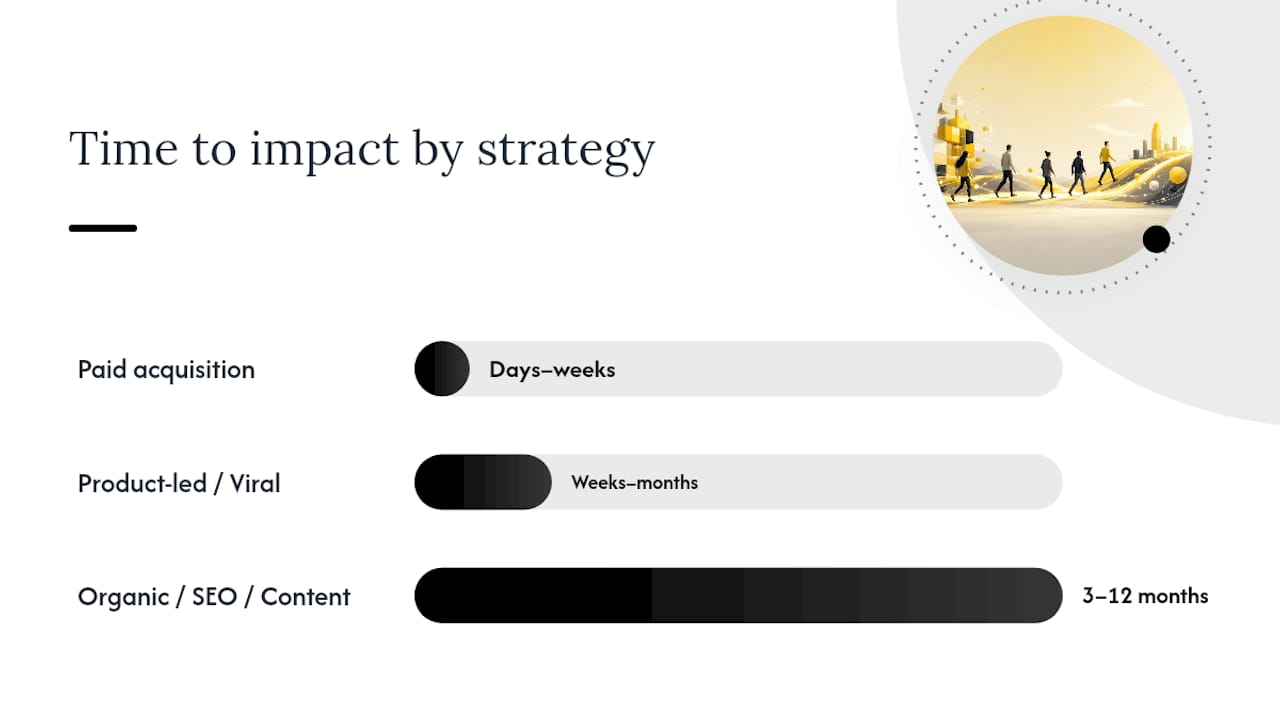
A few things worth noting about each approach in practice. Organic content compounds over time in a way paid channels cannot: a well-optimized article or video continues generating leads years after publication, while a paused ad campaign goes dark immediately. Product-led growth, where the product itself drives acquisition through referrals, free tiers, or shareable outputs, tends to produce the lowest CAC of any channel when it works. The catch is that it requires deliberate product design, not just a referral link bolted on after launch. Partnerships deserve more attention than most early-stage founders give them. A single distribution deal with a complementary brand can deliver more qualified customers in a month than six months of content work.
For small business marketing strategies that translate directly to channel selection, the principle is the same: match the channel to where your customer already spends attention, not where you find it easiest to publish.
Which metrics and benchmarks should you actually track?
Founders often track too many metrics and act on too few. The goal is a small set of numbers that tell you whether the business is healthy and whether your experiments are working.
KPI | Definition | Formula | Practical Benchmark | Caveat |
Weekly growth rate | Revenue or customer growth week-over-week | (This week − Last week) / Last week × 100 | 5–7% is solid; 10% is exceptional (early stage) | Applies to early stage; later-stage companies target monthly |
CAC | Cost to acquire one paying customer | Total sales + marketing spend / New customers acquired | Varies by sector; target payback under 12–18 months | Blended CAC hides channel-level inefficiency |
LTV | Total revenue expected from one customer | Avg. revenue per customer × Gross margin × Avg. customer lifespan | LTV:CAC ratio of 3:1 or higher is a common benchmark | Requires stable churn data to be reliable |
Churn rate | Percentage of customers lost in a period | Customers lost / Customers at start of period × 100 | Under 2% monthly for SaaS; under 5% for consumer | Revenue churn often more important than logo churn |
MRR / ARR | Monthly or annual recurring revenue | Sum of all active subscription revenue | Varies; Series A often requires $1M+ ARR | Only meaningful for subscription models |
Net revenue retention | Revenue from existing customers including expansion | (Starting MRR + expansion − churn − contraction) / Starting MRR × 100 | 100%+ is healthy; 120%+ is exceptional | Best single indicator of product-market fit at scale |
Pro Tip: Run cohort analysis monthly, not just aggregate retention. Aggregate retention can look stable while your newest cohorts are churning faster than older ones, which is an early warning sign that something in your acquisition or onboarding has changed. Group customers by the month they joined and track their retention separately.
The north-star metric concept is worth adopting early. Pick one number that best captures the value your product delivers to customers, and use it to evaluate every experiment. For a marketplace, that might be successful transactions per week. For a content platform, it might be weekly active readers. The north-star keeps teams aligned and prevents the common trap of optimizing for a metric that looks good but doesn’t correlate with revenue.
Carta’s fundraising guidance notes that planning for 24–30 months of runway has become more common as fundraising timelines have lengthened, which means your runway model is itself a metric worth tracking weekly alongside growth rate.
When should you raise, and how much is the right amount?
Fundraising timing is one of the highest-stakes decisions in a startup’s life, and the most common mistake is raising too early, before the metrics tell a compelling story.
Y Combinator’s seed fundraising guide recommends raising enough to reach your next fundable milestone, which typically means funding 12–18 months of runway. The milestone matters more than the dollar amount: investors are buying the right to participate in the next round, and they need to believe the current raise will produce evidence that justifies that next round.
Runway calculation rule of thumb:
Monthly burn rate × months of runway needed = minimum raise amount
Add a 20–25% buffer for hiring delays, slower-than-expected growth, and deal slippage
Target 18 months as your floor; 24 months gives you room to be selective about your next raise
How much dilution is reasonable?
Seed rounds typically involve 10–20% dilution
Series A rounds often add another 15–25%
Carta data shows that median founding-team ownership and dilution patterns vary by sector and stage, and that planning for longer runway (24–30 months) has become increasingly prudent given how fundraising timelines have shifted
What Series A investors actually check:
Traction: consistent growth over at least 6 months, not a single spike
Growth rate: weekly or monthly rate that projects to a meaningful ARR within 12–18 months
Unit economics: LTV:CAC above 3:1 and a payback period under 18 months
Channel: at least one repeatable, scalable acquisition channel with room to grow
Team: evidence that the founding team can hire, retain, and lead beyond the founding moment
StartupScience’s funding stage map finds that pre-seed rejections often stem from insufficient evidence of customer interest rather than team quality or storytelling. The implication is clear: get paying customers before you pitch, not after.
Unusual recommends treating fundraising as a repeatable discipline: curate a focused investor list, practice pitches with Tier-2 investors first, and time your Tier-1 meetings within a compressed, time-boxed window to create momentum and social proof.
How do you build a startup that scales without breaking?
Growth and scaling are related but distinct. Wharton’s executive education guidance draws the line precisely: growth means more users or revenue, while scaling means increasing output without proportional cost increases. A company that doubles revenue by doubling headcount is growing. One that doubles revenue with a 20% headcount increase is scaling.
Most early-stage startups grow before they scale, and that’s appropriate. The danger is continuing to grow without building the systems that allow scaling. At some point, every manual process becomes a ceiling.
High-impact systems to build before you need them:
Finance automation: accounts payable, payroll, and expense tracking should run without founder involvement. Rippling recommends automating HR and finance early to prevent administrative bottlenecks from consuming the time your team needs for growth work.
Onboarding SOPs: document every customer-facing process so a new hire can execute it without a two-week shadow period.
Scalable infrastructure: your tech stack, CRM, and data pipeline should handle 10x your current volume without a rebuild.
Pro Tip: Three automations that typically deliver outsized leverage at the seed stage: (1) automated onboarding email sequences triggered by user actions, (2) a weekly metrics dashboard that pulls from your data sources without manual compilation, and (3) automated invoice and payment reminders that remove founder time from collections entirely.
Tima Bansal’s Forbes piece adds an important caveat for community-sensitive businesses: in sectors with high local variation, a “slow and deep” approach to scaling preserves product quality and customer trust in ways that rapid geographic expansion cannot. For creative and media companies in particular, the local relationships that built the brand are often the hardest thing to replicate at scale.
How do you run growth experiments that actually produce learning?
Disciplined experimentation separates founders who grow intentionally from those who grow accidentally. The AARRR framework (Acquisition, Activation, Retention, Referral, Revenue) gives you a map of where to look for growth levers. Your north-star metric tells you which lever matters most right now.
Step-by-step experiment template:
Hypothesis: “If we [change X], then [metric Y] will increase by [Z%] because [reason].”
Metric: Name the single KPI this experiment moves. One metric per experiment.
Sample: Define the audience segment and minimum sample size before you start.
Timeline: Set a fixed end date. Open-ended experiments never close.
Expected impact: Estimate the business value if the hypothesis is confirmed.
Owner: One person is accountable for running the experiment and reporting results.
Common A/B testing pitfalls to avoid:
Stopping the test early when early results look good. Statistical significance requires patience.
Running multiple changes simultaneously. You won’t know which variable moved the metric.
Testing on too small a sample. Underpowered tests produce false positives.
Ignoring secondary metrics. A change that lifts conversion but tanks retention is not a win.
Growth loops are worth understanding as a complement to one-off experiments. A growth loop is a self-reinforcing cycle where each new customer or piece of content generates the inputs for the next cycle. A referral program is a simple loop: new user → refers a friend → new user. Content SEO is another: article ranks → generates traffic → earns backlinks → article ranks higher. Designing loops into your product or content strategy produces compounding returns that linear acquisition channels cannot match.
What mistakes kill startup growth before it compounds?
The most dangerous growth mistakes are the ones that feel like progress while they’re happening. Scaling before product-market fit is the clearest example: hiring a sales team to sell a product that customers don’t yet love produces churn, not growth.
Common mistakes founders make:
Scaling paid acquisition before unit economics are proven. If CAC exceeds LTV, more spend accelerates the loss.
Tracking vanity metrics (total signups, app downloads, social followers) instead of revenue-correlated ones (weekly active paying users, MRR, retention cohorts).
Over-hiring ahead of revenue. Every premature hire increases burn and complexity without adding proportional output.
Ignoring churn. Acquiring 100 new customers while losing 80 existing ones is a retention crisis, not a growth story.
Raising the wrong round for the wrong phase. StartupScience’s analysis shows that raising before demand signals exist creates expectation mismatches with investors that are hard to recover from.
Investor-facing red flags:
Metrics that change definition between conversations (“we count a user as active if they log in once a month” becomes “once a quarter” when churn looks bad).
Unclear runway with no model behind it.
Retention curves that never flatten, indicating the product hasn’t found its core audience.
A team that can’t articulate the single channel driving growth.
Corrective actions you can take this week:
Audit your metrics dashboard and remove any number that doesn’t correlate with revenue.
Build or update a 24-month runway model with three scenarios: base, upside, and downside.
Interview your three most recently churned customers. Their answers will tell you more than any dashboard.
Your 90-day growth plan: a practical sprint for founders
A 90-day growth sprint gives you enough time to run three meaningful experiments, see early results, and adjust before the quarter closes. The structure below is stage-aware: adapt the KPI targets to your current stage using the benchmarks from the metrics section above.
Month 1: Diagnose and design
Audit your current metrics against the benchmarks in this guide. Identify the single biggest gap.
Map your customer journey from first awareness to first payment. Mark every friction point.
Write three experiment hypotheses targeting the highest-leverage friction point.
Assign owners: founder owns strategy and fundraising narrative, growth lead owns experiment execution, ops owns systems and runway model.
Month 2: Run and measure
Launch experiment one. Track the primary metric daily.
Review cohort retention for the past three months. Identify the cohort with the best retention and ask why.
Hold a weekly 30-minute growth meeting: metrics review, experiment status, blockers.
Begin investor outreach preparation if runway is under 18 months.
Month 3: Iterate and scale
Close experiment one, document results, and launch experiment two.
If experiment one produced a positive signal, allocate more resources to that channel or change.
Update your runway model with actual burn and growth data from the past 60 days.
Prepare a one-page growth summary for investors or board: growth rate, CAC, LTV, runway, next milestone.
Pro Tip: The 90-day sprint works best when the weekly growth meeting has a fixed agenda: (1) north-star metric vs. target, (2) experiment status, (3) one blocker to resolve before next week. Keep it under 30 minutes. Longer meetings signal unclear ownership, not deeper thinking.
For content-led growth experiments, Vainnewyork’s content marketing strategy guide offers a practical framework for planning and executing content at scale without losing quality or brand voice.
How does customer segmentation sharpen your growth efforts?
Not all customers are created equal, and treating them as if they are is one of the quieter ways founders slow their own growth. Segmentation is the practice of dividing your customer base into groups that share meaningful characteristics, then tailoring acquisition, messaging, and retention strategies to each group.
The most useful segmentation dimensions for early-stage startups are behavioral, not demographic. Which customers use the product most frequently? Which ones refer others? Which ones churn fastest? Those behavioral patterns reveal your best-fit customer profile far more reliably than age, location, or job title alone.
Once you’ve identified your highest-value segment, the growth implication is direct: concentrate acquisition spend and product development on attracting more customers who look like that segment. This is sometimes called “finding more of your best customers,” and it consistently outperforms broad-market acquisition in both CAC efficiency and long-term retention.
For audience development and retention, the same principle applies: build for the audience that already pays attention and converts, then expand outward from that core.
Segmentation also sharpens your messaging. A single value proposition rarely resonates equally across all customer types. A creative agency might serve both early-stage founders and established brands, but the language, proof points, and channels that convert each group are different. Mapping those differences and creating segment-specific messaging is one of the highest-ROI activities a growth team can run in the first 90 days.
Detailed tactics for each growth strategy
Understanding which strategy to use is one thing. Knowing how to execute it is another.
Viral and referral marketing
The mechanics of viral growth require three things: a product worth sharing, a frictionless sharing mechanism, and an incentive that aligns with the sharer’s motivation. The incentive doesn’t have to be financial. Dropbox’s referral program offered additional storage, which was directly tied to the product’s core value. Before building a referral program, ask whether your product creates a natural moment where users want to share it. If that moment doesn’t exist organically, a referral link won’t manufacture it.
For creative and media brands, creator economy partnerships offer a particularly effective viral channel: a creator who genuinely uses and endorses your product reaches an audience that already trusts their recommendations, which converts at rates that paid ads rarely match.
Partnership development
Effective partnerships start with a clear answer to one question: what does the partner get? The most durable partnerships are those where both parties acquire customers they couldn’t reach efficiently on their own. Map your customer’s adjacent needs, identify the companies that serve those needs, and approach them with a specific co-marketing or distribution proposal rather than a vague “let’s collaborate” conversation.
Paid channel tactics
Paid acquisition works when you know your LTV well enough to set a CAC ceiling. Start with the channel where your best customers already spend time, not the channel with the lowest CPM. Test creative and audience targeting in small batches before scaling spend. The single most common paid channel mistake is scaling a campaign before it has produced enough data to be statistically meaningful, which locks in a CAC that looks efficient in week one but degrades as the best-fit audience saturates.
Digital marketing strategies that combine paid acquisition with organic content tend to produce better long-term CAC efficiency than either channel alone, because content builds the brand trust that makes paid ads convert at higher rates.
What does successful growth actually look like at each stage?
Abstract frameworks are useful. Concrete examples are more useful.
Pre-seed to seed: A two-person SaaS team building project management software for architecture firms spent their first six months doing 40 customer interviews before writing a line of code. They launched a manual, spreadsheet-based version of their product to five paying customers at $200 per month. Those five customers referred three more within 60 days. That referral signal, not the revenue, was what convinced their seed investors that product-market fit was within reach.
Seed to Series A: A consumer app that helps independent musicians manage royalties grew from 500 to 8,000 monthly active users over 18 months, primarily through organic content and partnerships with music schools. Their retention curve flattened at month four, meaning users who stayed past the first month tended to stay indefinitely. That cohort shape, combined with a 6% weekly growth rate sustained over three months, produced a Series A term sheet.
Series A to expansion: A B2B logistics platform raised a Series A after proving a single channel (outbound sales to regional freight brokers) at a CAC payback period of 11 months. Their Series A thesis was simple: the channel works, the unit economics are proven, and the raise funds the headcount to run the same playbook in five new markets simultaneously.
What these examples share is a commitment to validating one thing at a time before scaling it. None of them tried to run five channels simultaneously or hire ahead of revenue. Each one found a signal, confirmed it was repeatable, and then invested to amplify it.
How do you know when you’re ready to scale, not just grow?
Product-market fit is the prerequisite for scaling, and the most reliable signal of it is retention, not acquisition. You can acquire customers through sheer force of marketing spend. Retention tells you whether the product delivers enough value for customers to stay.
The classic test, attributed to Sean Ellis, asks your most active users: “How would you feel if you could no longer use this product?” If more than 40% answer “very disappointed,” you likely have product-market fit. Below that threshold, scaling acquisition will only accelerate churn.
Before you scale any channel, confirm three things: your retention curve flattens (customers who stay past month one tend to stay), your LTV:CAC ratio is above 3:1, and you can articulate in one sentence why your best customers chose you over every alternative. If any of those three conditions is missing, the right move is more product work, not more marketing spend.
The media and entertainment industry offers a useful parallel: content platforms that scaled distribution before building a loyal core audience consistently underperformed those that built depth first. The audience that stays and pays is always more valuable than the audience that arrives and leaves.
How do you reduce churn and build customer success into your growth model?
Churn is the silent tax on every growth strategy. A business growing at 10% monthly while losing 8% of its customer base monthly is barely moving. Retention is not a customer success problem; it is a growth strategy.
The most effective retention interventions happen before churn occurs. Identify the behavioral signals that precede cancellation in your cohort data: a drop in login frequency, a decline in feature usage, a support ticket that went unresolved. Build automated triggers that flag those signals and prompt a human or automated response before the customer decides to leave.
Customer success as a growth function means treating existing customers as a growth channel, not just a retention task. Expansion revenue, where existing customers upgrade, add seats, or purchase additional services, often carries a CAC near zero and an LTV multiple that exceeds new customer acquisition. Net revenue retention above 100% means your existing customer base is growing even without a single new customer, which is one of the most powerful signals a startup can show investors.
Practical retention tactics worth implementing in the first 90 days: a structured onboarding sequence that gets customers to their first meaningful outcome within 72 hours of signup, a 30-day check-in from a human (founder or customer success hire) for every new customer, and a quarterly business review process for your top 20% of accounts by revenue.
The blind spot most founders miss in audience-driven growth
We’ve watched a particular pattern repeat itself across creative and media startups: a founder builds something genuinely resonant with a specific local or niche audience, then scales the distribution before the product is ready for a broader one. The metrics look good for a quarter. Acquisition is up. Then retention collapses, because the new audience doesn’t share the same context, trust, or expectations as the original one.
The correction isn’t to stop growing. It’s to grow the audience before you grow the distribution. That means investing in the depth of your relationship with your existing community before spending to reach new ones. A brand that 500 people love deeply will outperform one that 50,000 people vaguely recognize, every time, when it comes to conversion, retention, and word-of-mouth.
Tima Bansal’s “slow and deep” framing applies here with particular force for creative businesses. The trust you built with your first audience is the asset. Protect it when you scale.

The practical correction you can implement this week: before launching any new acquisition campaign, audit your retention data for the past 90 days. If your newest cohorts are churning faster than your earliest ones, pause acquisition and fix the product experience first.
Vainnewyork helps startups build the creative foundation that growth demands
Growth without a compelling brand story is a leaky bucket. You can acquire customers, but you can’t keep them if the creative work doesn’t communicate your value clearly and consistently. Vainnewyork works with startups and brands at every stage to build the content, visual identity, and audience development infrastructure that makes growth stick.
From video production and animation to marketing strategy and brand development, Vainnewyork’s team of collaborators produces the creative assets that convert attention into customers and customers into advocates. We don’t hand you a template. We build the specific creative system your growth stage requires, whether that’s a seed-stage brand identity that earns investor trust or a Series A content engine that scales without losing voice.
If you’re ready to align your creative output with your growth objectives, start the conversation at Vainnewyork and let’s build something worth growing.
Sources
Founders who want to go deeper on any section of this guide will find these sources worth their time:
This article is general information, not a substitute for advice from a qualified financial advisor. Consult a qualified financial professional about your own circumstances before acting on anything here.
Recommended
Comments