Scaling a Business: A Practical Playbook for Entrepreneurs


Scaling a business means increasing revenue faster than costs grow, through repeatable systems, automation, and leverage. That distinction separates a business that gets bigger from one that gets more profitable as it grows. Before you commit to a major expansion push, four actions deserve your attention first:
Confirm product-market fit. Consistent, unprompted demand from customers who return and refer others is the clearest signal you have something worth scaling.
Lock the core metric. Choose one north-star number (monthly recurring revenue, gross margin, or customer acquisition cost payback) and make every team decision accountable to it.
Document the critical process. Identify the single workflow that generates the most revenue and write it down, step by step, before you hire anyone new to run it.
Protect cash runway. Know exactly how many months of operating expenses you hold before any new fixed-cost commitment.
Pro Tip: Treat technology as operational architecture, not a collection of point tools. Every platform you add should integrate with your core systems and reduce manual exceptions, not create new ones. The Inc. guide on scaling without chaos makes this case compellingly.
The sections ahead cover the frameworks that structure a scaling plan (Six S, Three-Horizon, BCG’s growth equation, and the HBS value stick), a readiness checklist with specific KPIs, a prioritized tactical playbook, and a 90-day sprint sequence you can start this week.
Key Takeaways
Scaling a business requires repeatable systems, proven demand, and disciplined capital allocation before any major fixed-cost commitment.
Point | Details |
Scaling vs. growth | Scaling means revenue grows faster than costs; growth means both rise together. |
Six-month demand rule | Validate consistently increasing revenue for at least six months before heavy hiring or fixed-cost expansion. |
Framework selection | Use the Six S for organizational design, the Three-Horizon model for resource allocation, and BCG’s growth equation for target-setting. |
90-day sprint structure | Sequence: assess (days 1–30), stabilize (days 31–60), accelerate (days 61–90), with go/no-go thresholds at each stage. |
Vainnewyork’s role | Vainnewyork provides creative production, campaign templates, and brand strategy that lower CAC and scale content output without adding fixed headcount. |
Table of Contents
Are you ready to scale? Signals, KPIs, and a readiness checklist
Which frameworks should you use to plan your scaling strategy?
What tactics actually move the needle when you scale operations?
How do you finance a scaling program without destroying cash runway?
What causes scaling efforts to fail, and how do you avoid it?
How does scaling a business differ from regular growth?
Growth and scaling feel like synonyms. They are not, and confusing them leads to expensive mistakes.
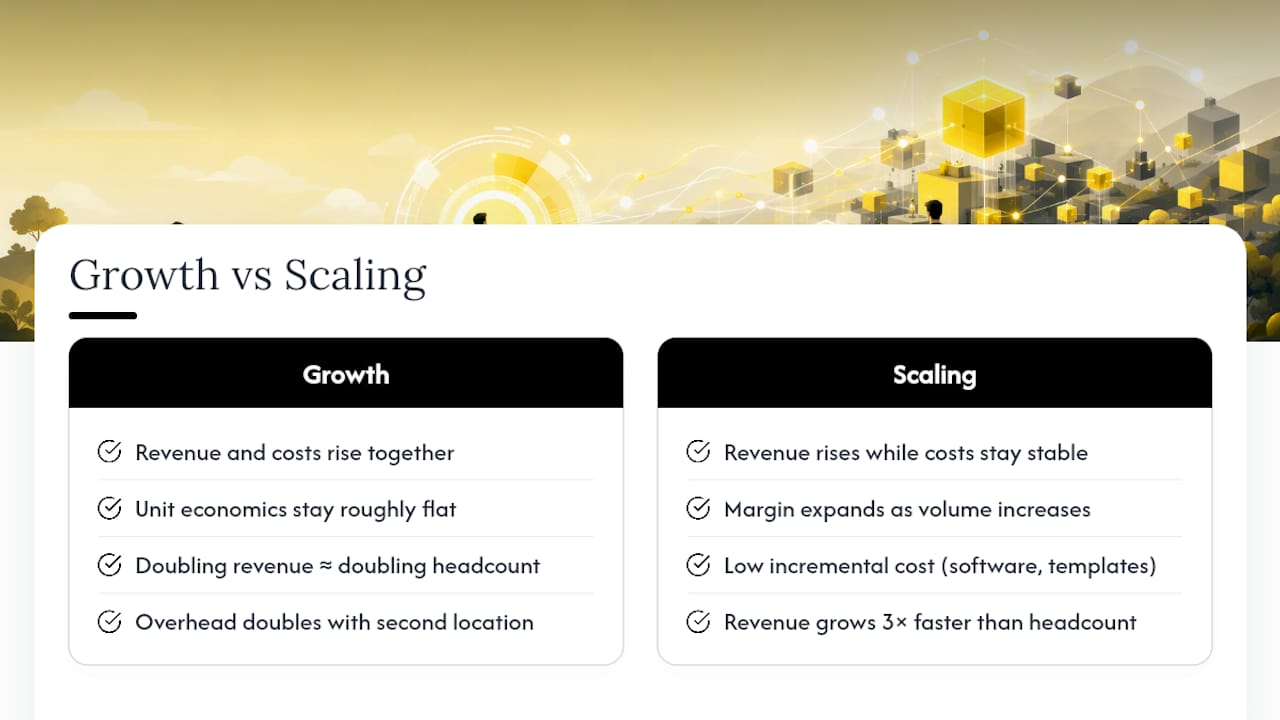
Growth means revenue and costs rise together. You hire a new account manager, you serve one more client. You open a second location, your overhead doubles. The unit economics stay roughly flat, and the business gets larger without getting more efficient. This is the natural mode for most service businesses early in their life.
Scaling a business means revenue rises significantly while costs stay relatively stable. A software product sold to a thousandth customer costs almost nothing incremental to serve. A documented content template used across fifty campaigns costs no more to produce than it did for five. The margin expands as volume increases.
Consider a consulting firm that bills by the hour. Doubling revenue requires roughly doubling headcount. Now imagine that same firm productizes its methodology into a licensed framework, a self-serve diagnostic tool, and a library of reusable deliverables. Revenue can grow at three times the rate of headcount. That is the structural shift scaling requires.
“Improving employee conditions and codifying value creation raises customer willingness to pay and supports sustainable scaling.” Harvard Business School’s value stick framework shows that the gap between what customers will pay and what it costs to serve them is the engine of scalable margin. Widen that gap through better processes and people, and growth compounds rather than just accumulates.
BCG advises leaders to set a bold, unambiguous growth target and build a growth equation that clarifies how much will come from organic sources versus inorganic ones (acquisitions, partnerships, licensing). Without that equation, most companies default to linear growth because it feels safer. Wharton’s scaling program frames the same question through return-on-invested-capital: every dollar deployed should generate a return that compounds, not merely covers cost.
Are you ready to scale? Signals, KPIs, and a readiness checklist
Scaling before the foundation is solid is one of the most common and costly mistakes founders make. The readiness signals below are not aspirational targets. They are minimum thresholds.
KPIs to verify before you scale
LTV:CAC ratio. Lifetime value should be at least three times customer acquisition cost. Below that, you are paying to acquire customers faster than they pay you back.
Gross margin stability. Margin should hold or improve as revenue grows. Declining margin under growth pressure signals a cost structure that will worsen at scale.
CAC payback period. How many months does it take to recover the cost of acquiring a customer? Shorter payback periods give you more capital to redeploy.
Churn rate. For subscription businesses, monthly churn above a low single-digit percentage erodes the compounding effect that makes scaling worthwhile.
MRR growth consistency. Month-over-month growth in monthly recurring revenue should be positive and stable, not spiking and crashing.
Channel ROAS. Return on ad spend by acquisition channel tells you which channels can absorb more budget without efficiency degrading.
Wharton’s curriculum ties each of these metrics to return-on-invested-capital decisions, which is the right frame: a metric only matters if it connects to how capital is being deployed and what it returns.
The six-month validation rule
Practitioners recommend looking for consistently increasing revenues over a minimum of six months before committing to heavy hiring or fixed-cost expansion. Rippling’s guidance on scaling reinforces this: demand that looks like a trend over one or two months is often noise. Six months of sustained upward movement is a signal worth acting on.
Readiness checklist
Product-market fit confirmed by repeat purchase or renewal behavior, not just initial sales.
Sales process documented and repeatable by someone other than the founder.
Gross margin stable or improving over the last two quarters.
LTV:CAC at or above 3:1 across your primary acquisition channel.
Churn below your category threshold and trending down.
At least six months of operating expenses in cash or committed credit.
One person clearly accountable for each core operational workflow.
Technology stack integrated, not siloed, with a single source of truth for revenue data.
Which frameworks should you use to plan your scaling strategy?
Four frameworks give you the most useful lenses for structuring a scaling plan. Each answers a different question, and together they cover the full decision surface.
The Six S Framework (Jeffrey Rayport / Harvard Business School)
The Six S Framework gives founders six focus areas to design for scalability: Staff, Shared values, Structure, Speed, Scope, and Series X (financing). Staff quality in multiplier roles determines how fast the organization can move. Shared values replace the need for constant managerial oversight by giving every team member a decision-making compass. Structure defines how authority and information flow. Speed measures how quickly the organization can sense and respond to market signals. Scope defines the boundaries of what the business will and will not do. Series X addresses the capital structure needed to fund each phase.
The Six S is most useful at the organizational design stage, when you are deciding how to build the team and governance model before adding headcount.
The Three-Horizon Model (BCG)
The Three-Horizon model asks you to allocate resources across three time horizons simultaneously. Horizon 1 covers the core business that generates cash today. Horizon 2 covers adjacent opportunities that could become significant revenue sources within two to three years. Horizon 3 covers exploratory bets with a longer payoff window.
Most SMBs over-invest in H1 and starve H2 and H3. The exact split depends on your cash position and competitive pressure.
BCG’s growth equation
BCG recommends setting a bold, specific growth target and then building a growth equation that breaks down how much will come from organic channels (retention, upsell, new customer acquisition) versus inorganic ones (partnerships, acquisitions, licensing). The equation forces clarity about which capabilities you need to build or buy, and it creates a stress-testing structure for scenario planning.
The HBS value stick
Harvard Business School’s value stick maps the gap between customer willingness to pay (WTP) and cost to serve, and separately the gap between cost to serve and employee willingness to sell (WTS). Scaling strategy should widen the WTP-to-cost gap by improving product quality, service consistency, or brand strength, while narrowing the cost-to-WTS gap by improving employee conditions and operational efficiency.
Choosing the right framework for your stage
Business stage | Primary question | Best framework to lead with |
Pre-scale validation | Do we have a repeatable model? | Six S (staff and structure audit) |
Early scale (first major hires) | Where do we invest growth capital? | HBS value stick + growth equation |
Growth phase (multi-channel) | How do we allocate across time horizons? | Three-Horizon model |
Mature scaling (M&A or partnerships) | Organic vs. inorganic path? | BCG growth equation |
The HBR six growth categories (new processes, experiences, features, customers, offerings, and models) complement all four frameworks by helping you allocate innovation budgets by risk profile: incremental bets on existing customers and processes carry the lowest risk; new business model experiments carry the highest.
What tactics actually move the needle when you scale operations?
Frameworks tell you where to look. Tactics tell you what to do Monday morning. Here are the ten highest-leverage moves, organized by function.
Pro Tip: Run each tactic as a small bet with a clear success criterion and a defined time box. A tactic that cannot be measured in 30 days is a project, not an experiment.
Top 10 scaling tactics
Document every critical workflow end-to-end (Owner: Head of Ops). Before you hire, write down how the work gets done. Every manual exception you leave undocumented becomes a training debt.
Eliminate manual handoffs between systems (Owner: Head of Ops / CTO). Integrate your financial backbone, CRM, and fulfillment data into a single source of truth. Fragmentation multiplies as volume grows.
Hire A-players for multiplier roles first (Owner: Founder / HR). A multiplier role is one where the right person makes three other people more effective. Fill those before filling execution roles.
Build an explicit onboarding path (Owner: Head of Ops). New hires who reach full productivity in 30 days instead of 90 days are a compounding advantage.
Productize your highest-margin service (Owner: Head of Product). Turn a repeatable service into a defined offering with a fixed scope, fixed price, and documented delivery process.
Focus GTM on your highest-velocity channel (Owner: Head of Marketing). Spreading budget across five channels at early scale dilutes learning. Double down on the one channel where CAC payback is shortest.
Invest in retention before acquisition (Owner: Head of Marketing / CS). Reducing churn by even a small percentage has a larger compounding effect on LTV than the same percentage improvement in new customer acquisition.
Automate the highest-volume, lowest-judgment tasks (Owner: CTO / Head of Ops). Automation that reduces marginal cost per transaction is the mechanical definition of scaling. Prioritize volume and repetition, not complexity.
Define SLAs for every customer-facing process (Owner: Head of Ops). SLAs create accountability and make exceptions visible before they become systemic.
Build a referral mechanism into the product or service (Owner: Head of Product / Marketing). Referral lowers CAC structurally. A content strategy that makes customers look good to their peers is one of the most underused referral levers in B2B.
Pro Tip: Convert variable costs into scalable processes before adding fixed costs. A new hire who replaces a manual process is a fixed cost. An automated workflow that replaces the same process is a scalable one. The sequence matters.
How do you finance a scaling program without destroying cash runway?
Capital decisions during scaling are irreversible faster than most founders expect. The wrong financing structure at the wrong moment can lock you into fixed costs before demand is proven.
Capital options for SMBs and startups
Internal cash flow. The cleanest option. No dilution, no covenants. Requires patience and strong gross margin.
Angel or venture capital. Accelerates timelines but dilutes ownership and introduces governance obligations. Best suited when the market window is short and capital efficiency is secondary.
Revenue-based financing (RBF). Repayments scale with revenue, which protects runway during slow months. Works well for businesses with predictable recurring revenue.
Debt (SBA loans, lines of credit). Lower cost of capital than equity, but requires collateral or cash flow history. The SBA 7(a) program is the most accessible route for U.S.-based SMBs.
Strategic partnerships. Distribution agreements, co-development deals, or white-label arrangements can fund growth through shared economics rather than capital injection.
Three budget scenarios
Conservative scenario. Hire one role at a time, validate each hire’s impact before the next, and keep tech spending to integration of existing tools. Prioritize gross margin protection over growth speed.
Base scenario. Hire two to three multiplier roles in the first 90 days, invest in one new acquisition channel, and allocate a defined budget for process automation. Tie every spend line to a specific metric threshold.
Aggressive scenario. Parallel hiring across functions, new market entry, and significant tech infrastructure investment. Requires a capital cushion of at least 12 months of projected burn and a clear go/no-go metric at the 60-day mark.
Budget line-item checklist for a scaling phase
Headcount (salaries, benefits, recruiting fees)
Technology (new tools, integration work, infrastructure)
Marketing and customer acquisition (paid channels, content production)
Fulfillment and operations (logistics, customer success, quality control)
Legal and compliance (contracts, IP protection, regulatory filings)
Finance and accounting (CFO support, audit, tax)
BCG’s programmatic growth approach recommends stress-testing each scenario against a downside case where revenue growth comes in at 50% of the base projection. If the business survives that scenario with positive cash flow, the plan is defensible.
What causes scaling efforts to fail, and how do you avoid it?
Most scaling failures share a common root: the business moved faster than its systems, culture, or cash could support.
Scaling on projection, not demand. Hiring and spending ahead of proven revenue is the single most common cause of scaling failure. The six-month validation rule exists precisely to prevent this.
Hiring too fast or for the wrong roles. Adding headcount before workflows are documented means new hires inherit chaos. Hire for leverage, not for volume.
Tech debt accumulation. Adding tools without integration governance creates fragmentation. Treating technology as operational architecture means every new platform must reduce exceptions, not create them.
Converting variable costs to fixed costs prematurely. Office leases, full-time hires, and annual software contracts are fixed costs. Taking them on before demand is proven compresses runway dangerously.
Losing culture and decision speed. As teams grow, decision-making slows unless values are codified and authority is distributed deliberately. The Six S Framework’s “Shared values” element addresses this directly.
Red flags that should trigger a scale pause
Gross margin declining quarter-over-quarter as revenue grows.
CAC payback period lengthening beyond your defined threshold.
Customer churn accelerating despite increased acquisition spend.
Operational exceptions becoming the norm rather than the exception.
Leadership team spending more time firefighting than building.
Pro Tip: Set a hard rule before you start: if gross margin drops by more than a defined percentage from your baseline, or if CAC payback extends beyond your threshold, you pause new fixed-cost commitments until the root cause is identified and corrected.
Your 90-day scaling playbook: sprint by sprint
This sequence assumes you have completed the readiness checklist. Each sprint has a clear owner, a metric to move, and a go/no-go threshold.
Days 1–30: Assess
Audit all core workflows (Owner: Head of Ops). Map every process that touches revenue. Identify the top three manual exceptions and document them.
Baseline your KPI dashboard (Owner: Finance Lead). Set current values for LTV:CAC, gross margin, churn, CAC payback, and MRR growth. These are your go/no-go anchors.
Identify the two multiplier roles (Owner: Founder). Define the two hires that would most accelerate the business. Write the job scope before posting.
Audit your tech stack for integration gaps (Owner: CTO / Head of Ops). List every tool that does not feed data into your core financial or CRM system.
Go/no-go threshold: All KPIs at or above readiness checklist minimums. If not, stabilize before proceeding.
Days 31–60: Stabilize
Document and automate the top three manual exceptions (Owner: Head of Ops). Each one should have a defined resolution path that does not require founder involvement.
Make the first multiplier hire (Owner: Founder). Begin onboarding with a 30-day productivity milestone defined in writing.
Launch one channel experiment (Owner: Head of Marketing). Define success as a specific ROAS or CAC threshold within 30 days. Use digital marketing frameworks to structure the test.
Run a scenario planning session (Owner: Finance Lead + Founder). Model conservative, base, and aggressive revenue scenarios for the next two quarters.
Go/no-go threshold: Channel experiment shows positive unit economics. Multiplier hire is on track to hit 30-day milestone.
Days 61–90: Accelerate
Scale the winning channel (Owner: Head of Marketing). Increase budget on the channel that cleared the ROAS/CAC threshold. Kill or pause the others.
Make the second multiplier hire (Owner: Founder). Use the onboarding path built in Sprint 2.
Productize one service or offering (Owner: Head of Product). Define scope, price, and delivery process. Sell it to at least two customers before Sprint 3 ends.
Establish weekly KPI review cadence (Owner: Finance Lead). A 30-minute weekly meeting reviewing the north-star metric and the three leading indicators that predict it.
Go/no-go threshold: Gross margin holding or improving. CAC payback stable or shortening. MRR growth positive for the third consecutive month.
Investors and buyers reward repeatable, documented processes over heroic problem-solving. Building that repeatability into the 90-day sprint structure is what separates a scaling program from a growth sprint.
Why brand and creative work are underrated scaling levers
We see this pattern often: a business reaches product-market fit, the founder starts hiring for sales and ops, and creative work gets deprioritized as a “nice to have.” That sequencing costs more than most leaders realize.
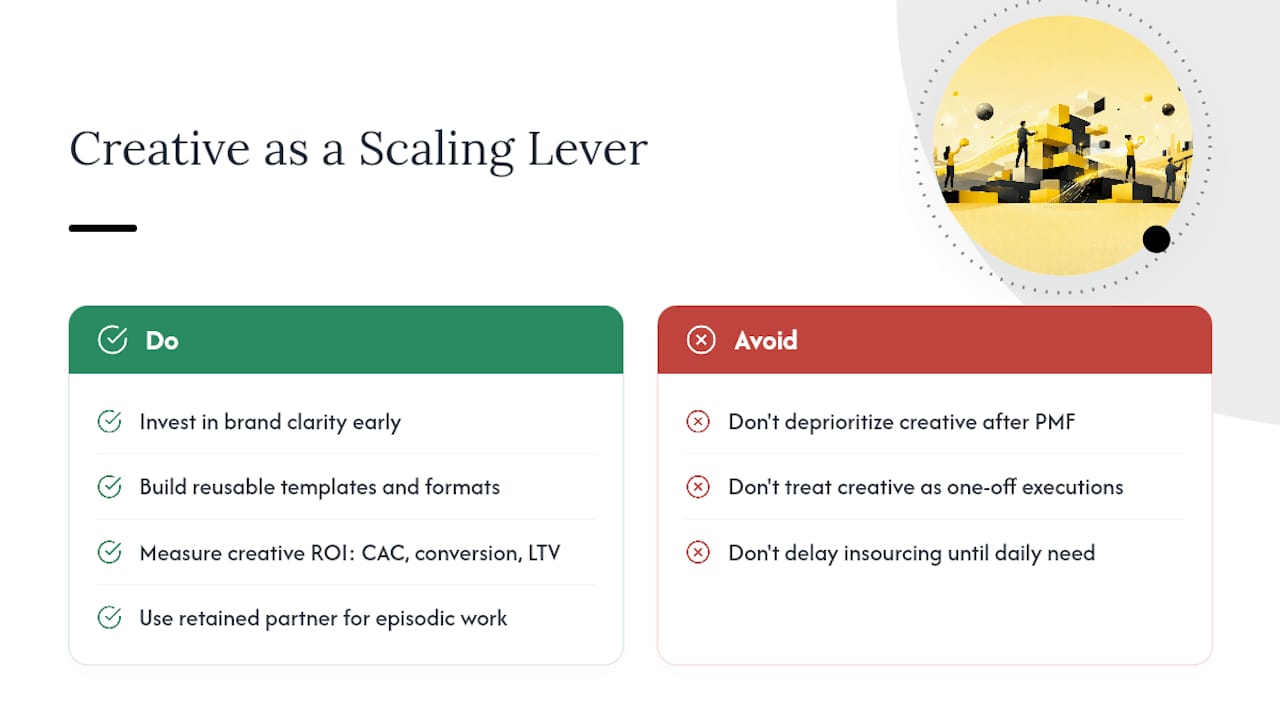
Brand clarity is a distribution multiplier. When your visual identity, messaging, and content formats are consistent and reusable, every new channel you enter costs less to activate. A well-built template library for campaigns means your marketing team can test a new channel in days, not weeks. Reusable content formats, from short-form video to case study frameworks, reduce the marginal cost of content production the same way automation reduces the marginal cost of operations. That is scaling logic applied to creative output.
The question of when to hire a creative partner versus building internal capability comes down to repeatability and measurable funnel impact. If your creative needs are episodic (a brand refresh, a product launch campaign, a content sprint to prove a new channel), a retained creative partner delivers faster and at lower fixed cost than a full internal team. When creative output becomes a daily operational need tied directly to revenue, that is the signal to bring capability in-house.
Evaluate creative partner ROI the same way you evaluate any other scaling investment: does it reduce CAC, improve conversion, or increase LTV? A content strategy built for scale should produce assets that compound in value over time, not one-off executions that expire. Brand-aligned merchandising, reusable campaign templates, and audience-building content all share that compounding quality. The media and entertainment trends shaping 2026 reinforce how quickly distribution channels shift, which makes format-agnostic creative systems more valuable than ever.
Vainnewyork helps you scale creative without the overhead
Scaling a business demands that every function, including creative, operates with the efficiency of a system rather than the unpredictability of a one-off project. Vainnewyork is built for exactly that moment: when you need creative production, marketing strategy, and brand development to move at the speed your growth plan requires, without the fixed cost of a full internal team.
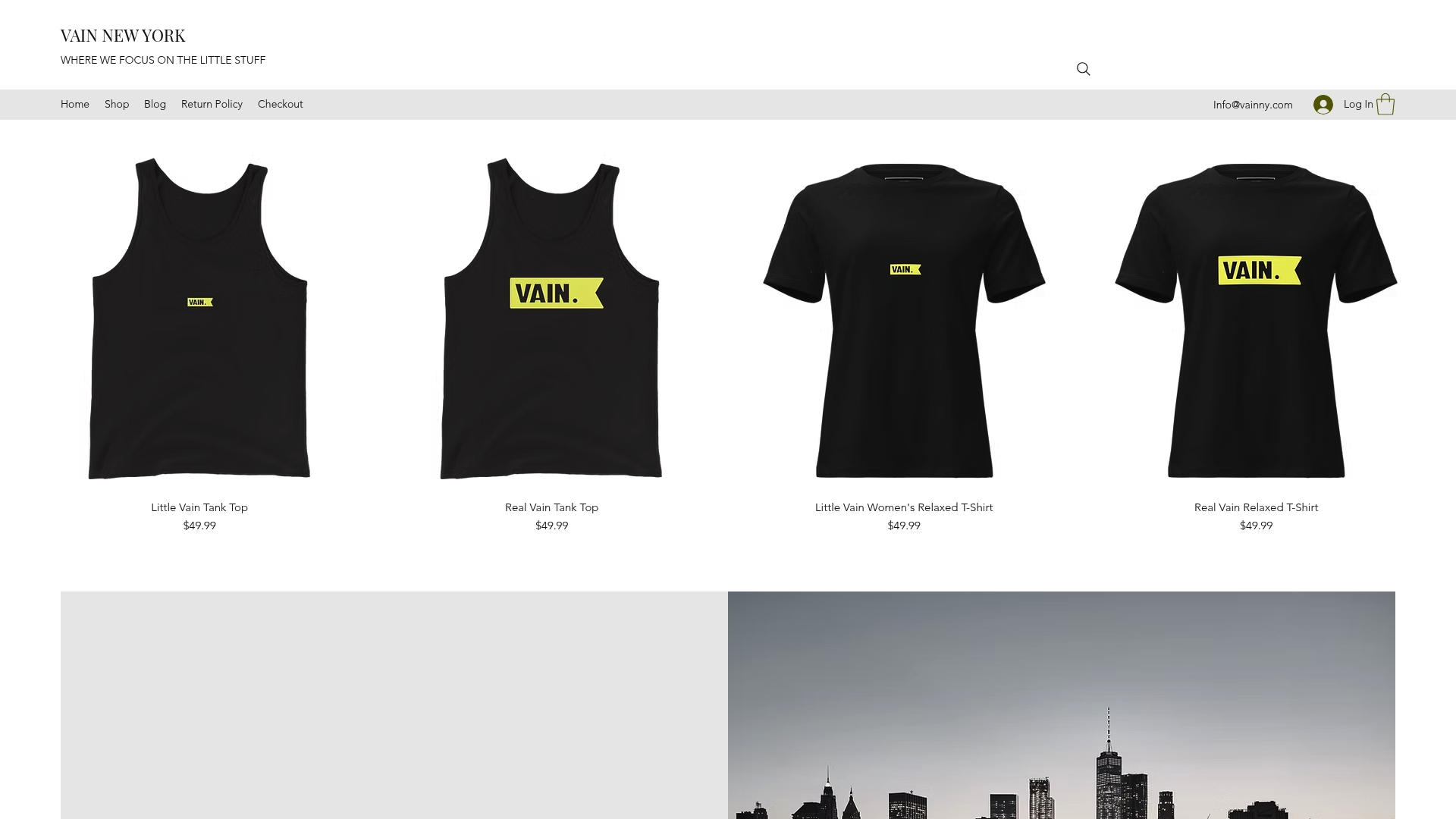
We plug into scaling programs in three concrete ways. First, rapid content sprints that prove a new acquisition channel before you commit budget. Second, template-driven campaign libraries that reduce your cost-per-asset as volume grows. Third, integrated brand and analytics work that ties creative output directly to CAC and conversion metrics, so you know what is working and can scale it deliberately.
If you are 30 days into your scaling sprint and need creative infrastructure that compounds rather than costs, reach out to Vainnewyork to start the conversation.
Sources
Recommended
Comments