Embroidery vs Printing: How to Choose for Your Apparel

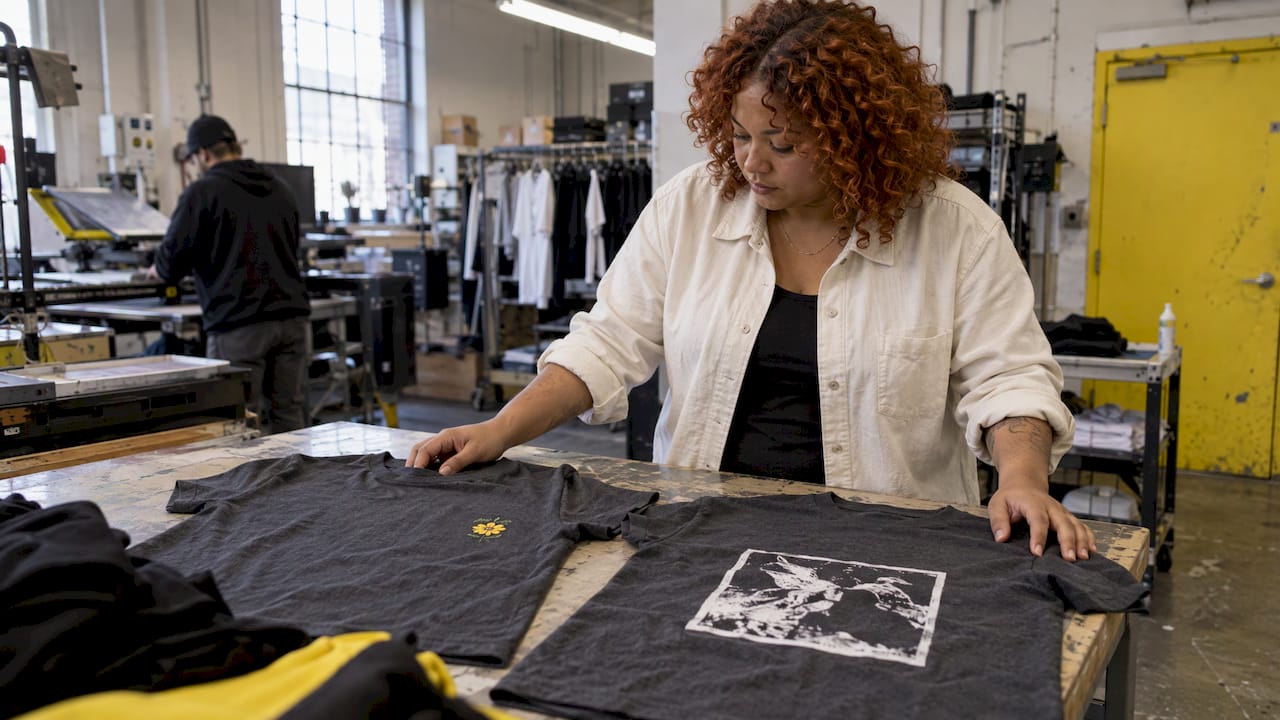
Embroidery builds your design out of thread, so it reads as raised, textured and premium. Printing lays ink onto the fabric, so it captures fine detail, gradients and full-color artwork at a friendlier price per piece. The right choice depends on three things: what your artwork looks like, what the garment is made of, and how many pieces you need. This guide walks through each method, screen printing, direct-to-garment (DTG) printing and embroidery, so you can brief a production run with confidence, whether it is a crew uniform, a launch capsule or a merch drop.
TL;DR
Choose embroidery for logos with bold shapes and few colors on structured pieces such as caps, polos, jackets and heavier hoodies. It delivers a raised, tactile finish.
Choose screen printing for larger graphics, solid colors and bigger runs. Research from Clemson University found it gave the most accurate color replication of the processes tested.
Choose DTG for photographic or many-color artwork and small runs, because it needs no screens and prints detail straight from a digital file.
Check three things before you decide: the smallest detail in your artwork, the fabric content, and the quantity per design.
Table of Contents
What each method actually does
The phrase “embroidery vs printing” sounds like a two-way choice, but printing covers two quite different processes. Here is each one in plain terms.
Embroidery
Embroidery stitches your design into the garment with thread. Before anything is sewn, the artwork has to be digitized: a specialist converts your logo into a stitch file that tells the machine where to place each stitch, in which direction and in what order. That file is usually a one-time job for each design, so a repeat order of the same logo can reuse it.
Because the design is made of thread, it has dimension. Light catches the stitches, and the logo feels substantial under your fingers. That is why embroidery shows up on chef coats, work jackets, golf polos and dad caps: it signals care.
Screen printing
Screen printing pushes ink through a mesh stencil, one screen per color. A design with three colors needs three screens, each prepared and aligned before a single shirt is printed. That setup is the main cost, and it is why screen printing shines on larger orders: once the screens exist, each additional shirt is quick to produce.
The result is bold, opaque color with crisp edges. It is the classic finish for band tees, event shirts, team apparel and streetwear graphics, and it handles large placements such as full-chest and back prints very well.
Direct-to-garment (DTG) printing
DTG works like an inkjet printer for fabric. The garment is loaded onto a platen, and water-based ink is sprayed directly into the fibers from a digital file. There are no screens, so there is no per-color setup, and a design with dozens of colors costs the same to prepare as a single-color one. We cover the process step by step in our guide to direct-to-garment printing.
DTG gives you soft, light-feeling prints with photographic detail, which makes it a natural fit for illustrations, gradients and short runs.
Side-by-side: look, feel and fit
Embroidery | Screen printing | DTG | |
Look | Raised thread, dimensional | Bold, opaque color | Detailed, photographic |
Feel | Textured, substantial | Ink layer on the surface | Soft, absorbed into the fabric |
Best artwork | Simple logos, lettering, few colors | Solid colors, graphics, large areas | Many colors, gradients, fine detail |
Setup | Digitizing file per design | One screen per color | None |
Best quantity | Small to large, strong for repeat logos | Medium to large runs | Small runs and one-offs |
Typical garments | Caps, polos, jackets, hoodies | Tees, hoodies, totes | Tees and light cotton pieces |
Use the table as a first filter, then work through the three checks below.
Check 1: your artwork
Artwork decides the method more often than budget does. Open your file and look for these things.
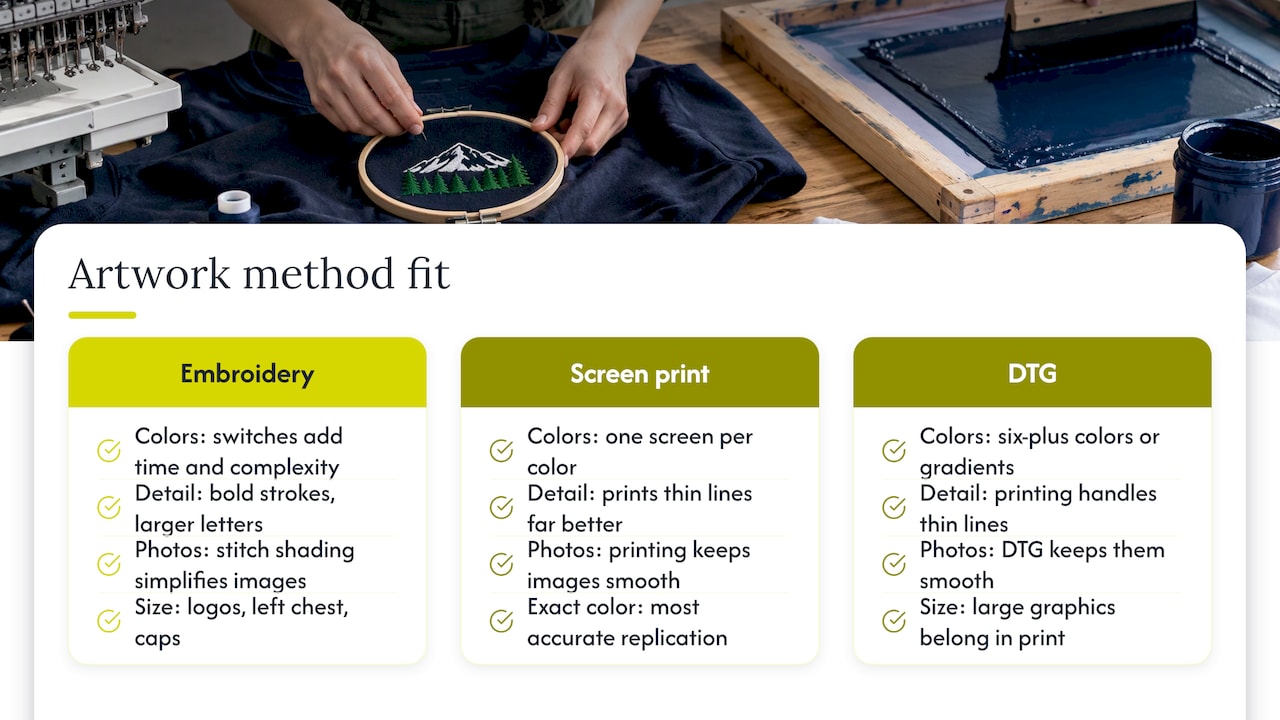
Number of colors. Embroidery thread changes cost time and complexity with every color switch, and screen printing adds a screen for every color. If your design has six or more colors, or gradients, DTG is the natural home for it. If it has one or two flat colors, either embroidery or screen printing will look sharp.
Fine detail and small text. Thread has thickness. Tiny lettering, hairline strokes and delicate serif typefaces can fill in when stitched, so embroidery works best with letters that are large enough and strokes that are bold. Print reproduces thin lines far better. If your wordmark relies on elegant, thin type, see how weight and spacing behave at small sizes in our typography in apparel design guide before choosing.
Gradients and photos. Embroidery builds shading with stitch direction and color blocks, so it simplifies photographic images. Printing, especially DTG, keeps them smooth.
Exact brand color. If a precise brand color matters, screen printing has a measurable edge. The Clemson University team of Walker and Bridges tested branded textiles and found screen printing provided the most accurate color replication of the processes they compared. When a logo color has to match a style guide, that is a strong reason to print.
Size. Embroidery is at its best at logo size, a left-chest mark or a cap front. A giant embroidered back panel is heavy, expensive in stitches and stiff to wear. Large graphics belong in print.
Check 2: your garment
The garment has as much say as the artwork.
Caps, beanies and structured jackets: embroidery is the traditional choice, since thread sits well on firm, thicker materials and these pieces are awkward to print flat.
Lightweight tees and stretchy fabrics: printing is kinder here. Dense stitching can pucker a thin or stretchy knit, so a printed design keeps the drape of the garment intact.
Fleece and heavy hoodies: both work. Embroidery gives a premium finish for small marks, and screen printing handles bold chest and back graphics.
Fiber content: DTG ink is water-based and bonds best with natural fibers, so 100% cotton is the safest base for it. Screen printing is more forgiving across fiber types, and embroidery works on a wide range of fabrics when it is backed with the right stabilizer, a thin support layer that keeps the stitches from distorting the cloth.
A practical habit: pick the garment first, ask what decoration suits it, and only then lock the artwork. Our piece on types of logo placement for apparel shows how placement, whether left chest, sleeve, back yoke or oversized front, narrows the method for you.
Check 3: quantity and cost structure
Each method front-loads or back-loads its costs differently, and understanding that shape prevents surprises on a quote.
Embroidery usually carries a one-time digitizing fee for each design, plus a per-piece price that rises with the number of stitches. A dense, large logo costs more per piece than a compact one. Reorders can reuse the stitch file, which makes embroidery economical for a logo you will put on many items over time.
Screen printing carries setup per color for screens. Spread across a large run, that cost becomes small per shirt, so the price per piece tends to fall as quantity grows. For a one-color design on hundreds of shirts it is hard to beat.
DTG carries little or no setup, but each piece costs roughly the same regardless of quantity, so it suits small runs, test drops and designs with many colors. If you are weighing it against transfer-based printing, this cost comparison of DTG and DTF looks at both small and large runs.
The trade-off is simple. Small run with a complex design points to DTG. Large run with a simple design points to screen printing. A compact logo on premium garments points to embroidery, and it gets more economical every time you reorder the same file. For a deeper look at how print methods stack up at volume, read our comparison of DTF and screen printing.
Durability and care
All three methods can last for the life of a garment when they are done well and cared for properly. A few findings help you set expectations.
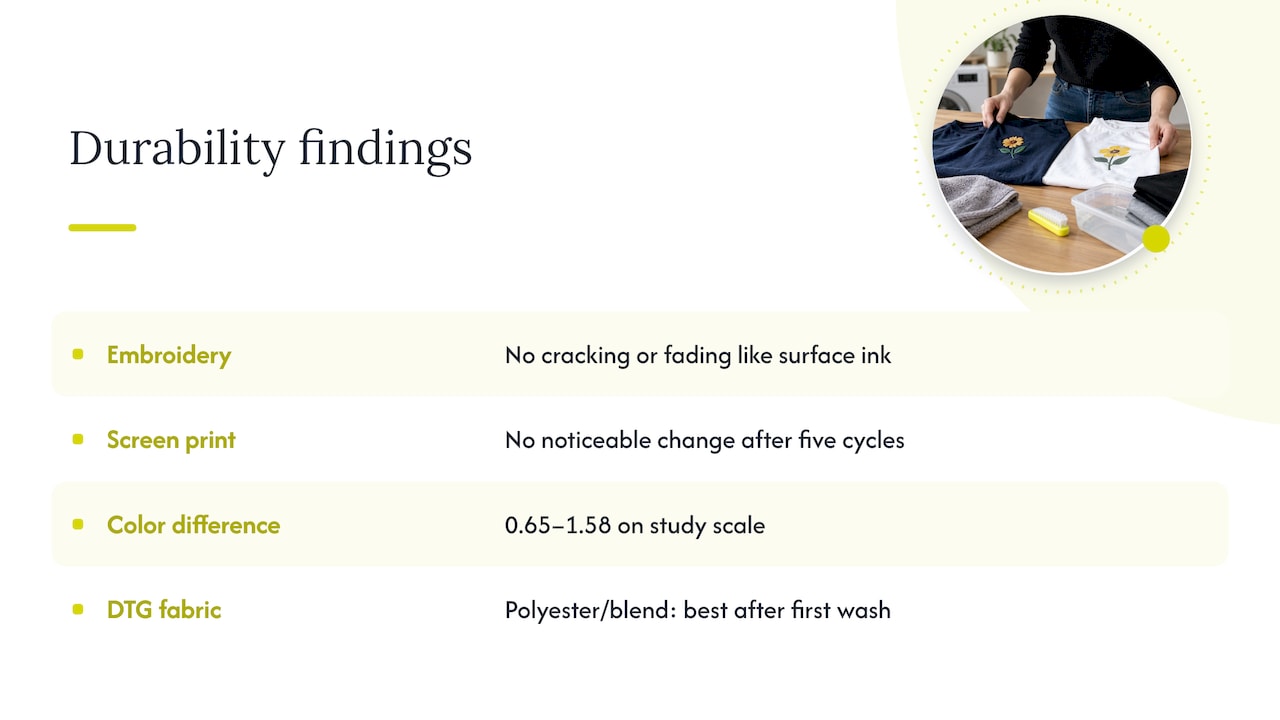
Thread is dyed and sewn into the fabric, so embroidery does not crack or fade the way a surface ink layer can, which is why it is a long-standing favorite for uniforms and workwear that get washed often.
For print, the evidence is encouraging. In a 2025 TAGA Proceedings study, the Clemson researchers found that screen-printed samples showed no noticeable visual color change after five home laundering cycles, with color difference values of 0.65 to 1.58 on the scale they used. Their earlier work found that DTG on polyester or poly-blend fabric gave the best color durability after the first wash. Fabric and process pairing matters, which is one more reason to decide the garment and the method together.
For every method, simple care extends life: wash inside out, use cool or warm water, and avoid very high dryer heat. Printed pieces in particular reward gentle drying, and embroidered pieces keep their shape best when they are not stretched while wet.
A quick decision guide
Work down this list and stop at the first line that describes your project.
A cap, beanie or jacket with a simple logo: embroidery.
A polo or button-down for staff or a client gift: embroidery, for the polished look.
A big graphic on the chest or back, in a few colors, on 50 or more pieces: screen printing.
An illustration or photo with many colors on fewer than a few dozen pieces: DTG.
A tee or hoodie capsule where the brand color has to match exactly: screen printing.
A mixed collection: combine them. Embroider the small marks on hats and outerwear, and print the bold graphics on tees and sweatshirts.
Mixing methods is often the smartest move. A brand that embroiders its logo on a hoodie sleeve and prints a large graphic on the back gets both the premium touch and the visual impact.
Common mistakes to avoid
Sending a low-resolution file. Print needs clean, high-resolution artwork, ideally vector. Embroidery needs a simplified version, so ask for a stitch proof before production.
Forgetting the garment color. A dark shirt changes how ink and thread read. Light inks on dark fabric usually need an underlayer, and thread colors look different against dark and light cloth.
Choosing on price per piece alone. Compare the full cost, including setup and digitizing, at the quantity you actually need.
Skipping the mockup. A mockup catches scale, placement and color problems before they become inventory. Our overview of apparel mockup tools can help you build one.
Good merchandise design practices start with this discipline: design for the method, rather than forcing a method onto a design.
Making it part of a brand, not just a shirt
Apparel is one of the few brand touchpoints people choose to wear. A well-matched method, a stitched crest on a heavyweight hoodie or a crisp graphic on a tee, tells people the brand cares about detail before they read a word. If you are building a capsule, the process in designing your graphic tee collection shows how to move from concept to finished pieces, and why custom apparel helps brands last explains the long game. If you are in the city, building your brand through merchandise in NYC covers the local picture.
Our perspective
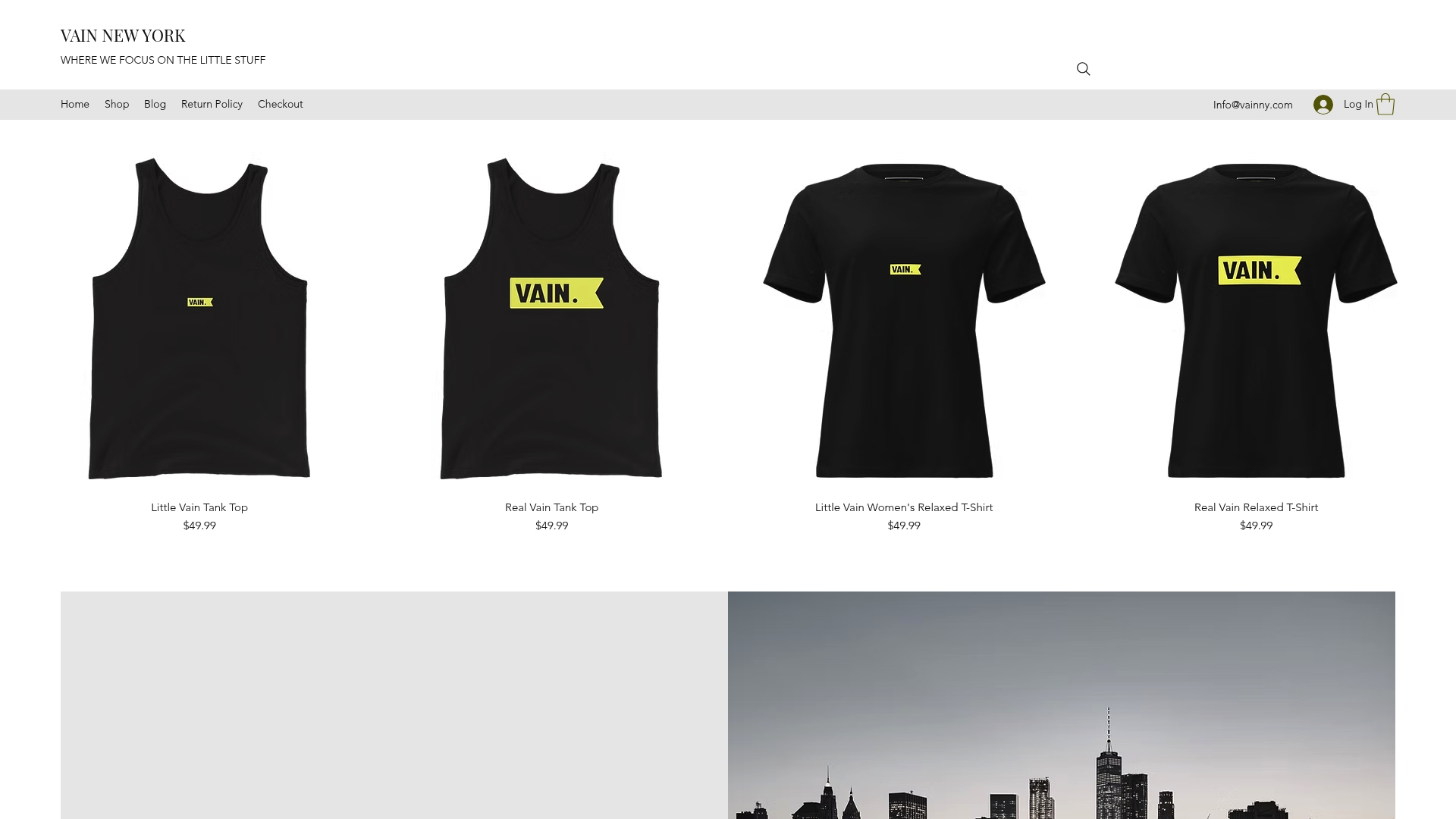
We love this question because it sits where craft meets brand. Every decoration method is a decision about how a design should feel in the hand, not just how it looks on a screen. Our approach is to start with the idea and the audience, then let the method follow. At Vain., we are a creative media and technology company, and we work as a creative consultancy and production company with a growing network of collaborators. That means apparel is rarely a standalone product for us: it connects to the story, the video, the campaign and the community around a brand. Our own merchandise is made to order with precision and care, from studio tanks and tees to hoodies and sweatshirts. We believe the best branded apparel comes from intentional, collaborative work, where the artwork, the garment and the finish are chosen together. That is how an ordinary shirt becomes something people want to wear. Vain.
Bring your apparel idea to life
If you are planning branded apparel and want the creative thinking around it, we can help. Vain. offers video, audio, animation and strategy for brands, artists and organizations, and we make our own studio apparel to order, with pieces ranging from the $49.99 Studio Tank Top to the $99.99 Studio Hoodie. Explore our work and offerings at vainnewyork.com.
FAQ
Is embroidery better than printing?
Neither is better in every case. Embroidery gives a raised, premium finish that suits caps, polos and jackets with simple logos. Printing suits detailed artwork, large graphics and many colors. Match the method to the design and the garment.
Is embroidery or screen printing more durable?
Both hold up well with sensible care. Embroidery is stitched into the garment, which is why it is common on uniforms and workwear. Screen prints also perform strongly: the Clemson researchers found no noticeable change after five home washes. Washing inside out and avoiding high dryer heat helps both.
What is the difference between embroidery and DTG?
Embroidery stitches thread into the fabric and works best for simple, compact designs. DTG sprays water-based ink directly onto the garment from a digital file, so it reproduces gradients, photos and many colors. DTG needs no screens, which makes it suited to small runs.
Which is cheaper for a small order?
For a small run with a colorful design, DTG is usually the most economical, since there are no screens to make. For a simple logo you will reuse, embroidery’s one-time digitizing file pays off on reorders. Screen printing becomes the value choice as quantities climb.
Can I use both on one collection?
Yes, and many brands do. Embroider small logos on caps and outerwear, and print bold graphics on tees and sweatshirts. The collection feels cohesive when the artwork, colors and placement are planned together.
Sources
Recommended
Comments