Content Pillar Strategy: How to Build One That Gets Produced


A content pillar strategy is a short list of themes your brand commits to owning, so every video, post, podcast and email has a reason to exist. The strategies that work are the ones that reach production: each pillar is tied to an audience need, a business goal and a format your team can actually make every month. That last step is where most plans stall, and it is where a creative team that shoots, records and animates alongside the strategy earns its place. We build pillars with that end in mind, and this guide shows you how to do the same.
TL;DR
A content pillar is a core theme your brand publishes around repeatedly. Most guidance lands on three to five at a time.
Good pillars sit where audience demand, your real expertise and a business goal overlap. Vague labels like “thought leadership” are too loose to guide production.
A style guide keeps the pillars sounding like one brand: voice, tone, word choices and formatting, with examples.
Each pillar needs an anchor piece, derived cuts and a calendar. Measure by pillar, monthly or quarterly.
Plan formats before you commit to a pillar. A pillar you cannot shoot, record or animate consistently is a wish.
Table of Contents
What a content pillar actually is
Think of pillars as the load-bearing columns of a building. Campaigns, trends and one-off announcements come and go, but the columns stay put and everything rests on them. In practice, a pillar is a theme broad enough to generate months of content and narrow enough that your audience knows what you stand for.
Search Engine Land’s Claire Taylor describes a pillar as a fundamental theme that forms the backbone of a brand’s content strategy, shaping brand identity and voice across platforms. Shopify defines it more operationally: a key theme that guides what you create for social channels, blogs and email, outlining the categories each piece falls into.
A pillar is a planning decision, not a tag. A tag describes what you already published. A pillar decides what you will publish next quarter, and what you will say no to.
Why brands build them
Pillars solve three everyday problems.
Consistency. When a brand posts across a website, social channels, video and email, a shared set of themes keeps the message recognizable. Without it, each channel drifts.
Focus. Planning gets faster when every idea has to fit a pillar. The “should we post this?” debate shrinks to “which pillar is this?”
Results. Gartner found that content marketing fails to affect business outcomes when it is not aligned with both organizational goals and audience needs, and recommends content pillars as the way to refine strategy into themes. The same analysis warns that loosely defined subjects such as thought leadership or sustainability are too vague to drive real content development.
If you want the wider frame around pillars, our guides on content marketing strategy and content strategy for marketers cover goals, audiences and channels.
How many pillars you need
The common range is three to five. Fewer than three and your channel reads like a single-issue account. More than five and your team spreads thin, and your audience cannot summarize what you are about. For a small studio, a boutique brand or a nonprofit with a lean team, three is often the honest number.
The real limit is production capacity. Count the people, the shoot days and the budget you have in a typical month, then pick the number of pillars you can feed without rushing. A pillar that publishes once and goes quiet is worse than no pillar, because it teaches your audience to stop looking.
How to create content pillars, step by step
1. Start with the audience, not the product
Write down who you want to reach and the questions they bring to you. A New York apparel label may be talking to people who care about studio culture, neighborhood style and how things are made. A boutique agency may be talking to marketing directors who need to ship video on a deadline. Pull these questions from customer emails, sales calls, comments and search results.
2. List what you can credibly own
Brand authority is the filter most plans skip. You can only hold a theme if you have real knowledge, access or a point of view on it. Behind-the-scenes process, founder stories, craft knowledge and original data all count. A generic “tips and tricks” theme does not.
3. Tie each theme to a business goal
Every pillar should connect to something the business wants: bookings, orders, subscribers, awareness in a specific market. Gartner’s finding above is the reason. If a pillar serves the audience but not the goal, it becomes a hobby. If it serves the goal but not the audience, nobody watches.
4. Write each pillar as a promise
A single word such as “Marketing” tells nobody what to make. A sentence does. Compare “Culture” with “Show how New York creatives make the work behind the work.” The second one suggests shoots, interviews and series, and it gives you an editing rule: if a piece does not keep that promise, it waits.
5. Run the 24-month test
Ask whether the theme will still matter in two years. If not, it is a campaign theme, and campaigns belong inside pillars, not beside them.
6. Check production fit
For every pillar, name the formats it will take and who makes them. Video, audio, animation and still photography each have different costs and turnaround times. Our guide to content creation walks through that planning in more detail.
Pillar examples you can adapt
Examples are the most searched part of this topic, so here are three shapes, each built from a different kind of brand. These are illustrations of structure, not claims about any company’s results.
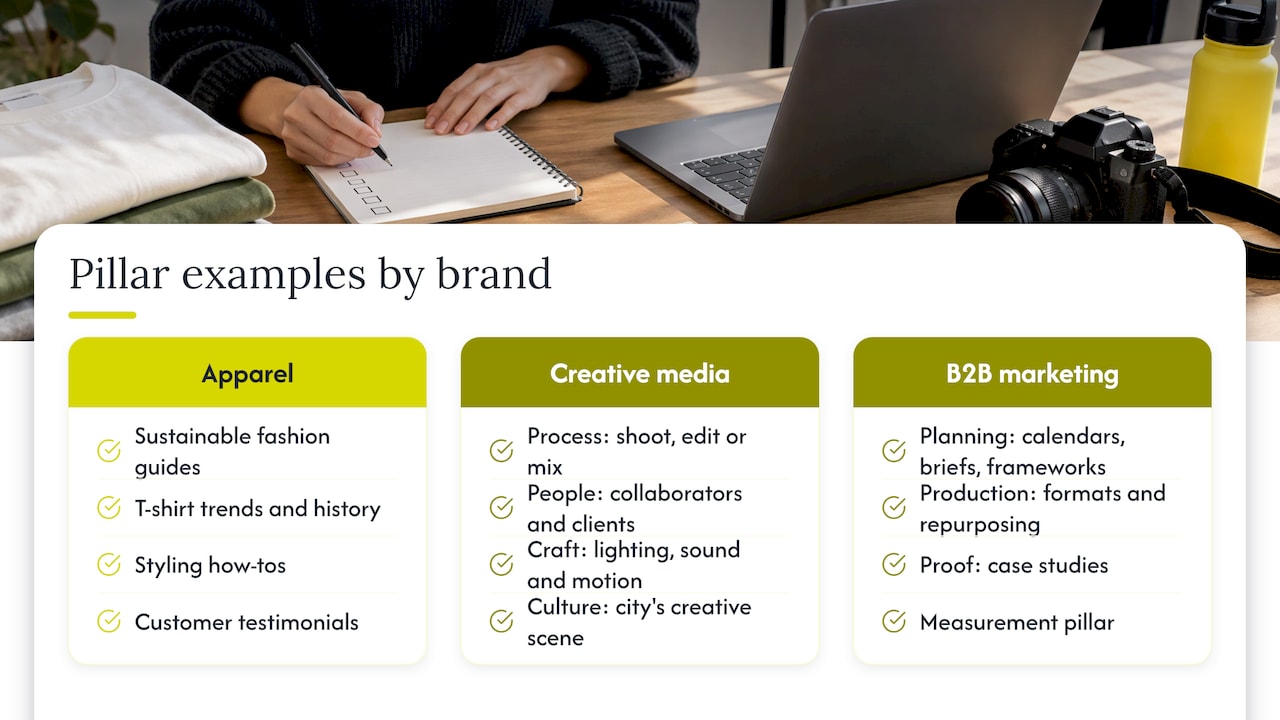
A merchandise and apparel brand. Shopify’s own sample for a sustainable t-shirt business lists four pillars: sustainable fashion guides, t-shirt trends and history, styling how-tos and customer testimonials. Notice the mix. Two pillars educate, one inspires, one proves. A made-to-order brand could adapt it to craft stories, styling, behind-the-scenes production and customer wear.
A creative or media company. Pillars might be process (how a shoot, edit or mix comes together), people (profiles of collaborators and clients), craft (short explainers on lighting, sound and motion) and culture (what is happening in the city’s creative scene). Each pillar has an obvious video or audio form.
A B2B brand selling to marketers. Pillars might be a planning pillar (calendars, briefs, frameworks), a production pillar (formats and repurposing), a proof pillar (case studies) and a measurement pillar. Our pieces on corporate video types and the case study video format show how a single pillar becomes several finished assets.
Across all three, the strongest pillars either define who the content is for or own a topic area. The weakest are about the product alone. A “company news” pillar tends to fill the calendar with announcements that few people outside the company were waiting for.
The content style guide that keeps pillars consistent
Pillars say what you talk about. A style guide says how you talk about it. Brands that publish across several channels, or with several contributors, need both, which is why searches for content style guides and brand content guidelines sit so close to pillar searches.
Zapier’s guidance says a style guide should cover voice and tone, grammar preferences, word usage rules and formatting essentials, with optional channel-specific sections. Its examples include a university that keeps a separate social media guide with instructions for each network.
What to put in yours
Voice. Three to five personality traits, each with a one-line definition and a do and don’t example.
Tone. How the voice flexes. Celebrating a client launch calls for a different register than answering a complaint.
Word choices. Terms you use, terms you avoid, how you write product names and numbers.
Formatting. Headline style, caption length, capitalization, hashtags, subtitle conventions for video.
Visual notes. Color, typography, framing and motion rules for video and animation.
Pillar mapping. One line per pillar saying which voice trait leads and which formats it favors.
Cloudflare’s 2025 content style guide is a useful model. It defines its voice with three traits and uses tone dials to turn each trait up or down by content type, so homepage copy, thought leadership and product content each lean on a different trait while the voice stays one. That is the idea to borrow: one personality, adjustable volume.
The guide only works if people can use it. Put in sentences that show how you say ordinary things, such as how you greet a customer, announce a new drop or explain a delay. Examples beat adjectives every time. Keep it a living document, and update it whenever the brand shifts.
From pillar to publishing plan
A pillar becomes real when it has a template and a rhythm. Here is a structure that works for lean teams.
Build a pillar tree
Give each pillar three levels. The pillar is the promise. Under it sit branches, which are the subtopics. At the end of each branch are leaves, which are individual videos, posts, episodes or emails that answer one question. For a pillar about pre-production, branches might be storyboarding, shot lists, scheduling and location scouting. A branch with no leaves is a content gap. A leaf with no branch is off strategy.
Anchor and derive
Choose one substantial anchor piece per pillar per quarter, staggered so you are not producing every anchor in the same month. A documentary-style video, a long interview or a detailed guide all qualify. Then cut derivatives from it: short clips, quote cards, audio snippets, carousel slides, newsletter sections. This is how a small team keeps four pillars alive without four full productions every week. Our ideas for short-form video hooks and the explanation of vertical versus horizontal framing matter here, because a clip cropped carelessly from a wide shot loses the point of the shot.
Put it on a calendar
Use columns for publish date, pillar, audience question, format, channel, anchor or derived, owner, reviewer and status. Fit the pillars into an overarching monthly topic, and tailor post types to each platform while keeping the voice constant, as Search Engine Land advises. Our walkthrough of a social content calendar shows a working layout.
Keep a backlog
Hold at least two months of topic ideas per pillar, so a missed shoot day never means an empty week.
Measuring whether pillars work
Track results by pillar, not just by channel. Three measures cover most needs: engagement rate by pillar (which themes resonate), content volume by pillar (whether your mix stayed balanced) and conversion rate by pillar (which themes lead to inquiries or sales). ClickUp recommends reviewing these monthly or quarterly rather than daily.
Be patient with search. Shopify notes that social and email results show up right away, while organic search traction can take up to six months. If a pillar is not drawing an audience after a fair run, move effort to the pillar earning the most engagement and rework the weak one rather than abandoning the system.
For a 90-day structure that connects pillars to proof, see our guide to proving a branded content strategy, and for the audience side, building an audience that converts.
Where Vain. fits
We are a creative media and technology company in New York City. Our services are video, audio, animation and strategy, so the plan and the production can come from one place. Our approach is collaborative: we draw on a growing network of collaborators to take a pillar from a written promise to finished content.
If you already have pillars, we can turn them into anchor pieces and derivatives. If you are still defining them, our strategy work covers content creation, marketing strategy, brand development and audience growth. See what we offer on Vain.'s services page.
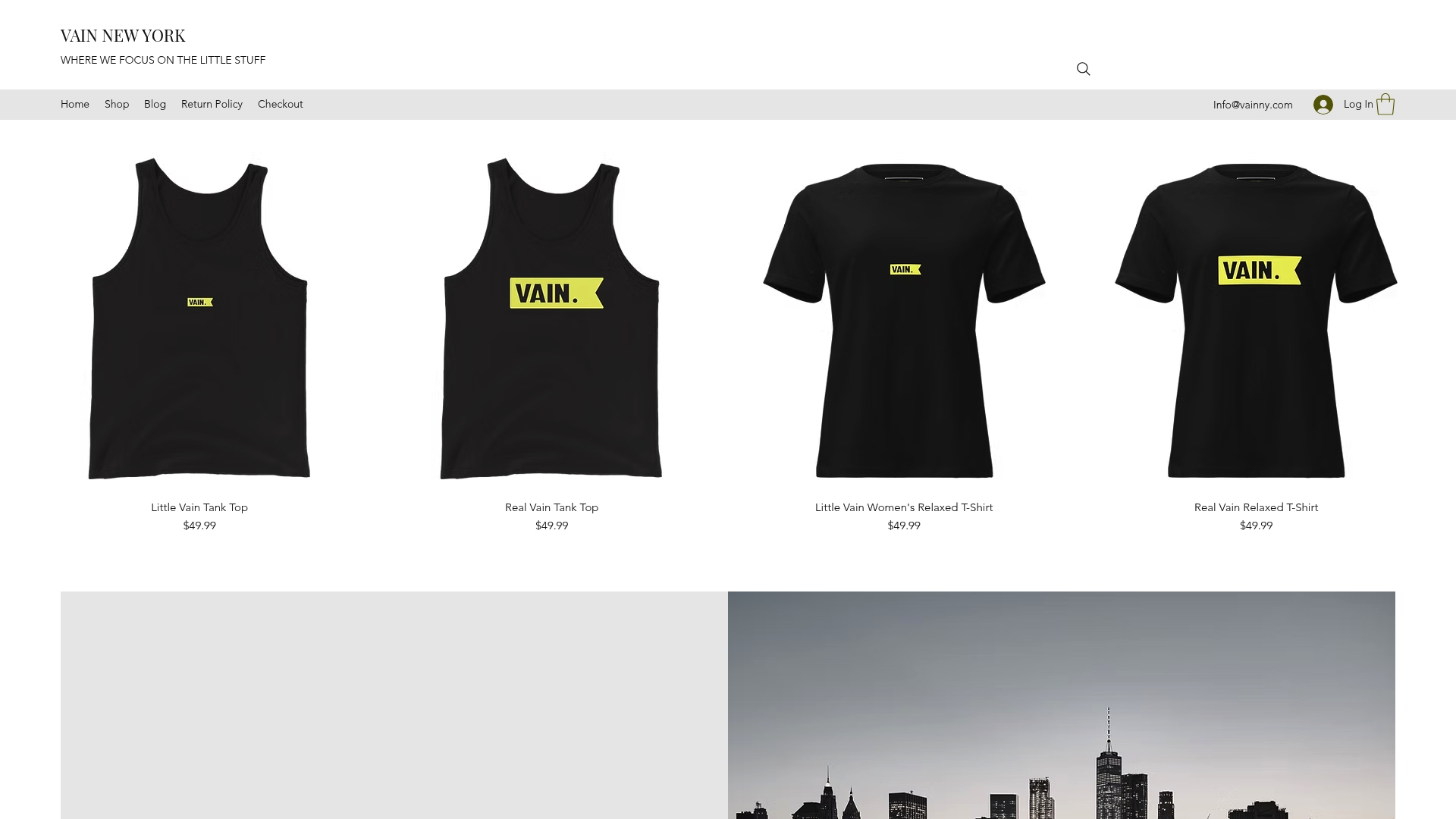
Brand also lives off the screen. Our made-to-order merchandise, such as the Studio T-Shirt at $59.99 and the Studio Hoodie at $99.99, gives a pillar like craft, studio culture or neighborhood identity something people can wear, and a physical object to feature in your content.
Our perspective
Most pillar plans we read are sound on paper. They name three to five themes, they sound sensible, and then they sit in a deck. The reason is simple: nobody asked who would film it. We believe a pillar is only as strong as the work it produces. The ordinary becomes extraordinary through intention and collaboration: a clear promise, the right collaborators and a production process that respects the craft. A pillar about process needs a camera that can follow a project from the first sketch to the final mix. A pillar about people needs interviews shot with care and sound that carries the room. That is why we pair strategy with video, audio and animation. When the plan and the production share a table, the pillars stay specific, the formats fit the budget and the voice survives every cut. Start with the promise, then build the work to keep it. Vain.
FAQ
What is a content pillar strategy?
It is a plan that organizes all your content around a few core themes, usually three to five. Each pillar connects an audience need to a business goal, and each piece you publish belongs to one of them. The result is more consistent messaging and faster planning.
What are the four pillars of content?
There is no official set of four. Many brands use a mix such as educational, inspirational, entertaining and promotional content. Better pillars are specific to your brand, such as a craft, a community or a point of view you can own, with those general types serving as formats inside them.
How do I create a content style guide?
Start with three to five voice traits, add rules for tone, word choices and formatting, and include real examples of how you say common things. Add channel notes for social, video and email, then share it with everyone who creates content and update it when the brand changes.
How often should I review my pillars?
Review performance monthly or quarterly, by pillar. Keep the pillars themselves steady, since the point is to build recognition over time, and change one only when the data and your goals both say it has stopped doing its job.
Sources
Recommended
Comments