Customer Retention: A Practical Playbook With Metrics


Customer retention is the practice of keeping paying customers active and buying over time, and it is the single fastest lever most businesses have for growing revenue. A 5% increase in retention can lift profits by 25% or more, which makes it more efficient than most acquisition campaigns.
The highest-impact levers, in order, are:
Onboarding speed, or “time to value” — how fast a new customer reaches the moment your product proves its worth.
Product experience that removes friction at the exact points customers get stuck.
Personalized lifecycle communication that matches the message to the customer’s stage, not a generic blast.
A loyalty program built around effortless redemption, not just points.
Proactive customer service that catches problems before a customer has to complain.
Pro Tip: This week, pull your last 90 days of cancellations and read the first three support tickets each of those customers ever filed. The pattern you find there is usually your biggest retention fix, and it costs nothing to run.
Key Takeaways
Customer retention improves fastest when teams pair precise measurement (CRR, churn rate, NDR, CLV) with lifecycle-stage tactics like fast onboarding, proactive outreach, and effortless loyalty redemption.
Point | Details |
Retention drives profit | A 5% retention increase can lift profits by 25% or more, more efficiently than most acquisition spend. |
Measure before acting | Use CRR, churn rate, CLV, and NDR formulas monthly, and build cohort curves quarterly. |
Fix onboarding first | Poor time-to-value is the most common churn driver and the fastest one to fix. |
Loyalty needs frictionless redemption | Program members spend substantially more with a preferred brand, but only if redemption feels effortless. |
Segment before personalizing | Map new, at-risk, and high-LTV customers to distinct actions rather than one blanket campaign. |
Creative execution decides outcomes | Vainnewyork produces the onboarding content and lifecycle campaigns that make retention strategies work in practice. |
Table of Contents
What Customer Retention Actually Means
Customer retention describes a business’s ability to keep customers buying, subscribing, or engaging over time instead of churning to a competitor or simply going dormant. It shows up in three related but distinct forms: logo retention (did the account stay?), revenue retention (did the dollars stay, or grow?), and repeat-purchase retention (did the same shopper buy again?). Confusing these three is one of the most common measurement mistakes teams make.
Retention plays out across a lifecycle. A prospect makes first contact, moves through onboarding, adopts the product into their routine, renews or repurchases, and, in the best cases, becomes an advocate who brings in referrals. Every stage has its own drop-off risk, and a strategy tuned for the onboarding stage will usually fail if applied to a renewal conversation.
It helps to separate three terms that get used interchangeably but mean different things:
Retention is a measured outcome. Did the customer stay and keep transacting?
Loyalty is an attitude and a behavior pattern. It’s why a customer stays even when a cheaper option exists.
Churn is retention’s mirror image. It’s the rate customers leave, and it is usually the number leadership actually watches.
Why Customer Retention Matters for Growth
Retention changes the shape of your revenue, not just its size. A retained customer typically costs less to serve, buys with less friction, and often expands their spending over time. Consider the impact:
Higher lifetime value. A customer who stays three years is worth several times more than one who churns after three months, even at the same monthly spend.
Lower acquisition pressure. Every dollar you don’t need to spend replacing a lost customer can fund product or service improvements instead.
More predictable revenue. Recurring customers make forecasting realistic instead of aspirational.
Built-in referral value. Loyal customers refer other customers, which quietly lowers your blended acquisition cost.
That 5% retention lift translating to a 25% or greater profit increase is one of the most durable findings in business economics, and it holds because retained customers cost less to serve while they buy more.
This is also why retention deserves its own line item in the budget conversation, not just a mention in the marketing plan. When leadership treats retention as a product and customer success problem instead of purely a marketing one, the investment tends to follow the customers who are actually at risk.
Should You Prioritize Retention Over Acquisition?
Three signals tell you it’s time to shift budget toward retention: your customer acquisition cost (CAC) has been rising for two or more quarters, a specific cohort is churning faster than the rest of your base, or you have a near-term revenue gap that new customers won’t close fast enough to matter.
The math tends to favor retention more than most teams assume. Losing one customer often requires acquiring roughly three new ones just to replace that lost revenue. If a $200 monthly customer churns, replacing that revenue with new logos, factoring in acquisition cost and ramp time, usually costs more than a retention offer that keeps the original customer for another year.
Before your next budget conversation, run this checklist:
Is CAC trending up while retention stays flat or drops?
Does one segment show disproportionate churn versus the rest of your base?
Would a modest retention investment close more revenue gap than a comparable acquisition spend?
If you answered yes twice, retention should win the next budget cycle. Our client acquisition guidance covers the acquisition side of this tradeoff in more depth.
What Makes Customers Leave in the First Place?
Churn rarely has one cause. It usually stacks up from a handful of predictable failure points, roughly in this order of frequency:
Poor onboarding and slow time-to-value — customers give up before the product proves itself.
Product-market mismatch — the customer bought for a use case your product doesn’t actually solve well.
Bad support experiences — one poorly handled ticket can undo months of goodwill.
Price-to-value gaps — the customer no longer feels the price matches what they’re getting.
Billing and payment failures — expired cards and failed charges cause silent churn that looks voluntary but isn’t.
Lack of personalization — generic messaging makes customers feel like an account number, not a relationship.
Each driver leaves a different fingerprint in your data. Onboarding failure shows up as drop-off in the first 30 days. Payment failure shows up as churn with no complaint ever filed. Support-driven churn usually follows a specific ticket within weeks.
Pro Tip: Cross-reference your transactional NPS scores, behavioral analytics (login frequency, feature adoption), and payment failure logs side by side for churned accounts. The driver that shows up across all three data sources first is your real problem, not the one your team assumes it is.
How Do You Measure Customer Retention?
You cannot manage retention without measuring it precisely, and the formulas are simpler than most dashboards make them look.
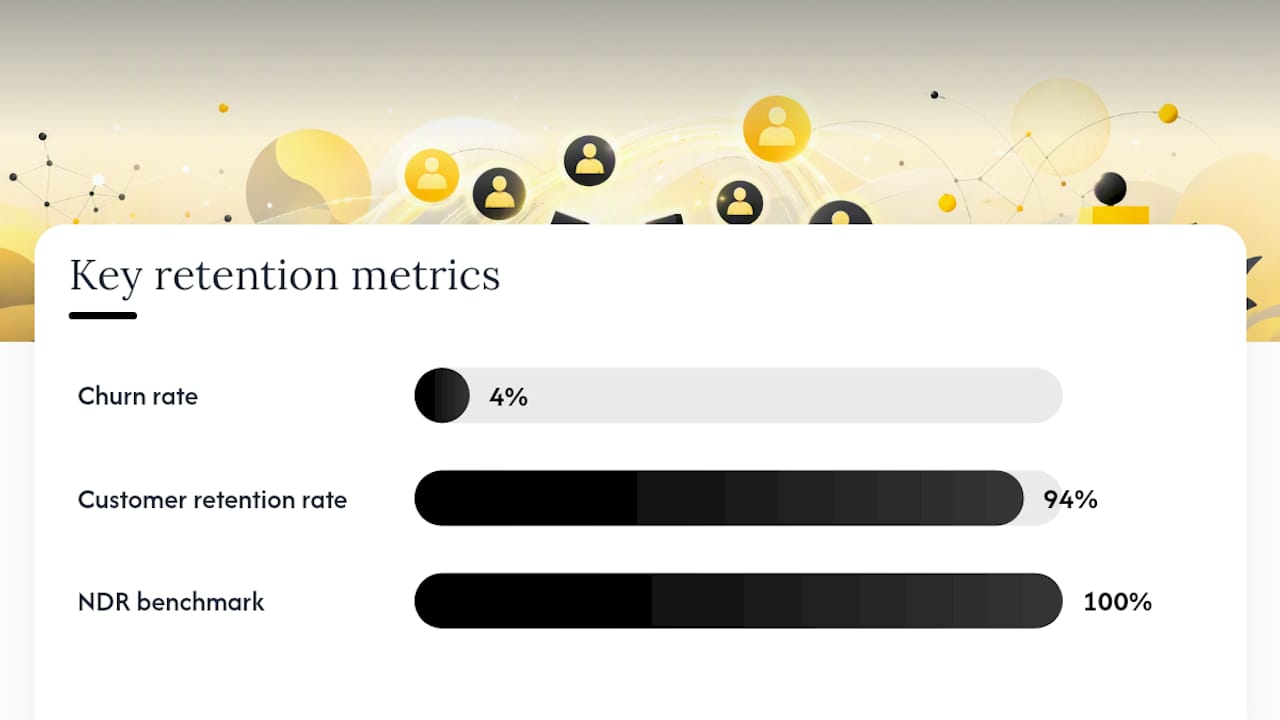
Churn rate = (Customers lost during period ÷ Customers at start of period) × 100. Lose 20 of 500 customers in a month, and your monthly churn rate is 4%.
Customer retention rate (CRR) = ((Customers at end of period − New customers acquired) ÷ Customers at start of period) × 100. Start with 500, end with 510, add 40 new ones, and CRR is (510 − 40) ÷ 500 = 94%.
Customer lifetime value (CLV) = Average purchase value × Purchase frequency × Average customer lifespan. A customer spending $50 per month for 24 months has a CLV of $1,200.
Net dollar retention (NDR) = (Starting revenue + Expansion − Contraction − Churn) ÷ Starting revenue × 100. NDR above 100% means existing customers are growing revenue faster than they’re shrinking it, a benchmark SaaS finance teams watch closely.
Repeat purchase rate = Customers with more than one purchase ÷ Total customers.
Net Promoter Score (NPS) functions as a leading indicator: a dropping score often predicts churn weeks before it shows up in billing data.
Cohort analysis turns these formulas into a picture over time. Group customers by the month they signed up, then track what percentage of each cohort is still active at 30, 60, and 90 days. The resulting retention curve usually flattens somewhere; that flattening point is your loyal base, and the steep early drop before it is where onboarding is failing.
Closing the loop between feedback and revenue is what separates teams that measure retention from teams that act on it. A useful cadence: check transaction volume and active users weekly, review revenue retention and churn monthly, and audit NPS and cohort curves quarterly. Our marketing analytics playbook walks through building this reporting rhythm in more detail.
What Strategies Actually Improve Retention?
Not every retention tactic deserves equal investment. Some move the needle fast and cost little to test; others take longer but compound.
Tactic | What to do | How to measure | Quick experiment |
Onboarding / time-to-value | Cut the steps between signup and the first meaningful result | Days to first value, activation rate | Test a shortened onboarding flow against your current one |
Proactive customer success | Reach out before usage drops, not after | Time-to-first-outreach, save rate | Trigger a check-in call after several days of declining logins |
Personalized lifecycle messaging | Match message content to lifecycle stage | Open rate, conversion by segment | A/B test generic versus behavior-triggered emails |
Product UX fixes | Remove the top three friction points from support tickets | Task completion rate, ticket volume | Ship one fix, measure ticket volume for 30 days |
Loyalty and rewards | Reward the behaviors that predict retention, not just spend | Enrollment and redemption rate | Test point-based versus tiered status with a small segment |
Payments recovery | Automate retries and card-update prompts before failed charges churn accounts | Recovered revenue, involuntary churn rate | Add a dunning email sequence and track recovery rate |
Content-led re-engagement | Send value-first content to dormant users, not just discount offers | Reactivation rate, click-through rate | Test a helpful how-to email against a discount email |
Retention starts at first contact and runs through the entire lifecycle, which is why the tactics above work best layered rather than run in isolation. Onboarding fixes reduce early churn; lifecycle messaging keeps the middle of the relationship warm; loyalty programs and content re-engagement extend the tail. For SMB teams specifically, CRM-driven visibility into post-sale activity and automated reminders makes these tactics operational without adding headcount. Businesses building out lifecycle messaging in-house often start with our content marketing strategy framework, which maps content types to each stage of the customer journey.
How Do You Design a Loyalty Program That Works?
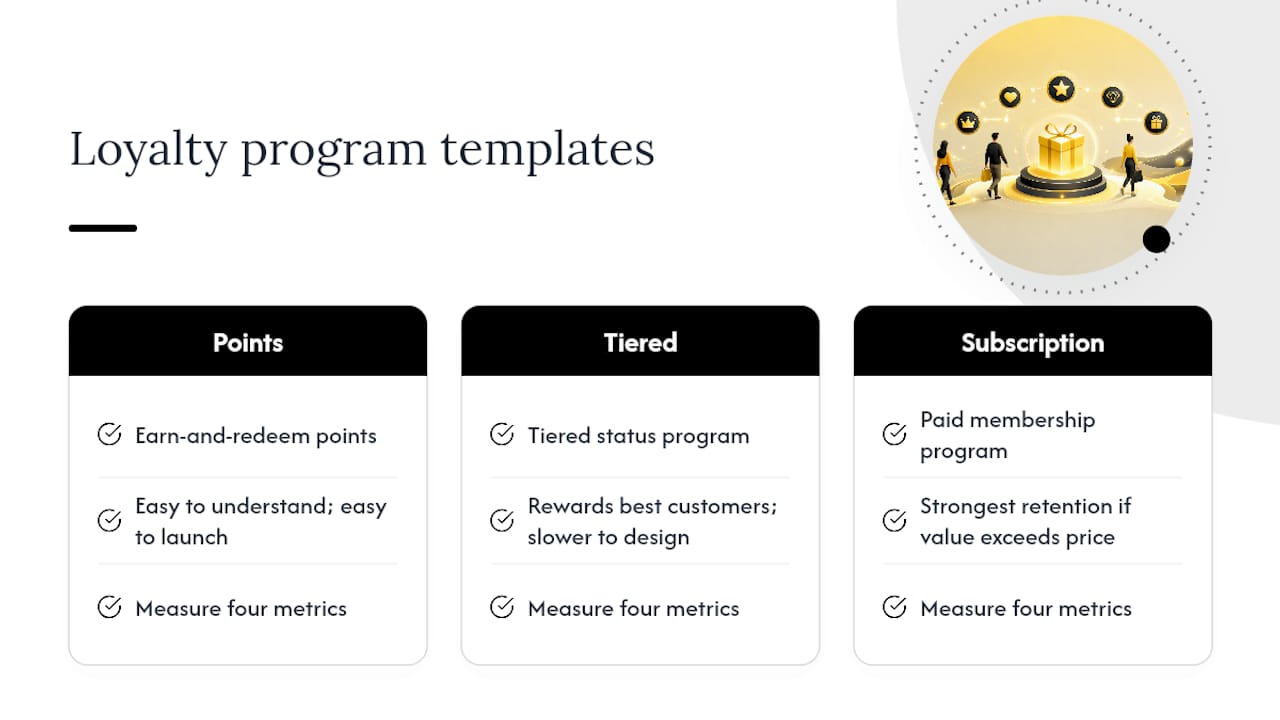
Three loyalty program templates cover most use cases. A points-based earn-and-redeem program is simple to understand and easy to launch, but it can feel transactional if the rewards feel arbitrary. A tiered status program rewards your best customers with escalating perks and works well when status itself is motivating, though it takes longer to design fairly. A subscription or paid-membership program creates the strongest retention lock because customers have already paid for the relationship, but it only works when the membership value clearly exceeds its price.
Whichever template you choose, measure the same four things: enrollment rate, active participation rate (not just signups), redemption rate, and the lift in average order value or repeat purchase rate among members versus non-members.
Loyalty program members are substantially more likely to keep spending with a preferred brand, but enrollment routinely outpaces actual participation. That gap usually traces back to friction at redemption. Make redemption fast and seamless, not time-consuming, and personalize rewards around what a specific customer actually buys rather than a generic catalog.
How Should You Segment Customers for Retention?
Different customers churn for different reasons, so a single retention message will always underperform a segmented one. Map your segments to specific actions:
New customers: fast, guided onboarding focused on reaching first value quickly.
At-risk customers: targeted offers paired with proactive outreach before they churn silently.
High-LTV customers: VIP treatment, early access, and expansion campaigns rather than generic loyalty perks.
Build these segments from behavioral and value-based signals: recency, frequency, and monetary value (the classic RFM model), product usage depth, and engagement signals like email opens or app logins. Personalization and predictive analytics now function as baseline expectations in digital retention rather than a differentiator, and survey data confirms most digital users respond better to tailored content and offers than to generic messaging.
One reminder that’s easy to skip under deadline pressure: personalization only works if you have clear consent for how customer data gets used, and the retention gains disappear fast if a segmentation tactic feels invasive rather than helpful.
Does Retention Work Differently for B2B and B2C?
B2B retention runs through relationships and contracts; B2C runs through habits and convenience. In B2B, success plans need to account for multiple stakeholders inside one account, expansion often comes through account-based upsell motions, and SLAs give both sides a shared standard to manage against. The metrics that matter most are net dollar retention and expansion ARR, since a single account’s growth can outweigh dozens of small transactions.
In B2C, frictionless checkout and app experience usually beat any loyalty mechanic on its own, lightweight point-based rewards outperform complex tiers for most retail buyers, and digital re-engagement campaigns (email, push, retargeting) recover more dormant customers than discounting does. Repeat purchase rate and average order value are the metrics worth tracking weekly.
Ownership differs too: B2B retention usually sits with customer success working alongside sales, while B2C retention typically lives with marketing and product working together.
What Tools Support a Strong Retention Program?
Six tool categories cover most retention programs: a CRM or customer data platform to unify customer records, analytics and cohort tools to build retention curves, automation platforms for lifecycle messaging, payments recovery tools to catch failed charges before they become silent churn, loyalty platforms to manage points or tiers, and feedback or NPS tools to close the survey-to-action loop.
Before buying or configuring any of these, check for five capabilities: identity resolution across devices and channels, behavioral triggers that fire in near real time, the ability to link activity back to revenue, built-in support for A/B experimentation, and real-time personalization rather than batch-and-blast segmentation. A tool that can’t tie a customer action to a dollar figure will make it hard to prove any retention program actually worked.
A 10-Step Retention Playbook You Can Run This Quarter
Benchmark current retention against your CRR, churn rate, and NDR. KPI: baseline retention rate.
Set specific retention goals tied to revenue, not just satisfaction scores. KPI: target CRR or NDR by quarter.
Run cohort analysis to find your steepest drop-off window. KPI: percentage retained at 30/60/90 days.
Redesign onboarding around the fastest path to first value. KPI: time-to-first-value.
Implement behavioral triggers for at-risk signals like declining logins. KPI: save rate on triggered outreach.
Build a feedback loop that routes NPS and survey data to the team that can act on it. KPI: percentage of feedback closed within 30 days.
Run small experiments on messaging, onboarding, or offers before scaling. KPI: lift versus control group.
Design or refine your loyalty program around effortless redemption. KPI: redemption rate.
Tie customer experience metrics to revenue so leadership sees retention as a financial lever. KPI: revenue retained per experience score improvement.
Set governance and reporting cadence so retention stays visible, not just measured once a year. KPI: retention reviewed in every monthly business review.
Assign ownership by function: marketing typically drives steps 2, 6, and 7; product owns steps 4 and 5; customer success carries steps 3, 8, and 9.
What We’ve Learned Producing Content That Keeps Audiences Coming Back
Retention work rewards specificity over polish. In our own content and campaign production, the projects that moved repeat engagement the most weren’t the highest-budget ones. They were the ones built around a single, clear reason for an audience to come back. A short video series built around one recurring format, released on a predictable schedule, outperformed a larger one-off campaign in follow-through and repeat views. Retention often responds better to consistency than to spectacle.
When Should You Bring in Creative Help for Retention?
Retention tactics like onboarding content, lifecycle campaigns, and loyalty communications all live or die on execution quality, and that’s exactly where Vainnewyork’s production experience fits in. Vainnewyork functions as a creative consultancy and production partner, building the video, content, and campaign assets that turn a retention strategy on paper into something customers actually notice and respond to.
DIY works fine when you have in-house creative capacity and time to spare. It stops working the moment you need to launch multiple lifecycle campaigns at once, test creative variants quickly, or produce content at a pace your internal team can’t sustain. That’s the gap Vainnewyork exists to close: our team brings customer engagement and content strategy experience to bear on exactly the onboarding sequences, campaign videos, and loyalty communications that decide whether a retention strategy survives contact with real customers. If your onboarding content or lifecycle campaigns need a production partner who can move at the pace your retention experiments require, book an introductory consultation with Vainnewyork and bring your current retention numbers to the conversation.
Frequently Asked Questions
What is a good customer retention rate?
How is customer retention rate different from churn rate? Retention rate measures the percentage of customers who stayed; churn rate measures the percentage who left. They’re mirror images, and most teams track both because churn spikes can hide inside an otherwise healthy retention number.
What’s the fastest way to improve customer retention? Fixing onboarding and time-to-value usually produces the fastest measurable gains, since most churn happens in the first 30 to 90 days before a customer has experienced real product value.
How often should retention metrics be reviewed? Check transaction and activity data weekly, review churn and revenue retention monthly, and audit NPS and cohort curves quarterly to catch both short-term problems and longer-term trends.
Does a loyalty program guarantee better retention? No. Enrollment alone doesn’t move retention; participation and easy redemption do. A well-designed program with frictionless rewards outperforms a larger program that customers sign up for and then ignore.
Sources
Recommended
Comments