Commercial Production for Brands: What to Expect


Commercial production, in the advertising and video context, is the end-to-end process of turning a marketing concept into a finished, broadcast-ready or platform-ready asset. When brands and agencies talk about commercial production, they mean the full creative and technical pipeline: from scripting and casting through shoot days and into post-production, color, sound, and final delivery.
What it includes: pre-production planning, principal photography or animation, and post-production finishing, all coordinated to deliver a polished ad or branded video.
Who runs it: production companies, executive producers, and agency liaisons working together as a single creative organism.
A note on the term: “commercial production” also appears in manufacturing, pharmaceuticals, and resource extraction to describe large-scale goods output. When briefing vendors, clarify that you mean advertising or branded video production.
Vainnewyork operates squarely in the advertising and media sense of the term, bringing creative consultancy and hands-on production together under one roof.
Table of Contents
What does a commercial production company actually do?
A commercial production company turns a marketing brief into finished visual content, managing every creative and logistical layer between concept and delivery. Think of it as the architecture firm that translates your vision into a building you can actually occupy.
Core services you should expect:
Concepting support and script development
Location scouting, permitting, and production design
Casting (union and non-union talent)
Direction, cinematography, grip, and lighting
Sound recording and on-set audio
Post-production: editing, color grading, VFX, sound design, and mix
Deliverables packaging: broadcast masters, social cuts, platform-specific versions, lower-thirds, and still assets
Key roles and who fills them:
Executive producer (EP): owns the project relationship and budget at the highest level
Line producer: manages day-to-day logistics, crew, and spend
Director: drives creative vision on set
Director of photography (DP): the visual architect responsible for camera and lighting
Production coordinator: schedules, call sheets, and vendor communication
Editor and colorist: shape the story and visual tone in post
Sound mixer and post supervisor: deliver broadcast-quality audio and oversee finishing
Agency liaison: the bridge between the brand’s agency and the production team
US-specific contract items to watch for include usage rights windows, licensing territory, SAG-AFTRA talent agreements, and production liability insurance certificates. Understanding production roles and departments before your first call with a vendor puts you in a far stronger negotiating position.
What are the stages of a commercial production project?
Every commercial video production moves through three core phases: pre-production (planning and preparation), production (the shoot), and post-production (finishing and delivery). Each phase has its own rhythm, and understanding that rhythm helps you set realistic expectations before you sign anything.
Pre-production: Client brief, script development, storyboards, casting, location scouting, permitting, crew hiring, and scheduling. For smaller social spots, pre-production typically runs a few weeks. Larger broadcast campaigns often need several weeks of pre-production alone.
Production: Principal photography or animation capture. Crew call sheets go out the night before each shoot day. Dailies (raw footage) are reviewed by the director and agency after each day. A single-location social spot might wrap in one day; a multi-location broadcast spot can run several shoot days or more.
Post-production: Offline edit, client review rounds, sound design, color grade, VFX, and mix. A tight social cut can turn around in a couple of weeks; a broadcast spot with heavy VFX can take over a month in post alone.
Delivery: Final QC, master file export, platform-specific versions, and asset handoff. The commercial production date marks when the asset is cleared for distribution, not when the shoot ends.
A well-documented production workflow is what separates a repeatable, professional operation from a chaotic one-off shoot.
Pro Tip: To compress timelines without sacrificing quality, lock the script and storyboards before pre-production begins. Every revision after that point costs time and money. The single biggest schedule killer in commercial production is creative indecision during pre-production, not production itself.

Which type of production company should you hire?
Not every production company is built for every project. The type of company you choose shapes your creative outcome, your budget, and how smoothly the whole process runs.
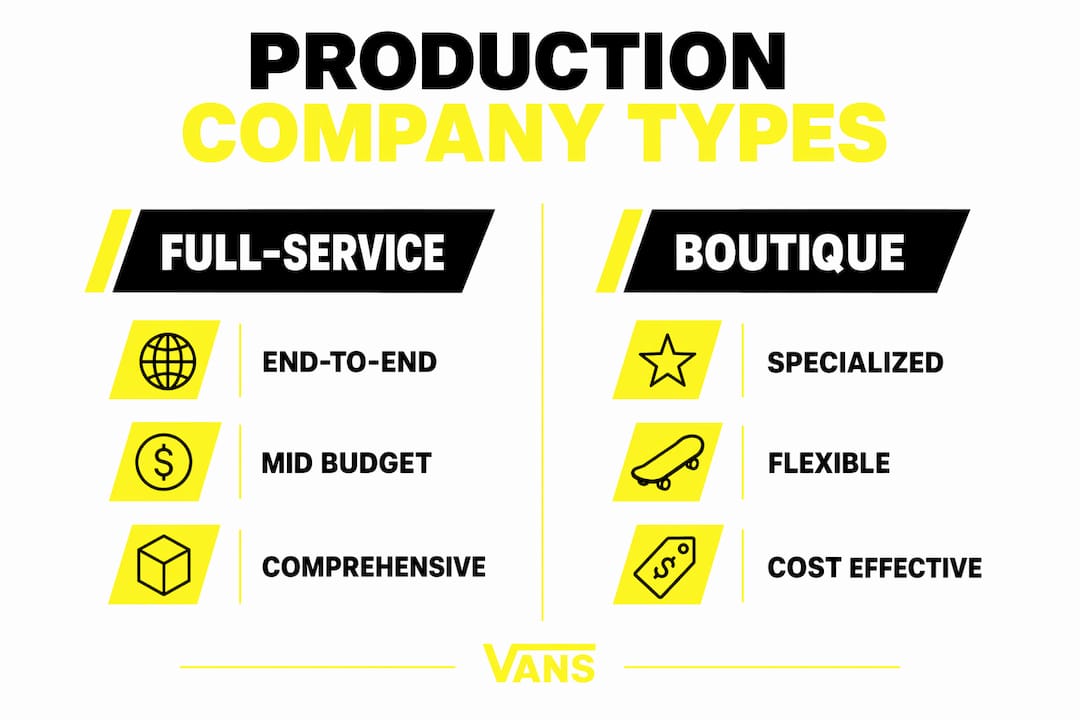
Full-service production companies handle everything from concept through delivery. They carry full crews, own or rent equipment, and manage post in-house or through trusted partners. Best for brands that need a single accountable vendor on a mid-to-large broadcast or digital campaign.
Boutique creative shops are smaller, often director-led companies with a distinct aesthetic point of view. They excel on projects where creative voice matters more than production scale. Ideal for brands that want a specific look and are willing to build a slightly larger vendor team around a strong director.
Post-production houses specialize in editing, color, VFX, and finishing. You bring them footage; they make it sing. Best when you have an in-house or agency production team and need specialist finishing.
Animation and CG studios live in the world of motion graphics, 2D/3D animation, and visual effects. The right call when live-action is not the medium or when explainer-style content is the goal.
Audio-only and music production shops handle original scoring, sound design, and mix. Often brought in as a specialist sub-contractor by full-service companies.
Company type | Best fit | Budget shape | Key advantage | Watch out for |
Full-service | Mid-to-large campaigns, single vendor needed | Mid to high | End-to-end accountability | Higher overhead on small projects |
Boutique creative | Director-driven, brand-voice projects | Low to mid | Strong creative POV | Limited crew/equipment depth |
Post house | Footage already shot, finishing needed | Low to mid | Deep technical expertise | No on-set production support |
Animation/CG studio | Non-live-action, explainer, motion content | Variable | Specialized medium mastery | Longer timelines for complex CG |
Audio/music shop | Scoring, sound design, mix only | Low | Specialist craft | Narrow scope |
For brands managing multi-platform campaigns, content creation planning across deliverable types helps you decide which company type to anchor your project around.
What drives cost and timeline in U.S. commercial production?
Cost and timeline in U.S. commercial production are driven by crew size, shoot days, locations, talent agreements, equipment, VFX complexity, and deliverable count. Every one of those variables compounds: add a location, and you add travel, permits, and a longer shoot day.
Primary cost drivers:
Talent and casting: SAG-AFTRA union talent commands session fees, residuals, and use fees tied to media and territory. Non-union talent costs less upfront but limits some distribution channels.
Locations and permits: Studio rentals in major U.S. markets run from a few hundred to several thousand dollars per day. Exterior locations in cities like New York or Los Angeles require permits that add both cost and lead time.
Crew hours and overtime: Union crew rules (IATSE) set overtime thresholds that can materially inflate a budget if the shoot runs long.
Production design: Sets, props, wardrobe, and art direction can range from minimal to a significant line item on larger productions.
VFX and post complexity: Simple color and cut is one price; compositing, 3D integration, or motion graphics is another category entirely.
Music licensing: Sync licensing for a known track can cost as much as the entire production on a small project. Original composition is often more predictable.
Deliverable volume: Each platform-specific cut (15-second, 6-second, vertical, square) adds editing time and QC rounds.
Budget reality check: A social-first spot produced in a single U.S. market might run a moderate to high budget depending on crew, talent, and post scope. A broadcast commercial with union talent, multiple locations, and VFX finishing can be substantially more expensive. These are generalized U.S. ranges; actual quotes vary significantly by market, scope, and timing.
Industry-specific factors like regulatory compliance, supply-chain logistics for props and equipment, and shifting market conditions can all affect timelines and budgets. Surface these risks early in your scoping call, not after the contract is signed.
How do you choose the right commercial production company?
The right production company balances creative fit, production capability, budget transparency, and process compatibility. A beautiful reel means nothing if the company cannot manage a three-location shoot on your timeline or cannot produce a clear, itemized quote.
Hiring checklist:
Portfolio and reel work comparable to your project type and scale
Named credits and verifiable references from past clients
Clear pricing structure with itemized line items, not lump sums
Defined revision and approval-round policy in writing
Production liability insurance certificate (minimum $1M general liability is standard in the U.S.)
SAG-AFTRA and IATSE familiarity if your project involves union talent or crew
Explicit usage rights and licensing language in the contract
Turnaround capacity that matches your delivery deadline
Questions to ask on your first call or in your RFP:
“Can you show reel work that is comparable in scope, tone, and budget to this project?”
“Who will be our day-to-day contact from brief through delivery?”
“How do you handle revision rounds, and how many are included in the quote?”
“What insurance and union credentials does your company hold?”
“What exactly is included in this quote, and what triggers a change order?”
“How do you handle usage rights, and what licensing windows are covered?”
Red flags to walk away from:
No references or vague credits (“we’ve worked with major brands”)
Deliverables described in broad strokes with no specifics
Open-ended change-order language with no cap or approval process
No insurance documentation available
Rights and licensing language absent from the contract draft
Producers typically build their credibility through a documented portfolio, verifiable credits, and a network of trusted crew. Ask to see all three before committing.
Key Takeaways
A professional commercial production company brings documented workflows, clear deliverables, and explicit rights language to every project, and choosing the right company type for your scope is the single decision that most affects outcome quality.
Point | Details |
Match company type to scope | Full-service for end-to-end campaigns; boutique for director-driven creative; post houses for finishing only. |
Budget for post and approvals | Post-production and revision rounds are significant cost centers; build them into the budget from day one. |
Confirm rights and insurance | Usage rights windows, licensing territory, and liability insurance must appear in the contract before any shoot day. |
Lock creative before production | Script and storyboard approval before pre-production begins is the single most effective timeline protection. |
Vainnewyork’s approach | Vainnewyork offers end-to-end creative production and consultancy, from concept through delivery, for brands and organizations. |
Why the “best reel” is the wrong thing to optimize for
The most common mistake brands make when hiring a production company is leading with the reel. A reel is a highlight package, and highlight packages, by definition, show only the best moments from the best projects. What a reel cannot show you is how a company handles a location permit falling through at 6 AM, how they communicate during a revision round that has gone sideways, or whether their line producer can hold a budget under pressure.
The companies that consistently deliver great work are the ones with documented processes, clear contracts, and producers who have built genuine crew relationships over years. Creative vision matters, and it matters a great deal. But creative vision without operational discipline produces beautiful chaos, not a finished broadcast master on deadline.
We have seen brands spend weeks evaluating reels and then sign a contract with no revision-round language, no usage rights definition, and no insurance requirement. The reel was extraordinary. The project was a disaster. The lesson is not to ignore the reel; it is to treat the reel as the opening act, not the audition.
The best commercial production companies are the ones that make the process feel as considered as the creative. That is the standard worth holding.
What Vainnewyork brings to your next production
Vainnewyork is the creative production partner for brands and organizations that want end-to-end accountability from brief to delivery, without the overhead of a traditional large agency. Where many production companies hand off post to a third party or leave rights language to the client’s legal team, Vainnewyork builds those elements into the project from the first conversation.
Starting a project is straightforward. A quick discovery call covers your brief, timeline, and deliverable needs. From there, Vainnewyork provides a scope estimate and shares relevant portfolio and reel work so you can evaluate creative fit before committing. The process is designed to be transparent at every stage, with clear revision rounds, explicit usage licensing, and production liability coverage built in. If you are ready to move from concept to camera, reach out to Vainnewyork to start the conversation.
Useful sources and further reading
Commercial Production Definition — Wall Street Mojo: Clear definition of commercial production across both the media and manufacturing contexts, with notes on the production lifecycle and commercial production date concept.
What is Commercial Production? — SuperfastCPA: Covers the transition from R&D to full-scale production and the operational steps required to reach repeatable output; useful for understanding timeline and cost drivers.
What is a Commercial Production Company? — Mob: Practical breakdown of what a production company does, the services it offers, and how it aligns with brand objectives.
What Does Commercial Production Mean? — Bizmanualz: Useful for clarifying the alternate manufacturing and resource-extraction uses of the term before briefing vendors.
How to Become a Commercial Producer — Indeed: Practical guidance on producer career paths, credentials, and what to look for when evaluating producer experience.
Media production concepts explained — Vainnewyork: An accessible guide to core media production concepts with concrete examples relevant to commercial shoots.
Video production workflow guide — Vainnewyork: Detailed coverage of video production services and practical workflow guidance for evaluating production company capabilities.
Production technology overview — Vainnewyork: Technical overview of production tools and infrastructure that influence crew needs, timelines, and budgets.
Mix engineer workflow guide — Aubiomix: Partner resource covering audio post workflows and mix delivery best practices relevant to commercial post-production finishing.
Recommended
Comments