Brand Strategy: A Practical Roadmap for Consistent Growth


A brand strategy is the set of deliberate choices that shapes how your organization is perceived, how it wins customers, and how it stays recognizable across every channel and contributor. Done well, it turns marketing spend into memory and preference rather than a series of disconnected campaigns. Consistent brand presentation across platforms can increase revenue significantly, according to Fuel for Brands. The immediate next step: run a quick audit of your current positioning statement, messaging, and visual rules against the components below.
A working brand strategy delivers five things you can act on right away:
A clear positioning statement that separates you from every alternative
Messaging pillars your team can use without a brief every time
Visual rules that remove interpretation and reduce rework
A governance layer that keeps freelancers and AI tools on-brand
KPIs tied to awareness, perception, and response so you can measure what moves
Table of Contents
Why brand strategy is the engine behind marketing ROI
Most marketing budgets leak because the creative decisions change with every campaign. Brand strategy stops that leak. When your positioning, voice, and visual identity are locked in, every piece of content reinforces the last one, and the cumulative effect is what builds preference over time.
That figure matters operationally, not just as a headline. It means a brand with $1M in annual revenue could attribute a substantial portion of incremental growth to consistency alone, before any increase in ad spend. For teams managing freelancers, agencies, or AI-assisted production, the payoff from clear brand rules compounds quickly because fewer decisions get escalated, fewer assets get rejected, and fewer briefs need rewrites.
The business outcomes that follow from a disciplined brand approach include:
Higher brand awareness and faster recall in competitive categories
Improved conversion rates when messaging matches the buyer’s actual decision context
Reduced creative review cycles because approvers have a clear standard to check against
Stronger preference and loyalty, measured through Net Promoter Score and repeat purchase rate
Measurement starts with three KPI layers: awareness (reach, branded search volume, share of voice), perception (sentiment analysis, NPS, qualitative interviews), and response (engagement rate, qualified leads, conversion by message variant). Mapping your current performance against those three layers is the fastest way to identify where your brand strategy is working and where it is not.
What goes into an effective brand strategy
A brand strategy is composed of a small set of decision-ready artifacts. Each one should resolve a specific type of question your team faces regularly, not sit in a slide deck that nobody opens.
Purpose, vision, mission, and values
These four statements are the foundation, but they only earn their place when they are translated into operational rules for decision-making. A purpose answers why the organization exists beyond profit. A vision describes the future state the brand is working toward. A mission defines what the brand does and for whom, today. Values are the behavioral commitments that govern how the work gets done.
Each value should come with a short example of what it looks like in practice and, crucially, what it rules out. That approved/rejected contrast is what makes values useful under pressure.
Positioning
Positioning is the mental place your brand occupies relative to alternatives. The most common mistake is building a positioning statement from product features inward. April Dunford’s five-component framework reverses that: start from competitive alternatives (what customers use if your brand doesn’t exist), then define your unique attributes, the value those attributes deliver, the target market that cares most, and the market category you want to own.

Shopify’s positioning guide identifies five common approaches: price-based, symbolic, experiential, functional, and emotional positioning. The right choice depends on where your category competes and what your business can actually deliver. A positioning claim you cannot back with operational capability erodes trust faster than no claim at all.
A Geoffrey Moore-style internal positioning template looks like this:
Keep this statement internal. It is a decision filter, not a tagline.
Audience and research
Demographic segments tell you who your audience is. Research moments tell you when and why they buy. The more useful frame is need state: what problem is the customer trying to solve right now, what workaround are they currently using, what objections do they have, and what outcome do they want? Those four questions produce messaging that lands in the actual buying context rather than a generalized profile.
Messaging and voice
Messaging pillars are the three to five core claims your brand makes repeatedly across every channel. Each pillar should be supported by proof points drawn from real capability. Voice attributes describe how the brand sounds: direct, warm, precise, irreverent. Tone-by-use-case shows how that voice shifts slightly depending on context. A brand that is warm and playful on social media might be precise and reassuring in a contract proposal. Same voice, different register.
For a practical worksheet on defining your brand voice, ClipForge’s free 30-minute exercise walks through the core attributes step by step.
Visual identity
A scalable visual identity includes a logo system (primary, secondary, and icon variants), a color palette with exact hex and Pantone values, typography rules for headings and body copy, and spacing and layout principles. The goal is to remove interpretation. Every rule should answer a question a designer or content creator would otherwise have to ask.
A brand brief and identity system created before scaling content production reduces rework significantly and keeps output recognizable across media formats.
Governance
Governance is the layer most brand strategies skip. It includes an approved/rejected traits list, a brand promise statement, and a lightweight approval matrix. Three artifacts are the minimum: a one-line purpose, three to five behavioral values with examples, and an approved/rejected traits list so teams can make quick decisions without escalating.
Component | What it resolves | Example |
Purpose | Why we exist | “We make the ordinary extraordinary through creative craft.” |
Positioning statement | Who we serve and why we win | Moore template filled in for your category |
Messaging pillars | What we say repeatedly | Three claims, each with two proof points |
Voice attributes | How we sound | Four adjectives with a do/don’t example each |
Visual rules | How we look | Logo clear space, primary palette, type hierarchy |
Governance | Who approves what | Approval matrix, approved/rejected traits list |
How to build or refresh your brand strategy step by step
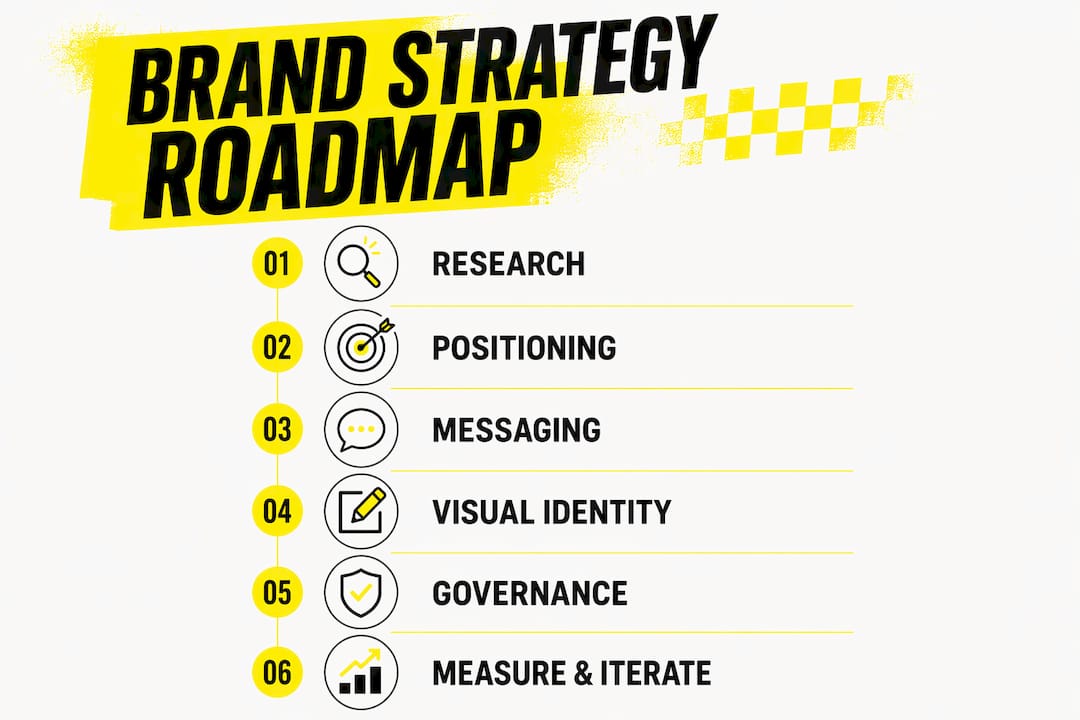
The sequence matters. Skipping stages produces weaker brand identity and execution. The roadmap runs: research → positioning → messaging → visual identity → activation → measure and iterate.
Step 1: Research and audit (weeks 1–2)
Owner: Brand lead or founder. Deliverable: Audit report.
Review existing positioning, messaging, and visual assets against current customer perception
Conduct five to ten customer interviews focused on need state, workarounds, and objections
Run a positioning audit using customer surveys, unsolicited reviews, share-of-search data, and sales call analysis to compare intended versus actual positioning
Map competitive alternatives (what customers use instead of you)
Step 2: Positioning workshop (week 3)
Owner: Brand lead plus leadership. Deliverable: Draft positioning statement.
Use Dunford’s five-component framework to draft a positioning statement from competitive alternatives outward
Choose your primary positioning approach (price, symbolic, experiential, functional, or emotional) based on category dynamics and operational capability
Pressure-test the statement: can the business actually deliver the claim?
Step 3: Messaging and voice (weeks 4–5)
Owner: Brand lead plus content team. Deliverable: Messaging pillar document and voice guide.
Write three to five messaging pillars, each with two proof points
Define four voice attributes with a do/don’t example for each
Create tone-by-use-case examples for your top three content contexts (social, sales, support)
Step 4: Visual identity (weeks 5–7)
Owner: Creative director or design partner. Deliverable: Brand identity system.
Finalize logo system, color palette, typography, and layout rules
Build templates for the five most common content formats
Document rules in a single shareable brand guide
Step 5: Activation and rollout (weeks 7–9)
Owner: Marketing lead. Deliverable: Rollout checklist and updated channel assets.
Update all owned channels with new identity and messaging
Brief all content contributors (internal, freelance, AI-assisted) on brand rules
Align media mix decisions with the new positioning
Step 6: Measure and iterate (ongoing, 90-day cycles)
Owner: Brand lead. Deliverable: KPI dashboard and quarterly review.
KPI Layer | Metric | Method |
Awareness | Branded search volume, share of voice, reach | Google Search Console, social analytics |
Perception | NPS, sentiment score, qualitative feedback | Survey tools, review analysis |
Response | Engagement rate, qualified leads, conversion by message | CRM, A/B testing, incrementality testing |
Pro Tip: Set a 90-day measurement cadence from day one. Brand KPIs move slowly, and teams that check monthly often abandon the strategy before the data has time to show movement. Quarterly reviews with a fixed scorecard keep the work grounded.
How Apple, Nike, and Airbnb put brand strategy to work
Real brand strategy is visible in the decisions a company makes repeatedly, not in a single campaign. Three short cases show how the components above map to outcomes.
Apple: product-led identity consistency
Apple’s strategic choice was to own the intersection of technology and liberal arts. Every product launch, retail environment, and piece of communication returns to that positioning. The visual identity is minimal by design, so the product is always the hero. The result is one of the most valuable brand portfolios in the world, sustained over decades through disciplined governance rather than trend-chasing.
Strategic choice: Simplicity as a competitive attribute, not just an aesthetic preference
Execution pattern: Remove everything that does not serve the product experience
Perceptual effect: Customers associate Apple with quality and ease before they read a single word of copy
Nike: emotional positioning and repetition
Nike does not sell shoes. It sells the belief that every person is an athlete. That positioning choice, made explicit in the “Just Do It” platform, has been executed consistently since 1988. The emotional positioning approach works because it is grounded in a real behavioral truth about the customer, not a product feature.
Strategic choice: Emotional positioning anchored in a universal human aspiration
Execution pattern: Repeat the belief across every touchpoint, from elite athlete campaigns to grassroots community runs
Measurable effect: Brand recognition and preference that persists even when product quality is comparable to competitors
Pro Tip: Emotional positioning only works when it is backed by product or service truth. Nike’s claim holds because the product genuinely performs. A brand that claims emotional resonance without operational substance loses credibility quickly.
Airbnb: category and experience positioning
Airbnb’s founding insight was that the category it competed in was not “short-term rentals.” It was “belonging anywhere.” That category repositioning changed everything: the visual identity, the host onboarding experience, the photography standards, and the community language all serve the same idea. The brand strategy was the product strategy.
Strategic choice: Redefine the category from accommodation to belonging
Execution pattern: Every touchpoint, from listing photography to customer support language, reinforces the belonging idea
Perceptual effect: Airbnb created a new market category rather than competing on price within an existing one
Treating brand strategy as an operating system for your team
The most useful shift in thinking about brand strategy is to treat it as an operating system rather than a document. An operating system creates repeatable decisions. A document gets filed and forgotten.
As content volume and channels grow, the main challenge is maintaining recognizability when many contributors and AI tools are involved. The governance layer is what makes that possible.
Practical governance components
Approval matrix: Who approves what, at what stage, and how fast (e.g., social posts: content lead; paid creative: brand lead; press releases: executive sign-off)
Approved/rejected traits list: Two columns, ten to fifteen entries each, covering tone, visual style, and claim types
Brand brief template: A one-page document covering positioning, audience, messaging pillar, voice note, and visual reference for every project
Messaging pillar template: Three pillars, each with a headline claim, two proof points, and a tone note
How briefs move through the workflow
A brand brief starts with the strategy layer (positioning, pillar, voice note). It moves to the creative contributor, whether internal, freelance, or AI-assisted. The contributor produces a first draft against the brief. The brand lead reviews against the approved/rejected traits list, not personal preference. The asset publishes. That sequence removes subjectivity from the approval process and speeds up every cycle.

For teams scaling content production across multiple channels, a lightweight content operations framework built on top of the brand strategy is the difference between a recognizable brand and a noisy one.
Pro Tip: When briefing freelancers or AI tools, share the approved/rejected traits list alongside the brief. Most inconsistency comes not from bad work but from contributors who never saw the rules. A one-page traits list solves that problem faster than any revision cycle.
Vainnewyork builds governance templates as part of every brand strategy engagement, so the rules are embedded in the workflow from day one rather than retrofitted after the first inconsistency appears.
Key Takeaways
A brand strategy only creates commercial value when it is built from competitive alternatives outward, documented in decision-ready artifacts, and governed so that every contributor, human or AI-assisted, works from the same rules.
Point | Details |
Consistency drives revenue | Consistent brand presentation can increase revenue by up to 23%, making governance a financial priority. |
Positioning starts from alternatives | Map what customers use instead of you before writing a single positioning claim. |
Three artifacts are the minimum | A one-line purpose, behavioral values with examples, and an approved/rejected traits list are the floor for governance. |
Measure in 90-day cycles | Track awareness, perception, and response KPIs quarterly before drawing conclusions about what is working. |
Vainnewyork operationalizes the strategy | Vainnewyork delivers brand strategy workshops, identity systems, and governance templates so the rules work across every contributor from day one. |
Why the operating-system frame changes everything
Most brand strategy guides stop at the components list. They tell you what to create but not how to make it work when a freelancer in a different time zone is producing your Instagram content at 11 PM. That gap between strategy document and daily execution is where most brand identities quietly fall apart.
The operating-system frame matters because it shifts the question from “what does our brand look like?” to “what decisions does our brand strategy make for us automatically?” When the answer to that second question is “most of them,” your team moves faster, your creative output is more consistent, and your brand compounds in the market rather than resetting with every new campaign.
What we find, working with brands across creative media and production, is that the governance layer is almost always the missing piece. The positioning is there. The visual identity is there. But the approved/rejected traits list, the brand brief template, the approval matrix: those are the artifacts that actually keep the strategy alive when the brand manager is not in the room.
The brands that win over time are not the ones with the most sophisticated strategy documents. They are the ones whose strategy is so embedded in daily operations that it runs without supervision. That is the standard worth building toward.
Vainnewyork helps you build a brand strategy that actually runs
Creative production without a brand strategy is expensive guesswork. Vainnewyork works with brands, artists, and organizations to build the strategy layer first, so every piece of content, every campaign, and every creative asset compounds toward the same perception goal.
Our brand strategy engagements cover the full operating-system build: positioning workshop, messaging pillars, voice guide, visual identity system, governance templates, and a 90-day measurement plan. You leave with a brand brief your entire team can use, an approved/rejected traits list that speeds up every approval, and a rollout checklist tied to your actual channels. For teams ready to scale creative production across freelancers or AI-assisted workflows, we also set up the content operations layer so the brand rules are embedded from the start.
Ready to see what a working brand strategy looks like for your organization? Start your brand project with Vainnewyork and get a discovery brief back within 48 hours.
Useful sources and further reading
Practitioners who want to go deeper on any section of this guide will find the sources below worth their time.
Source | What you will get |
Brand Awareness Strategies That Drive Real Growth | Vainnewyork’s practical guide to awareness KPIs and channel tactics |
Visual Branding Strategy: A 2026 Guide for Marketers | Deep guidance on logo systems, color, and scalable identity rules |
Content Strategy for Marketers: A 2026 Framework Guide | Messaging pillar frameworks and content operations for distributed teams |
Brand Development Strategy: A 2026 Guide (postnitro.ai) | The source for the 23% revenue consistency finding and KPI layering framework |
Brand Positioning Strategy: How to Own a Place (Digital Codex) | April Dunford’s five-component positioning framework and positioning audit methods |
Brand Positioning: Complete Guide With Examples (Shopify) | Five positioning strategy types with stepwise guidance and real examples |
Brand Development: Navigate Growth in Competitive Markets (Mailchimp) | Best-practice guidance on brand briefs, identity systems, and templates |
Foundational definition, archetype framework, and step-by-step strategy build | |
Practical guidance on scoping and pricing brand identity work with external partners |
Recommended
Comments