Tagline Brainstorming Methods That Get You to a Line Worth Keeping


The best tagline brainstorming methods share one habit: they separate making lines from judging lines. You generate dozens of raw options with a clear problem statement, narrow them against the brand’s positioning, and test the finalists with people who match your audience. At Vain., we treat a tagline the way a film crew treats a title card: a few words that carry the emotional heartbeat of the whole production. Below are the methods we would hand a brand, artist or small team in New York before a launch, a rebrand or a merch drop.
TL;DR
Start from one sentence of positioning, then aim for quantity: 25 to 100 raw lines before anyone edits.
Use structured methods (brainwriting, word banks, SCAMPER-style prompts, “How might we” framing) so quiet voices and odd ideas make it onto the wall.
Narrow to three to six finalists, then test them cold with people who match your audience, not with an internal vote.
A tagline is a long-term brand line; a slogan belongs to a campaign. Decide which one you are writing first.
Your tagline will live on packaging, video end cards, stickers and apparel, so check how it reads small, in motion and on fabric.
Table of Contents
Tagline or slogan: decide what you are writing
Before a single idea goes on the wall, settle the brief. A slogan supports the goals of a specific campaign, while a tagline is a branding tool meant to last for years or even decades. The same idea shows up in a well-known insurance example: a humorous campaign slogan sits alongside a long-term tagline about being in good hands that closes the brand’s commercials.
That difference changes how you brainstorm:
Tagline: write from who the brand is. The line should still make sense in five years, on a product you have not launched yet.
Slogan: write from what this campaign needs to say, to whom, and for how long. It can be sharper, funnier and more time-bound.
If you are unsure, write the tagline first. Campaign lines can then grow out of it, and the tagline keeps the whole body of work coherent.
Start with the problem, not the pen
Brainstorming works best when everyone attacks the same objective. Design researchers recommend starting from a single problem statement or a “How might we” question and time-boxing the session to roughly 15 to 60 minutes. For a tagline, that statement is your positioning in one sentence: who you serve, what you do differently, and the feeling you want them to have afterward.
If you do not have that sentence yet, write it first. We lay out a two-day process in our guide to locking your brand positioning statement, and a tagline brainstorm goes twice as fast once it exists. Then reframe it as a question:
How might we say “we make ordinary things extraordinary” in under five words?
How might we make a first-time customer feel the studio’s craft in one breath?
How might we sound like us, and only us?
Share the question a day ahead. TED-Ed’s guide to leading a brainstorm advises circulating the topic in advance so introverts can prepare, and the room gets better ideas for it.
The ground rules that keep a session productive
Most bad brainstorms fail for the same reason: someone starts critiquing in minute three. The classic rules from Alex Osborn are to defer judgment, welcome free-wheeling ideas, aim for quantity, and seek combination and improvement of others’ ideas. Modern facilitation guides repeat the same core, and StudioBinder frames it as deferring judgment, encouraging wild ideas, building on others’ ideas with “yes, and,” and favoring quantity.
In practice, we post these where everyone can see them:
One idea at a time, one person talking.
No comments, eye-rolls or “but” until the generating phase is over.
Number every line as it appears, so the room can see the count climb. TED-Ed suggests picking a target such as 25 ideas.
Build on what is already on the wall before adding something new.
Keep it short, with a visible timer.
Wild lines matter more than they seem. The unusable idea at number 31 is often the doorway to the usable one at number 44.
Seven tagline brainstorming methods
Pick two or three of these per session. Variety keeps energy up, and different methods surface different kinds of lines.
1. Silent brainwriting
Everyone writes lines alone on sticky notes for 10 to 15 minutes, then the notes go up on the wall. One facilitation guide for creative concepts suggests starting with about 30 minutes of individual idea generation on sticky notes before group work. It protects against the loudest voice setting the direction and gives you a pile of raw material fast.
2. The word bank
Before writing lines, write words. Make four columns: what we do (verbs), what the customer feels (emotions), what we look like (images and textures) and what we refuse to be (anti-words). Then recombine across columns. This is where craft vocabulary pays off: a studio might pull “frame,” “cut,” “score,” “reel” and turn them into puns, promises or commands.
3. Rewrite the same idea ten ways
Take one strong thought, such as “we make everyday projects feel cinematic,” and force ten versions: as a command, a question, a two-word phrase, a rhyme, a promise, a confession, a dare. Constraints produce more variety than a blank page does.
4. SCAMPER prompts
SCAMPER is a checklist of creative moves: substitute, combine, adapt, modify, put to another use, eliminate, reverse. StudioBinder’s roundup of brainstorming techniques covers it. Run your three best lines through each prompt. “Eliminate” is especially useful for taglines, because the strongest ones are often a longer idea with words cut away.
5. Reverse brainstorm
Ask the opposite question: how would we make people forget us? Write the dullest, most generic lines you can. Then flip each one. Generic phrasing shows you precisely what to avoid, which is useful because a tagline that sounds like everyone’s is worth nothing.
6. Customer-language mining
Collect the exact words clients and fans use to describe you: review text, DMs, comments on your videos, what buyers say when they pick up a shirt. Underline phrases that are vivid or repeated. Some of your best raw material is already being said out loud.
7. Sound and rhythm pass
Read every finalist out loud. Tap the beat. Say it as a voiceover, as a chant, as a whisper. A line that works in a mouth often works in a spot, a podcast tag or a sonic logo, and we cover how sound carries brand memory in our look at sonic branding examples.
How many lines is enough?
More than feels comfortable. One facilitator recommends aiming for 100 ideas in 60 minutes with a visible timer and a structure of preparation, warm-up, divergence, convergence, selection and action planning, and notes that many workshops fail by skipping straight to critique. A small team will not always reach 100, and that is fine. A useful floor is 25 to 50 lines, with a second session a day later when people have had time to think. The second session is often where the better lines arrive, because the obvious ones have already been spent.
Narrowing: from the wall to three finalists
Convergence is a separate meeting, or at least a separate phase with a clear signal that the rules have changed. A workable routine:
Cluster. Group similar lines, and keep the strongest of each cluster.
Cross out the misfits. Delete lines that cannot be said honestly about the brand today, or that clash with the positioning sentence.
Score the survivors on four questions: Is it clear? Is it memorable? Is it true to us? Does it make someone feel something?
Check distinctiveness. The U.S. Patent and Trademark Office describes a slogan as reinforcing a brand’s messaging, often in a few words, and advises making it catchy, easy to remember and distinctive. A line that is distinctive is also easier to protect, so run a quick search of existing marks before you fall in love. If a mark matters to the business, bring the final list to a trademark attorney.
Shortlist three to six. Marketing research guidance says to narrow to three to six distinct directions, and distinct is the key word: three versions of the same idea is one finalist.
On length, a university copywriting text calls three words or fewer the gold standard, with four words sometimes acceptable. Treat it as a strong guideline, not a law. A tagline has to fit a hoodie chest, an end card and a voiceover tag, and shorter lines travel to all three.
Testing without fooling yourself
An internal vote is a popularity contest. Everyone on the team knows the backstory, has opinions about the winner, and cannot see the line fresh. Better to show finalists cold to people who resemble your customers, without telling them which line the team likes best, and ask two things: what does this company do, and which do you prefer and why.
Sample size matters if you survey at scale. SurveyMonkey’s guidance is at least 200 to 300 completed responses per tagline to detect a meaningful preference difference, and it warns that 20 or 30 responses per option can look decisive without being reliable. If you are an artist or a small brand without that audience budget, a smaller informal round still beats an internal vote, as long as you treat it as direction rather than proof.
What to measure matters too. A review of copy-testing research points to persuasion, likability, branded recall and comprehension as the measures worth watching, and cautions that raw recall alone is a poor predictor of sales. A line can be unforgettable and still get credited to a competitor, so ask people which brand it belongs to.
The last stage is live. Run the finalists as the headline of otherwise identical posts or ads and see which one earns the clicks. If you want to set that up properly, our 90-day marketing analytics playbook walks through the measurement.
What strong taglines have in common
When you read examples, look past the words to the job each line does. Common traits of effective taglines include clarity and simplicity, memorability, authenticity and brand alignment, and emotional appeal. The same guide points to familiar lines such as “A diamond is forever” and “Let’s go places.”
Notice what each of those does:
It names a feeling, not a feature.
It could only belong to one brand once you know the brand.
It is built to be repeated: on packaging, in a jingle, at the end of a spot.
One more point for any team working in video: a tagline stated only as a sign-off is weaker than one built into the creative itself. If your tagline is going to work hard, shoot and edit with it in mind. Our guide to one-sentence hooks for short-form video shows how a single line can anchor a whole clip, and the same discipline applies to a tagline.
Where your tagline will actually live: merch and stickers
For a brand in New York selling apparel and small goods, a tagline is going to be read on a chest, a mug and a sticker. That changes the final check. Print the finalists at real size before you commit: on a tee, a tag, a laptop sticker. Long lines get cramped, and fine script gets lost on fabric.
Stickers raise the question that many brands ask: matte or glossy. As a design rule of thumb, glossy finishes tend to make color look punchy and saturated, which suits bold, graphic taglines, while matte finishes read softer and quieter, which suits understated, editorial or typographic lines. Order a small run of each before you choose, hold them next to each other, and pick the one that looks like your brand voice. The tagline should feel at home on the finish, the same way it should feel at home in a voiceover.

How we would bring this to your brand
If you would rather not run the whole process alone, our team at Vain. works across strategy, video, audio and animation, so a tagline is developed with the way it will sound and look rather than on paper alone. We are a creative consultancy and production company with a network of collaborators, and our approach is intentional and collaborative. You can see the services on our site, and the tagline question is a natural starting point for a strategy conversation.
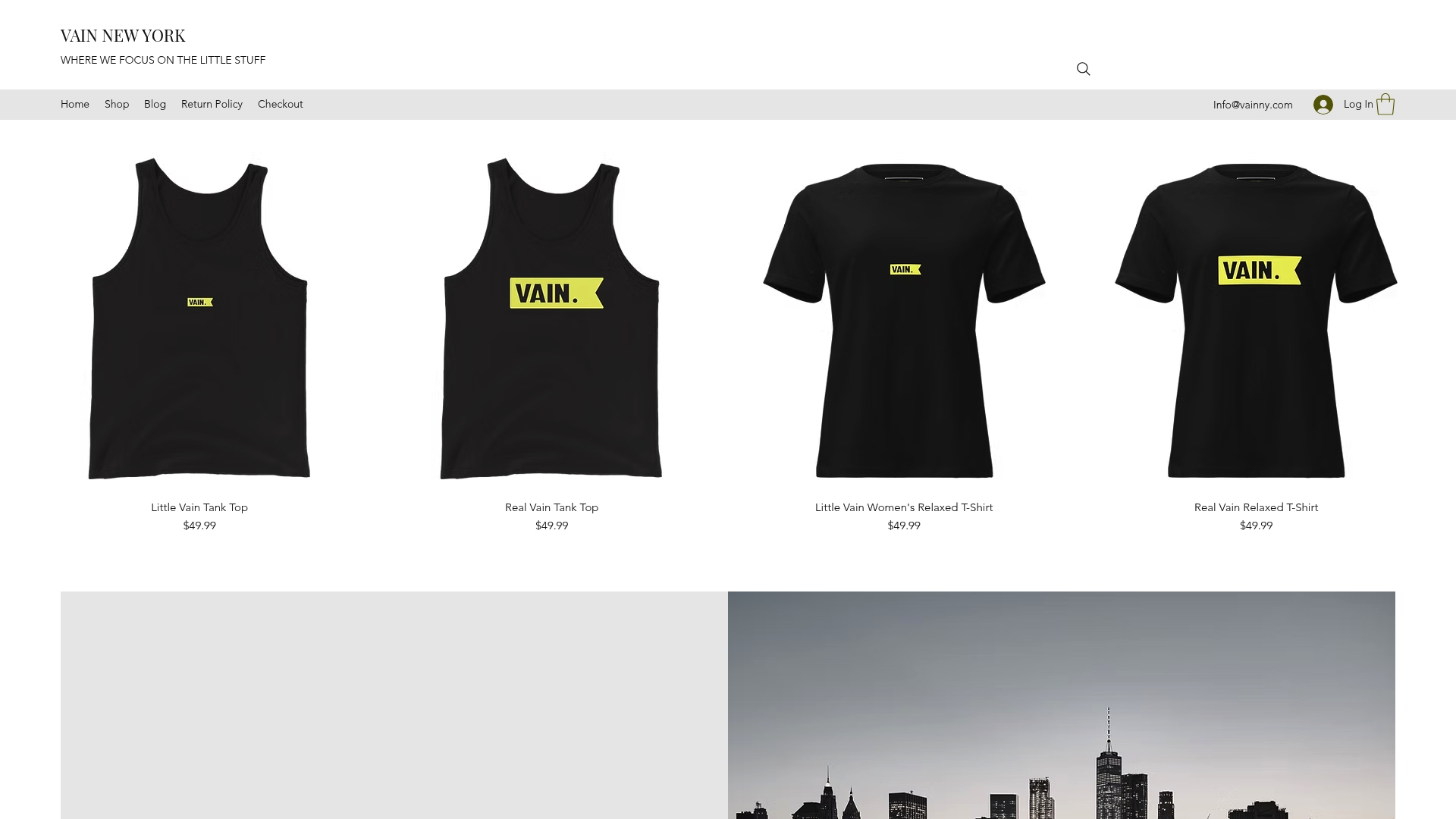
Once the line is chosen, it can go straight onto products. Our made-to-order merchandise includes the Studio Tank Top at $49.99, the Studio T-Shirt at $59.99 and the Studio Hoodie at $99.99, all of which are good surfaces to see a tagline in the real world. For launches, our piece on go-to-market creative covers what to have ready before you go public.
Our perspective
A tagline is the shortest piece of storytelling a brand will ever produce, and it deserves the same care as a title sequence. We have always believed that ordinary ideas become extraordinary through process: a clear brief, a generous room, and a willingness to write the bad lines on the way to the good ones. We would also say this: the best taglines are rarely invented in isolation. They come out of positioning, voice, visuals and sound working together. When a line is written with the film, the sound design and the product in mind, it lands with more weight, because it was built to be seen and heard, not only read. That is why we bring strategy, video, audio and animation to the same table, along with a network of collaborators who each see the brand from a different angle. Your tagline should sound like a team that knew exactly who you are. Vain.
FAQ
What is the difference between a tagline and a slogan?
A tagline is a long-term brand line that expresses identity and stays the same for years. A slogan belongs to a specific campaign or product and changes as campaigns change. One marketing platform describes slogans as selling a product or service, while taglines communicate an idea about the overall brand.
How do I write a tagline from scratch?
Write your positioning in one sentence, turn it into a “How might we” question, and generate at least 25 raw lines using silent brainwriting or a word bank. Cut to three to six distinct finalists, read them aloud, and test them cold with people who match your audience. Pick the line that is clear, true to the brand and easy to repeat.
How long should a tagline be?
Short enough to say in one breath. One copywriting text sets three words or fewer as the gold standard and allows four. Longer lines can work, but they are harder to fit on packaging, apparel and video end cards.
Should I choose matte or glossy stickers for a tagline?
Choose by mood. Glossy usually makes color look vivid and suits bold, graphic lines; matte looks softer and suits quieter, typographic ones. Order a small sample of each with your actual tagline printed at real size, and keep the one that matches your brand’s voice.
Sources
Recommended
Comments