Production Technology for Creative Professionals in 2026


What is production technology, and what does it cover?
Production technology is the combined application of technical processes, scientific principles, and facilities that enable industrial and creative production at scale. According to the REFA International framework, it transfers scientific knowledge into technologically controllable and economically usable production systems. That definition holds whether you are assembling aerospace components or building a video production workflow.
The field divides into three core segments:
Energy technology: managing power sources and consumption across production systems
Production technology: the tools, machines, and methods that physically create goods or content
Process technology: the sequences, controls, and quality checks that govern how production runs
For creative professionals, this framework is not abstract. Every shoot schedule, render pipeline, and post-production workflow maps directly onto these same principles.
How current trends are reshaping production technology
Digital transformation is now a C-suite mandate. 97% of industrial manufacturing CEOs surveyed in 2023 called continuing digital and technology transformation a top near-term priority, citing labor shortages and supply chain pressure as the driving forces.
Stat to know: AI-powered self-driving labs at U of T Engineering developed a nickel-cobalt-chromium alloy that outperforms Inconel 625 by 85% in oxidation resistance at 1,000°C, with minimal human involvement in the discovery process.
Key trends driving modern production forward:
AI and machine learning: real-time bottleneck detection, predictive maintenance, and autonomous materials discovery
Industry 4.0 integration: IoT sensors, smart factories, and continuous data exchange across production lines
Robotic automation: modern robots now handle complex, flexible tasks alongside humans, far beyond preprogrammed repetition
Additive manufacturing: 3D printing shortens lead times, reduces waste, and opens custom design possibilities in aerospace, fashion, and medical devices
For media producers, the parallel is direct. AI audio tools like those explored in AI mix analysis reflect the same data-driven discovery logic reshaping industrial labs.
Why collaboration drives production technology forward
Three-quarters of U.S. manufacturers have fewer than 20 employees. That scale makes solo innovation nearly impossible, which is exactly why public-private networks like Manufacturing USA exist. Shared infrastructure and pooled expertise let smaller firms access advanced manufacturing techniques they could never fund independently.
Integrating R&D directly into production lines accelerates innovation cycles. Rockwell Automation’s Singapore facility demonstrated this by testing prototypes directly on production lines, cutting development time and reducing siloed inefficiencies.
Collaboration benefits extend well beyond the factory floor:
Cross-disciplinary teams surface blind spots that single-department thinking misses
Supply chain partners provide real-world feedback that shapes better product design
Manufacturing innovation now spans design, R&D, logistics, and end-of-life management as one connected system
We see the same dynamic in creative production. The best content comes from teams where directors, editors, and strategists share a workflow, not separate silos.
What smart production systems mean for the future of manufacturing
Smart Production Systems (SPS) are manufacturing systems capable of self-diagnosing performance and autonomously designing continuous improvement projects. The University of Michigan frames SPS as the next wave in production management, where AI handles decisions that once required experienced operators.
The core tool is the Programmable Manufacturing Advisor (PMA), a patented AI device that evaluates system health and calculates optimal improvement steps without operator intervention. PSE Toolbox-trained teams at GM, Ford, Toyota, and Kroger have used related analytics to achieve significant throughput increases without capital investment.
Key SPS capabilities:
Self-diagnosis: analyzes performance losses and identifies their root causes automatically
Autonomous project design: calculates corrective actions without human participation
Minimal equipment changes: improvements stay within the operations manager’s existing resources
Predictive results: deployed projects deliver analytically guaranteed productivity gains
Pro Tip: If you manage a production workflow, whether on a factory floor or a content studio, the SPS principle applies. Systems that monitor their own performance and flag inefficiencies save more time than any single process upgrade.
How production technology principles apply to creative media
Creative media production runs on the same core logic as industrial manufacturing: inputs, processes, outputs, and quality control. The video production workflow mirrors a production line, with pre-production as design, the shoot as fabrication, and post as finishing and quality assurance.
Practical applications for creative professionals:
AI-assisted editing and color grading: machine learning tools analyze footage and suggest cuts, reducing post-production time
Automated quality control: render farms and review platforms flag technical errors before delivery
Additive thinking in content design: building content layer by layer, from script to sound design, mirrors 3D printing’s additive logic
Smart scheduling systems: production management platforms track crew, equipment, and deadlines the way IoT tracks factory assets
At Vainnewyork, we apply these principles as a creative consultancy, connecting content strategy, brand development, and production execution into one integrated system. Explore film production departments to see how that tapestry of talent comes together.
How production technology evolved over time
Production technology’s arc runs from hand tools to steam-powered machinery, then to the moving assembly line Henry Ford popularized in the early 20th century, and finally to the digital and AI-driven systems defining the present. Each shift compressed time-to-output and raised quality expectations. The first industrial revolution mechanized labor. The second standardized it. Industry 4.0 is now making it autonomous.

Key components and types of production technologies across industries
Industry | Primary Technology | Core Function |
Aerospace | Additive manufacturing, AI alloy design | Lightweight, heat-resistant custom parts |
Automotive | Robotic assembly, IoT sensors | High-volume precision manufacturing |
Media production | AI editing tools, render pipelines | Content creation and quality control |
Apparel | Digital pattern systems, automated cutting | Speed and customization at scale |
Pharmaceuticals | Automated dispensing, real-time monitoring | Compliance and consistency |
Challenges in implementing production technologies
Cost is the first barrier. Advanced systems require upfront investment in hardware, software, and integration that smaller organizations struggle to absorb. Data readiness is the second. AI and SPS tools depend on clean, consistent equipment data, and many facilities lack the infrastructure to collect it reliably.
Workforce resistance adds friction. When automation changes job roles, teams need retraining and clear communication about what the technology does and does not replace. Cybersecurity is a growing concern as more production systems connect to networks, expanding the attack surface for industrial operations.
How production technology reshapes workforce skills
Automation does not eliminate jobs so much as it redefines them. Operators who once monitored machines manually now interpret data dashboards and manage AI-driven systems. Rockwell Automation’s Singapore facility documented a substantial reduction in time-to-competency for workers following digital training, a model increasingly adopted across advanced manufacturing.
The skills in demand now combine technical literacy with creative problem-solving: data analytics, systems thinking, and the ability to collaborate across engineering and design disciplines. For creative professionals, this mirrors the shift from craft-only skills to craft-plus-platform fluency.
Environmental and sustainability considerations
Additive manufacturing reduces material waste by building products layer by layer rather than cutting away excess. IoT-enabled monitoring tracks energy consumption in real time, letting facilities identify and reduce inefficiencies before they compound. Rockwell Automation’s Singapore engineers are actively experimenting with sustainable materials and energy-efficient product designs to help customers meet tightening environmental regulations.
Sustainability in creative production follows the same logic: digital-first workflows reduce physical waste, cloud-based collaboration cuts travel, and efficient render pipelines lower energy draw.
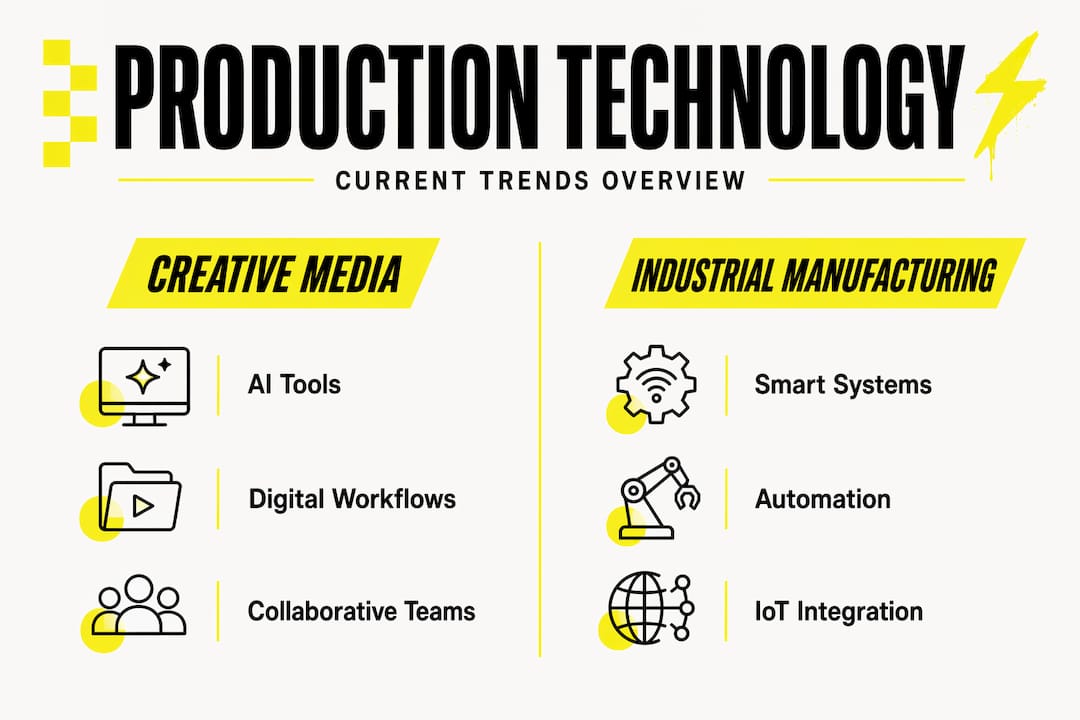
Creative media vs. industrial manufacturing: how production technology compares in the US
Both sectors share the same foundational goals: speed, quality, and cost control. The differences are in scale and physical constraints. Industrial manufacturing operates at volumes where a 1% efficiency gain translates to millions of dollars. Creative media production operates at project scale, where quality and differentiation matter more than volume throughput.
Industrial facilities invest in capital-heavy robotics and IoT infrastructure. Media production studios invest in software, AI tools, and content creation systems that achieve similar gains with lower physical overhead. Both sectors are converging on AI as the common thread, whether that means a self-driving materials lab or an AI-powered audio analyzer reviewing a mix before it goes to a client.
At Vainnewyork, we bring this same production intelligence to every creative project. Start your project with us and experience what happens when creative vision meets production discipline.
Key Takeaways
Production technology spans industrial manufacturing and creative media, with AI and smart systems now driving the most significant gains in both sectors.
Point | Details |
Three core segments | Production technology divides into energy, production, and process technology across all industries. |
Digital transformation priority | 97% of industrial manufacturing CEOs in 2023 named digital transformation a top near-term goal. |
AI materials breakthrough | A self-driving lab developed an alloy outperforming Inconel 625 by 85% in oxidation resistance at 1,000°C. |
Smart Production Systems | SPS self-diagnose performance and autonomously design improvement projects, delivering significant throughput gains recorded. |
Creative media parallel | Video production workflows mirror manufacturing lines, and AI tools are reshaping both with the same core logic. |
Recommended
Comments