Creative Collaboration: A Practical Guide for Team Leaders

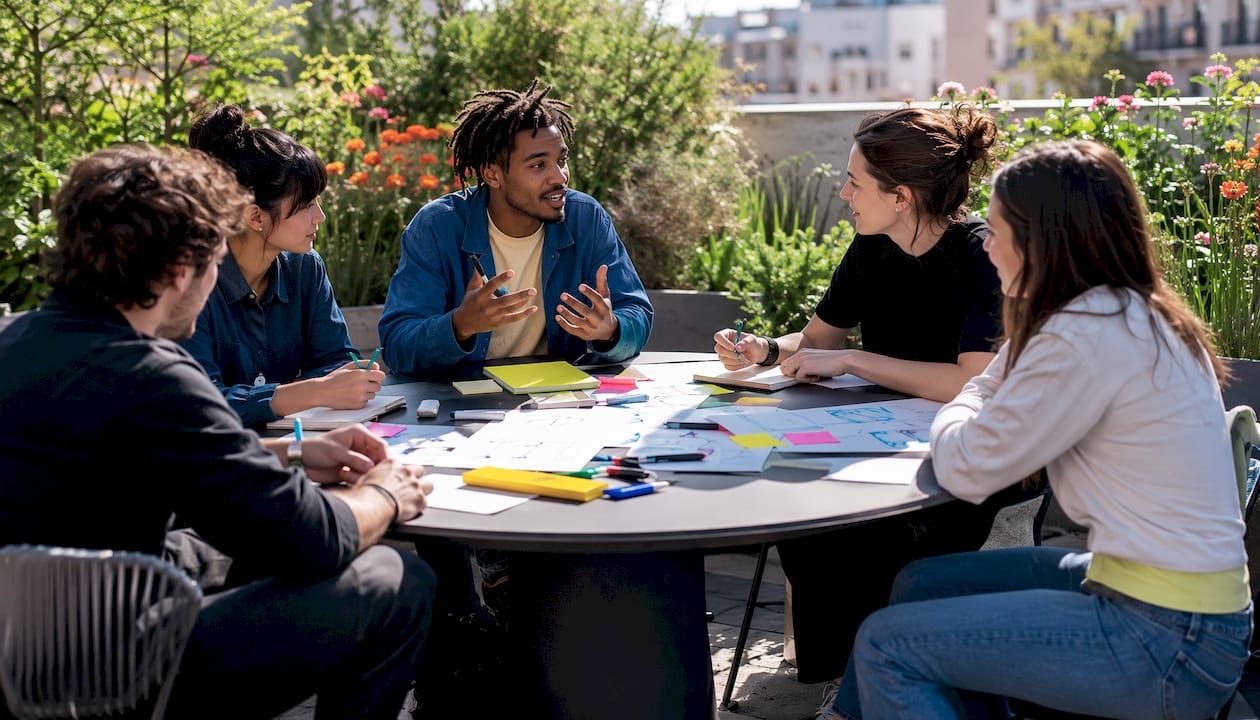
Creative collaboration is a structured, repeatable process in which diverse people generate original ideas together and turn them into testable experiments — not by working in parallel, but by actively building on each other’s thinking. IDEO describes it as a choreographed cycle of divergence and convergence that requires deliberate facilitation, and systematic reviews published in Frontiers in Psychology confirm that interaction itself is the engine: social processes and distributed creativity are central to how groups produce genuinely new outcomes. At Vainnewyork, we’ve seen this play out across content, brand, and production work — the sessions that produce the most original ideas are never the loosest ones. They’re the most intentionally designed.
When to use creative collaboration:
You’re facing an ambiguous problem with no obvious right answer
Your team is running an innovation sprint or launching a new creative direction
The project crosses functional boundaries (design, strategy, production, marketing)
You need buy-in from multiple stakeholders, not just a single decision-maker
Existing approaches have stopped producing fresh results
Three steps to convene your first session:
Define a single, specific challenge question (not “how do we grow?” but “how might we reach first-time buyers under 30 through short-form video?”)
Timebox the session to 90–180 minutes and protect that block on the calendar
Assign a facilitator whose job is to manage the process, not contribute ideas
Table of Contents
What creative collaboration really means — and how it differs from routine teamwork
Why creative collaboration produces better ideas — the evidence and benefits
Core structure and modes: divergence, convergence, and productive tension
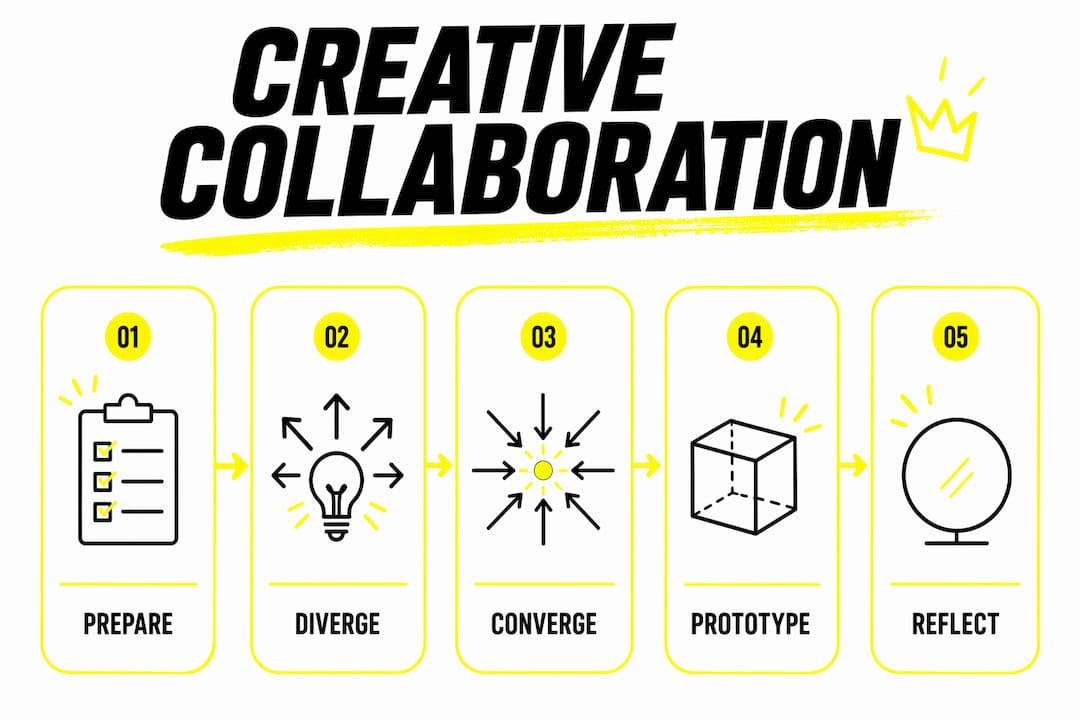
A practical, repeatable session recipe: prepare, diverge, converge, prototype, reflect
Tools, spaces, and formats that enable creative collaboration
How to measure whether your creative collaboration is working
Vainnewyork’s approach: a short practical case study and reusable playbook
Why the “messy middle” of creative collaboration is actually the signal you want
What creative collaboration really means — and how it differs from routine teamwork
Most teams collaborate every day. They share files, attend standups, divide tasks, and ship work. That’s coordination, and it’s genuinely useful. Creative collaboration is something different in aim and in method.
Where routine teamwork executes known tasks, creative collaboration generates combinations that didn’t exist before. The goal isn’t to complete a defined deliverable efficiently; it’s to produce options, surface unexpected connections, and build something no single person could have conceived alone. Research confirms that a team’s creative output depends more on the diversity of perspectives and the degree of task interdependence than on any individual’s talent working in isolation.
The theoretical grounding here matters. Distributed creativity — the idea that creative outcomes emerge from the interaction between people, not from one person’s mind — reframes what a leader’s job actually is. You’re not managing talent; you’re choreographing interaction. Keith Sawyer’s work on group creativity and the Cambridge Handbook of Creativity both point to the same conclusion: the conditions for interaction matter more than the raw creative ability of the individuals in the room.
Routine teamwork vs. creative collaboration at a glance:
Focus: Routine teamwork executes a plan; creative collaboration generates new options
Process: Routine work follows a defined workflow; creative collaboration cycles between divergence and convergence
Facilitation needs: Routine work needs a project manager; creative collaboration needs a skilled facilitator who can hold ambiguity
Success metric: Routine work measures completion; creative collaboration measures idea quality, variety, and learning speed
Failure mode: Routine work fails through inefficiency; creative collaboration fails through premature consensus or dominant voices
Why creative collaboration produces better ideas — the evidence and benefits
The case for structured group creativity isn’t intuitive. Many leaders assume that putting more people in a room slows things down or dilutes the sharpest thinking. The evidence runs the other way.
Social interaction drives creativity in a mutually reinforcing cycle: the more people interact around a creative challenge, the more ideas surface, and the more ideas surface, the richer the interaction becomes. Studies in musical improvisation illustrate this vividly. Jazz ensembles and experimental music groups have long served as laboratories for understanding how collective flow and emergent group ideas develop — each musician responds to what others play, producing something none of them planned. The same dynamic operates in a well-run creative session.
Research on team creativity shows that collective integration of diverse perspectives and high task interdependence predict creative performance more reliably than individual autonomy. In practical terms, that means a cross-functional team with a shared challenge will consistently outperform a group of specialists working in their own lanes.
The main benefits teams report:
More options on the table: Divergent phases surface ideas that no single person would have generated alone
Higher-quality solutions: Iterative remixing — building on, combining, and stress-testing ideas — filters out weak concepts faster than solo review
Faster learning through prototyping: Teams that move quickly from idea to rough prototype learn what works in hours rather than weeks
Stronger buy-in: People support what they helped build; collaborative processes reduce implementation friction downstream
Broader skill transfer: Training in group creativity increases divergent thinking, openness, and perspective-shift capacity across the whole team, not just the most vocal contributors
Core structure and modes: divergence, convergence, and productive tension
Every effective creative session moves through two fundamentally different modes, and the leader’s primary job is to signal clearly which mode the team is in at any given moment.
Divergence is the generative phase. The goal is quantity and variety: no idea is too strange, no connection too loose. Judgment is suspended. The facilitator’s role is to protect this space from premature evaluation and to keep energy high. Constraints — a specific user, a tight budget, a two-minute format — paradoxically help here. IDEO’s framework makes this explicit: leaders who set clear constraints and signal the process stage produce more generative sessions than those who leave the field wide open.
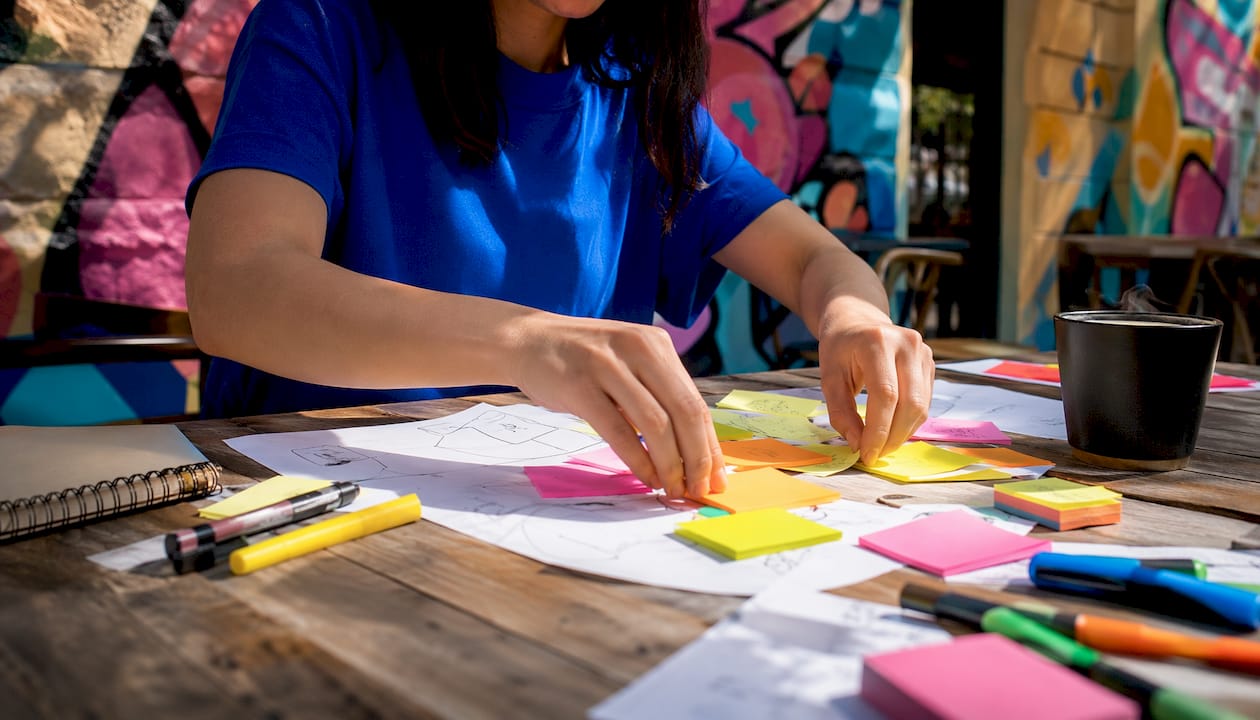
Convergence is the evaluative phase. The team shifts from generating to selecting, clustering, and refining. This is where criteria matter: feasibility, originality, alignment with the challenge. The facilitator’s job changes too — from protecting ideas to helping the group make decisions without losing the best options to groupthink.
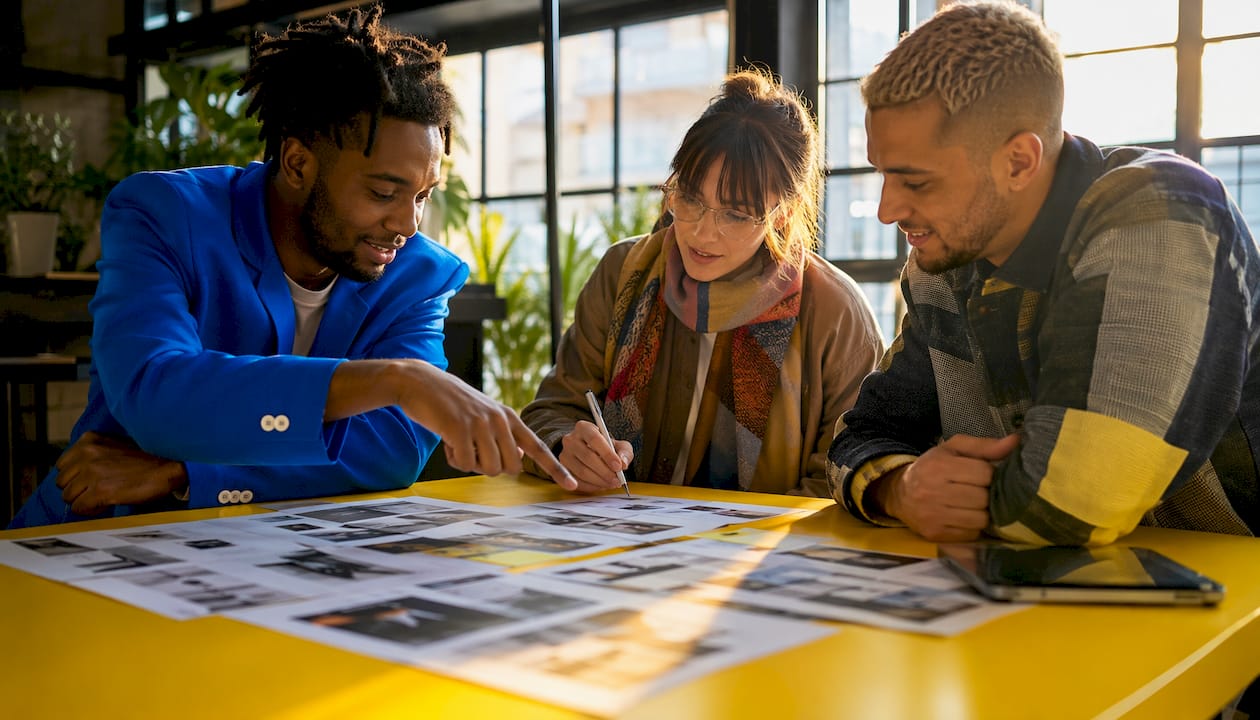
The tension between these modes is productive when it’s managed. It becomes destructive when the team collapses into convergence too early (killing ideas before they’ve had room to develop) or stays in divergence too long (generating without ever deciding). Final creative outcomes typically emerge through distributed, iterative remixing — teams cycle between generating and refining multiple times before landing on something worth prototyping.
Facilitation rules for managing the cycle:
Signal mode transitions explicitly: “We’re now in diverge — no evaluation yet” or “We’re shifting to converge — let’s apply our criteria”
Set a timebox for each phase before it starts
Withhold judgment during divergence, including body language
Assign a timekeeper separate from the facilitator
Define the decision rule for convergence before the session begins (dot voting, ranked choice, facilitator call)
Tension signals to watch:
Productive: Disagreement about which direction is best, multiple strong options competing, energy and noise
Destructive: One voice dominating, silence after a bold idea, the group converging on the first plausible option
A practical, repeatable session recipe: prepare, diverge, converge, prototype, reflect
A 90–180 minute session is long enough to move through a full cycle and short enough to protect from fatigue. The template below scales up or down depending on your challenge complexity.
Roles checklist
Before the session starts, assign these five roles:
Facilitator — manages the process, signals mode transitions, protects divergence
Decider — the person with authority to make the final call in convergence (often the project lead)
Note-taker — captures ideas in real time, visible to the whole group
Timekeeper — tracks phase timeboxes and gives two-minute warnings
Domain advisor — the subject-matter expert the group can query for constraints or feasibility checks
Timed session template (90 minutes)
Phase | Duration | What happens |
Prepare & frame | 10 min | Share the challenge question; align on the decision rule; confirm roles |
Warm-up | 10 min | A short exercise to shift into creative mode (e.g., “Yes, and…” rounds) |
Diverge | 20 min | Silent individual ideation followed by rapid-fire group sharing; no evaluation |
Cluster | 10 min | Group similar ideas; name the clusters; identify outliers worth keeping |
Converge | 15 min | Apply criteria; dot-vote or rank; narrow to 2–3 directions |
Prototype | 15 min | Sketch, storyboard, or write a one-paragraph concept for the top direction |
Reflect | 5 min | What worked? What to change next session? One metric to track |
Pro Tip: For a 180-minute session, double the diverge and prototype phases — not the framing or reflection. The bookends stay tight; the creative work expands.
Short exercise library
“How Might We” reframing (10 min): Rewrite the challenge as 10 “How might we…” questions. Forces perspective shifts and surfaces hidden assumptions.
Forced connections (15 min): Pick two random objects or concepts and generate ideas that combine them with your challenge. Breaks habitual thinking patterns.
Worst possible idea (10 min): Generate the most catastrophically bad solutions first. Lowers the stakes, increases participation, and often reveals the inverse of a good idea.
Rapid prototyping (20 min): Build a rough physical or digital sketch of the top concept. The act of making surfaces problems that discussion never does.
Remix round (15 min): Each person takes someone else’s idea and improves or extends it. Directly activates the distributed remixing dynamic that research identifies as a driver of emergent creative outcomes.
Hybrid and remote adaptations
Remote sessions need more explicit process signals because nonverbal cues disappear. Use a shared digital whiteboard (Miro, FigJam, or MURAL) as the live note-taking surface. Send a one-page pre-work brief 24 hours before so participants arrive with initial ideas already formed. For async collaboration, run the diverge phase asynchronously over 48 hours using a shared doc, then bring the group together only for clustering and convergence. This approach often produces more ideas from quieter team members than a live session alone.
Common failure modes and how to avoid them
Even well-intentioned sessions derail. The problems below appear consistently across teams, and each has a practical remedy.
Failure mode | What it looks like | Remedy |
Dominant voices | One or two people dominate most of the speaking time | Use silent individual ideation before group sharing; rotate speaking order |
Premature convergence | The group settles on the first plausible idea | Enforce a minimum idea count before evaluation begins; use “Yes, and…” to extend ideas |
Idea hoarding | People protect their concepts rather than building on others’ | Frame the session as collective ownership; use the remix round exercise |
Tech friction | Tools fail or participants can’t access the whiteboard | Run a 5-minute tech check 15 minutes before the session; have a paper backup |
Evaluation creep | Judgment language (“that won’t work,” “we tried that”) enters the diverge phase | Facilitator names it immediately and redirects: “We’re still in diverge — let’s hold that thought” |
Participation drop-off | Energy fades after the first 30 minutes | Build in a physical or energizing exercise at the midpoint; keep phases short |
Equity and participation
A Frontiers in Psychology systematic review found that female participation in creative-collaboration research was roughly 32% compared to 68% for males — a gap that reflects real dynamics in facilitated sessions, not just academic samples. Inclusive facilitation isn’t a soft add-on; it directly affects the quality of ideas the group produces.
Equity-focused facilitation practices:
Use anonymous idea submission tools (sticky notes, digital cards) during diverge to reduce social pressure
Rotate who speaks first in each round — the first voice in a group disproportionately anchors the discussion
Explicitly invite quieter participants by name: “We haven’t heard from everyone yet — what’s your read on this?”
Track participation visually: a simple tally of who has contributed helps facilitators spot and correct imbalances in real time
Pro Tip: Before the session, send a one-question async prompt to all participants: “What’s one idea you’d bring to this challenge?” It gives quieter voices a head start and ensures the session doesn’t open with a blank slate.
Red flags that a session is failing:
The same two people have spoken for the last 10 minutes
The group is nodding along without generating new ideas
The prototype phase is being skipped “because we’re out of time”
No one can name the challenge question without looking at the slide
Tools, spaces, and formats that enable creative collaboration
The right tool is the one that disappears — it supports the process without becoming the focus of the session. Choosing based on what the team already knows reduces friction and keeps attention on the ideas.
Visual collaboration whiteboards (Miro, FigJam, MURAL): best for live diverge and cluster phases, especially in hybrid settings. They make ideas visible to everyone simultaneously, which is the closest digital equivalent to a shared physical wall. For teams building out production workflows, these tools also double as lightweight project-planning surfaces.
Design and prototyping tools (Figma, Canva, Adobe Express): best for the prototype phase when the output is visual. Figma’s multiplayer mode lets two or three people sketch simultaneously, which accelerates the remix dynamic.
Async ideation docs (Notion, Google Docs with comment threads): best for the diverge phase when the team spans time zones or when you want maximum participation from introverts. Palmedor AI can help synthesize large volumes of async ideas into clusters, reducing the manual effort of the clustering phase.
Task trackers (Asana, Linear, Trello): best for capturing decisions and next steps at the end of the converge phase. The session’s output should land in the team’s existing workflow immediately — not in a separate doc that no one revisits.
Format guidance:
In-person: Best for high-stakes sessions, early-stage ambiguous challenges, and teams that haven’t worked together before. Physical space and nonverbal cues accelerate trust and idea-building.
Hybrid: Works well when the team is distributed but the challenge is well-defined. Requires a dedicated facilitator for the remote participants and a shared digital surface that both groups use equally.
Async: Best for diverge phases, pre-work, and follow-up refinement. Not suited for convergence decisions, which need real-time discussion to resolve disagreement.
Setup checklist (run this 24 hours before any session):
Confirm all participants have access to the digital whiteboard and have tested it
Share the challenge question and any relevant context in a pre-work brief
Assign all five roles and confirm each person knows their responsibilities
Prepare the physical or digital space: templates loaded, timers ready, materials on hand
Set a clear decision rule so convergence doesn’t stall
How to measure whether your creative collaboration is working
Measuring creative work feels counterintuitive to many leaders, but without metrics, it’s impossible to know whether sessions are improving or just consuming time. The goal isn’t to quantify creativity itself — it’s to track the conditions and outputs that indicate a healthy collaborative process.
Idea velocity: How many distinct ideas does the team generate per session? Track this over time. A rising count suggests the team is getting more comfortable with divergence.
Experiment rate: How many ideas from sessions move into a prototype or test within two weeks? A low rate signals that convergence isn’t producing actionable decisions.
Percentage of ideas prototyped: Of the ideas that reach convergence, what share get a rough prototype built? This measures whether the team is moving from talk to making.
Cross-functional participation: Are the same people contributing every session, or is the group drawing on diverse perspectives? Track who speaks and who contributes ideas in writing.
Perceived psychological safety: Run a short pulse survey after each session with two questions: “Did you feel comfortable sharing an idea that might seem unusual?” and “Did you feel your contributions were heard?” A five-point scale is enough.
Simple retro template (5 minutes at the end of every session):
What produced the most energy or the best ideas today?
What slowed us down or blocked participation?
One thing we’ll do differently next session
Capture these in a shared doc and review them before the next session. Over three to four sessions, patterns emerge that tell you exactly where to invest in facilitation improvement. For teams building a content marketing strategy, tracking idea velocity alongside content performance metrics creates a direct line between collaborative process quality and business outcomes.
Vainnewyork’s approach: a short practical case study and reusable playbook
At Vainnewyork, we’ve applied the session recipe above to brand development and content creation projects where the challenge was genuinely ambiguous: a client with a strong aesthetic but no clear content direction, or a production team that needed to move from brief to concept in a single afternoon.
The pattern we return to consistently is a compressed 90-minute session structured around a single “How might we” question, with a facilitator who is explicitly not the creative director. Separating facilitation from creative authority changes the room. The creative director becomes a participant, which means their ideas compete on equal footing with everyone else’s — and the best ideas often come from unexpected contributors.
What changes when this approach is applied:
Concept development time drops from multiple review cycles to a single session with a clear output
Stakeholder alignment improves because the decision-makers participated in the process, not just the outcome
The team builds facilitation confidence over time, which means each subsequent session runs more smoothly than the last
Reproducible elements to copy directly:
The “How might we” framing for the challenge question
Silent individual ideation before group sharing (eliminates anchoring bias)
A remix round as the bridge between diverge and converge
A five-minute retro with the three questions above
For teams working on creative team projects in media and content, the session recipe scales from a two-person creative partnership to a cross-functional team of twelve. The roles and phases stay the same; only the timebox lengths change.
Key Takeaways
Creative collaboration produces better ideas than solo work because interaction itself drives creativity, and structured facilitation is what makes that interaction generative rather than chaotic.
Point | Details |
Interaction drives creativity | Social processes and distributed idea-building are the core mechanism — not individual talent working alone. |
Structure enables divergence | Timeboxing, mode signaling, and clear constraints help ideas surface; they don’t suppress them. |
Equity affects idea quality | A participation gap between contributors directly reduces the range of ideas the group produces. |
Measure process, not just output | Track idea velocity, experiment rate, and psychological safety to know if sessions are improving. |
Vainnewyork applies this live | Vainnewyork’s facilitation approach separates creative authority from process management, producing faster alignment and stronger concepts. |
Why the “messy middle” of creative collaboration is actually the signal you want
Here’s the view from inside the work: the moment a session feels most uncomfortable — when ideas are half-formed, when two directions seem equally valid, when the room goes quiet after a bold suggestion — is usually the moment just before something genuinely original surfaces. Most leaders try to resolve that discomfort quickly. They call for a vote, defer to the most senior person, or retreat to a familiar solution. That instinct is understandable and almost always wrong.
What we’ve come to believe at Vainnewyork is that the facilitator’s most important skill isn’t running exercises or keeping time. It’s tolerating productive ambiguity long enough for the group to find its own synthesis. The research supports this: structure enables creativity not by eliminating tension but by giving it a container. Timeboxes, ground rules, and clear mode signals don’t resolve the tension — they make it safe to stay in it a little longer.
The lone-genius myth is genuinely harmful here. When leaders believe that the best idea will come from the smartest person in the room, they unconsciously design sessions that confirm that belief: they ask for input but defer to the expert, they run brainstorms that are really just presentations with questions at the end. Moving away from that model requires a deliberate act of leadership — designing for interaction rather than performance.
One practical thing you can do this week: Before your next creative session, write down the decision rule you’ll use in convergence and share it with the group before you start. That single act removes more anxiety from the room than any icebreaker.
Pro Tip: Build facilitation skills inside your organization by rotating the facilitator role across team members. Each person who facilitates once becomes a better participant in every session afterward.
Vainnewyork’s creative collaboration services
Vainnewyork works with creative teams and brand leaders who need to move from ambiguous challenge to concrete concept faster than a traditional agency process allows. Our facilitation work is built around the session recipe in this guide: a single sharp challenge question, a structured diverge-converge cycle, and a prototype output that gives the team something real to react to by the end of the session.
We bring this to content creation, brand development, and production projects — and we can run a single 90-minute test session with your team before any longer engagement. If you’re ready to see what a well-facilitated session produces with your specific challenge, book your session and we’ll design the process around your goal. For teams building out their own facilitation capacity, we also offer workshop formats that train internal facilitators using the same playbook.
Useful sources and further reading
Creative Collaboration and Collaborative Creativity: A Systematic Literature Review (PMC/Frontiers in Psychology) — The most comprehensive academic review of the field; covers interaction theory, distributed creativity, and the participation equity gap. Start here for the theoretical foundation.
What Is Creative Collaboration? A Framework to Unlock Innovation on Your Team (IDEO U) — IDEO’s practitioner framework for divergence/convergence facilitation; the source for the choreographer model and constraint-setting guidance. Read this alongside the session recipe above.
Collaborative Creativity (IntechOpen) — Academic chapter covering group creativity training, divergent thinking development, and the evidence for teaching facilitation skills. Useful for leaders building internal facilitation capacity.
Collaborative Creativity, The Cambridge Handbook of Creativity — The definitive academic reference on group creativity, including Paulus and Brown’s foundational work on brainstorming and ideational creativity. Dense but authoritative.
Research on team creativity and interdependence (ScienceDirect) — Empirical research on how creative diversity and task interdependence predict team creative performance. The evidence base for designing teams around collaboration rather than individual autonomy.
Recommended
Comments