Lock Your Brand Positioning Statement in Two Days for Marketing Teams


A brand positioning statement is a one-sentence internal tool that defines who you serve, what they need, the category you compete in, the one benefit you own, and why anyone should believe you. The canonical format is: for [target audience] who [need], [brand] is the [category] that [key benefit] because [reason to believe]. It’s meant for your team’s eyes, not your customers’. Use it to align messaging, product choices, and pricing before a single ad gets written.
TL;DR:
A strong positioning statement should focus on one target audience, one specific need, one clear category, one key benefit, and one credible reason to believe; overloading reduces effectiveness.
Drafting it requires a quick, targeted workshop that includes selecting a segment, capturing customer language, choosing a category, and only keeping language that passes the subtraction test.
A well-constructed position serves as a fundamental decision guide for product, pricing, and marketing, ensuring consistency and faster team alignment.
Positioning effectiveness should be measured through brand recall, consideration lift, target segment conversion, and cross-channel message consistency.
Rushing a two-day workshop to lock in a clear, actionable, one-line position is more efficient than prolonged debates or vague strategy development.
Table of Contents
What Is a Brand Positioning Statement, Really?
A brand positioning statement is the internal compass a company uses to decide what it will say, build, and charge, before any of that reaches a customer. Harvard Business School frames positioning as staking out mental real estate: the goal is to own a specific, memorable spot in a customer’s mind relative to every alternative competing for that same spot. That’s a different job than a mission statement, a value proposition, or a tagline, though people confuse all four constantly.
Here’s the practical breakdown:
Mission statement: why the company exists, aimed at employees and investors as much as customers.
Value proposition: the pitch of what a customer gets and why it’s worth paying for, often customer-facing.
Tagline: the compressed, public-facing line born from the positioning, built for memorability, not precision.
Positioning statement: the internal working document behind all three, built for precision, not memorability.
You will never see a positioning statement on a billboard. It reads clumsy on purpose. Every slot forces a decision, and that decision discipline is exactly what makes the finished creative sharp. HBS’s guidance is blunt about the biggest failure mode here: marketers tend to overload positioning with detail when the real skill is subtraction. Trying to be the best at everything for everyone is the fastest way to be memorable to no one. A strong position picks one lane and defends it, which is also why a well-built brand strategy treats positioning as the foundation everything else gets built on top of, not an afterthought bolted onto a launch deck.
The Canonical Template and Its Five Essential Elements
The format everyone in marketing eventually converges on traces back to the Geoffrey Moore school of positioning popularized in Crossing the Chasm, and it survives because each slot works as a stress test. Fill it in honestly and weak thinking exposes itself fast.
The template:
For [target audience] who [need or job to be done], [brand] is the [category] that [key benefit] because [reason to believe].
A common alternate phrasing swaps the order slightly: “Unlike [alternative], [brand] [key benefit] for [audience] because [reason to believe].” Either version forces the same five decisions.
Target audience. Narrow enough that you can picture one real person, not a demographic slab. “Busy people” is not an audience. “Independent restaurant owners running a single location with no dedicated marketing staff” is.
Need or job to be done. State it in the customer’s own words, not your product’s feature list. What are they actually trying to accomplish?
Category or frame. The mental shelf you’re asking to be placed on. This is where companies get cute and vague (“a lifestyle platform”) instead of committing to a frame customers already understand.
Key benefit. One. Not three. Pick the single benefit you’re willing to be judged on if you can’t deliver the others.
Reason to believe. The proof that makes the benefit credible: a mechanism, a proprietary process, a founder’s specific background, a measurable guarantee.
The most common failure sits in slot five. Teams write aspirational filler like “because we care” or “because quality matters to us,” which believes nothing and proves nothing. A credible reason to believe names something specific and checkable, which is also the difference between a claim that survives a skeptical customer and one that dissolves on contact.
How to Draft a Positioning Statement in a Two-Hour Workshop
You don’t need a strategy offsite to produce a usable draft. A template plus a handful of short team exercises is the fastest documented path to something you can actually work with, and you can run the whole thing in one sitting if you timebox each step.
Here’s the sequence, with rough time budgets for a working session:
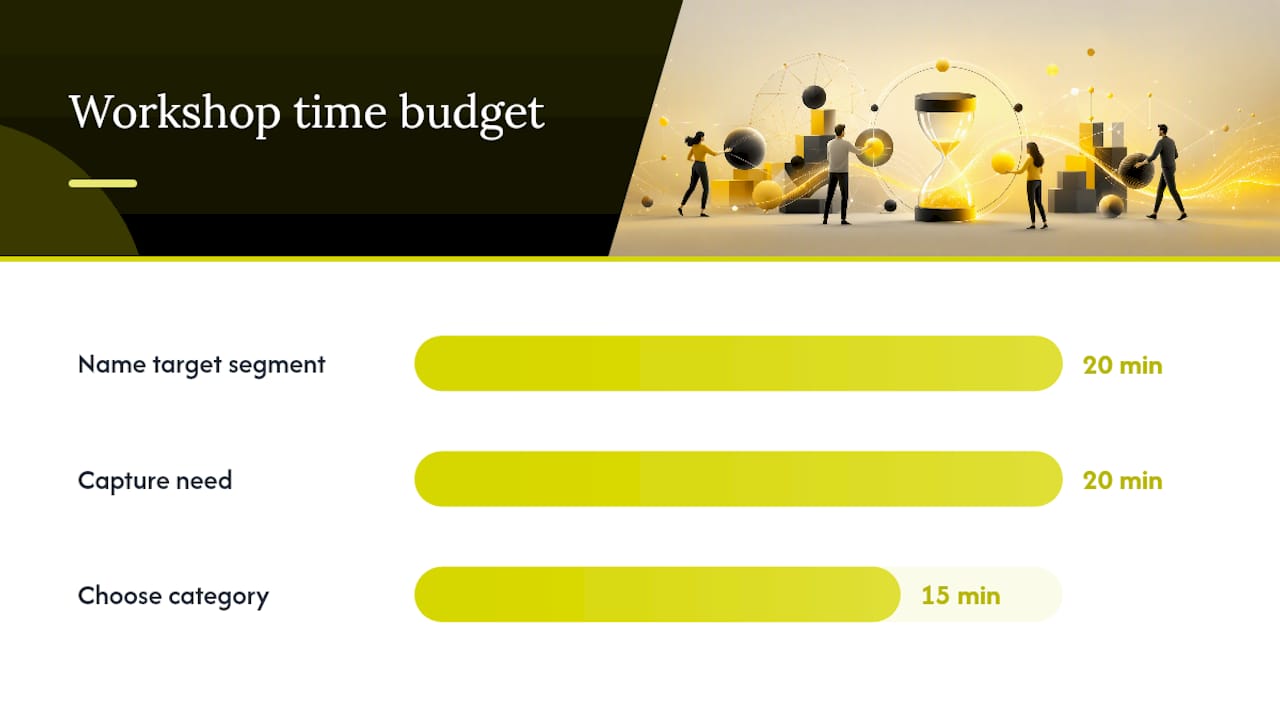
Name the single target segment (20 minutes). Pull up your customer list or CRM and force a ranking: which one segment, if you served it exceptionally well, would generate the most durable growth? Resist the instinct to write “small businesses” or “millennials.” If your team can’t agree on one segment in 20 minutes, that’s diagnostic information, not a scheduling problem. It usually means the business hasn’t picked a lane yet. A layered segmentation exercise helps here, because it forces you to rank segments by value rather than list them by size.
Capture the need in their language (20 minutes). Interview notes, support tickets, and sales call transcripts are goldmines most teams never mine. Pull five direct quotes from real customers describing their problem. Whatever phrase shows up more than twice is your need statement. Skip the internal jargon entirely.
Choose the category deliberately (15 minutes). List three ways a customer might currently describe what you do, even if those descriptions feel beneath your ambitions. Then pick the one that’s both true and useful. Fighting the category customers already put you in rarely works. Owning it and then out-executing inside it usually does.
Pick one benefit and a credible reason to believe (30 minutes). List every benefit your product offers, then force a vote: if a customer could only remember one, which one wins the most business? Attach a reason to believe that’s a fact, not a feeling. “Because our founder spent eleven years running commercial kitchens” beats “because we understand restaurants” every time.
Run the subtraction test and finalize (15 minutes). Read the draft aloud. Cross out every adjective and clause that isn’t load bearing. If removing a phrase doesn’t change the meaning, it wasn’t doing anything. This step mirrors what Semrush calls the value based approach to positioning: map segment, essence, benefit, and reason to believe as four distinct blocks, then only keep language that survives contact with each block.
Run this with no more than six people in the room. Positioning workshops die in committees larger than that. Assign one person as the scribe who writes the actual sentence live on a shared screen. Watching the words get crossed out and rewritten in real time does more to align a team than any amount of pre-work slides.
Pro Tip: Bring three real customer quotes into the room before you start. Teams that argue from opinion burn an hour; teams that argue from a transcript settle it in ten minutes.
Positioning Statement Examples That Actually Work (and One That Doesn’t)
Abstract templates only click once you see them filled in. Annotated example libraries work because they translate the five slots into decisions you can copy, not just admire.
A budget airline: For price-sensitive travelers who fly short domestic routes, [Airline] is the no-frills carrier that gets you there for less because we cut every cost that doesn’t affect your safety or your seat. Audience is narrow, benefit is singular (price), and the reason to believe explains the trade-off instead of hiding it.
A project management tool: For small agency teams juggling five or more client projects at once, [Tool] is the workspace that keeps every deadline visible in one screen because it was built by agency owners who missed too many handoffs themselves. The founder story doubles as proof, which is a stronger reason to believe than a generic feature claim.
A children’s shoe brand: For parents of toddlers learning to walk, [Brand] is the shoe that supports natural foot development because our design is reviewed by pediatric podiatrists. Category (shoe) stays simple; the reason to believe is a checkable credential, not a feeling.
A meal kit service: For time-strapped parents who still want home-cooked dinners, [Brand] is the meal kit that turns thirty minutes into a real family dinner because every recipe requires five ingredients or fewer. The benefit is emotional (family dinner) but the proof point is mechanical and specific.
A cybersecurity firm: For finance teams at companies with under 200 employees, [Firm] is the security partner that prevents wire fraud because our monitoring flags anomalies before a transfer clears. Narrow buyer, narrow benefit, and a reason to believe tied to timing, not just capability.
A skincare line: For adults managing rosacea, [Brand] is the skincare line that calms visible redness because our formulas are dermatologist-tested on sensitive skin specifically, not adapted from general product lines. This example draws on the same insight/consistency lesson behind repositioning wins like Dove’s, where a distinct claim and consistent proof point moved actual sales.
A regional credit union: For first-time homebuyers in the region, [Credit Union] is the lender that makes the mortgage process understandable because every loan officer walks clients through the paperwork in person, not by portal. Local, specific, and the reason to believe is a process difference, not a marketing claim.
A canned water brand: For people who want a distinct, non-corporate alternative to bottled water, [Brand] is the beverage company that stands out on the shelf because its packaging and tone reject every convention of the category. This is the Liquid Death playbook: the position is built on tone and shelf distinction as the benefit itself, not a hidden feature.
A creative production studio (weak version): We are a full-service creative agency offering video, branding, strategy, and growth solutions for businesses of every size. This fails immediately: no named audience, three benefits stacked together, and no reason to believe anywhere in the sentence.
Same studio, repaired: For independent artists and NYC brands who need festival-ready content on a tight turnaround, a creative studio that turns raw footage into release-ready media because a production network has shipped work across video, audio, and animation without adding agency overhead. One audience, one benefit (speed to release-ready), and a reason to believe rooted in the network model itself.
The Subtraction Test and a One-Page Checklist
Most weak positioning statements fail for the same handful of reasons, and they’re easy to spot once you know what to look for.
Overreach: claiming three benefits because the team couldn’t agree on one.
Fuzzy audience: describing a demographic instead of a real person with a real job to do.
Aspirational reason to believe: “because we’re passionate” instead of a fact a skeptic could verify.
Category confusion: inventing a new category name instead of committing to one customers already understand.
Internal jargon leaking in: using words your own sales team uses, not words your customer used first.
The subtraction test HBS describes solves most of these in one move: read the draft aloud and delete anything that isn’t earning its place. If a phrase could apply to any competitor in your category, cut it. If removing a clause changes nothing, it was never load bearing.
Pro Tip: Print your draft, hand it to someone outside marketing, and ask them to read it back to you in their own words. If they can’t repeat the benefit accurately, the sentence is too crowded.
Quick checklist before you lock a draft: one named audience, one need in customer language, one clear category, one benefit, one checkable reason to believe, zero adjectives that survive a read-aloud pass.
How Do You Know If Your Positioning Is Actually Working?
Positioning without measurement is just a sentence in a slide deck nobody revisits. You need signals on both the quantitative and qualitative side to know whether the position you drafted is landing.
Track these over time, not just at launch:
Brand recall: do target customers name your brand unprompted when asked about the category?
Consideration lift: does exposure to your positioned messaging move people from unaware to actively comparing you?
Conversion within the target segment specifically: a lift in general traffic means nothing if the named segment isn’t converting better.
Message consistency across touchpoints: audit your website, ads, and sales deck for whether they all lead with the same benefit.
Semrush’s research on brand consistency found that companies presenting a consistent brand image across channels saw revenue increases of up to 23%. That’s not a claim about positioning alone, but consistency is impossible without a position locked well enough to repeat.
On the qualitative side, run short customer interviews asking people to describe your brand in their own words, and compare that against the benefit you picked. A simple perceptual map exercise, plotting your brand and three competitors against two axes customers actually care about, will show you fast whether you occupy the space you think you do. Cheap experiments work too: run two landing page headlines built from different candidate positioning statements and see which one moves conversion in your target segment.
Vainnewyork’s Two-Day Positioning Sprint, Step by Step
Most companies don’t need a six-week strategy engagement to lock a position. They need two focused days and the discipline to stop adding slides. Here’s the shape of the sprint Vainnewyork runs with clients who need to move fast without skipping the thinking.
Day one, morning: discovery. Pull customer interviews, support transcripts, and competitor audits into one room and look for the phrase that keeps repeating.
Day one, afternoon: insight synthesis. Narrow to one audience, one need, one category. No voting on multiple benefits yet.
Day two, morning: draft and stress test. Fill the template, run the subtraction test, and read it aloud until nothing extra survives.
Day two, afternoon: test and lock. Pressure-test the draft against a real creative brief and finalize the messaging pillars underneath it.
The deliverables leaving the room: a one-line positioning statement, three to five messaging pillars derived from it, and a sample creative brief showing how the position translates into an actual content marketing strategy. Teams that have run this process with us walk out with language they can hand directly to a designer or copywriter the next morning, not another slide to revisit next quarter.
Why Positioning Has to Be a Decision, Not a Debate
A locked position is the quiet decision-maker behind every product call, pricing call, and creative call a company makes for the next year or more. Treat it as a North Star rather than a marketing artifact, and pricing debates, feature prioritization, and campaign briefs all get faster because the hardest question, who are we and what do we own, already has an answer. We’d rather see a team revisit a position on a quarterly rhythm and adjust deliberately than watch it drift sentence by sentence across a dozen decks with nobody noticing the shift. Positioning isn’t decoration on top of strategy. It’s the strategy, compressed into one sentence you can actually hold your team accountable to.
— Vain.
Get Your Positioning Locked in Two Days, Not Two Quarters
A strategy deck can tell you what a good position looks like. It won’t write yours for you, and most in-house teams lose weeks to circular debate before they ever reach a draft worth testing. A focused, two-day positioning sprint that ends with a locked one-line statement, messaging pillars, and a creative brief your team can hand straight to production, no drawn-out discovery phase, no committee-by-committee rewrite, leveraging proven AI use cases in creative workflows to optimize your content production.
If you’re a brand, artist, or organization that needs a position you can actually act on this quarter, not eventually, start a project with Vainnewyork and get a working draft on the table before your next planning cycle.
Sources
For deeper grounding on the concepts covered here: Harvard Business School’s breakdown of positioning as mental real estate explains the subtraction principle in full. Storyflow’s complete guide to brand positioning covers the canonical template’s origins. Zendesk’s positioning statement examples offer additional annotated cases. Semrush’s value-based positioning framework details the revenue-consistency research cited above.
FAQ
What is an example of a brand positioning statement?
A workable example: “For time-strapped parents who want home-cooked dinners, [Brand] is the meal kit that turns thirty minutes into a real family dinner because every recipe requires five ingredients or fewer.” It names one audience, one benefit, and a checkable reason to believe.
What is Nike’s positioning statement?
Nike’s public positioning centers on performance and achievement for athletes at every level, built around the belief that everyone is an athlete, though the company’s actual internal statement isn’t published. Its “Just Do It” tagline is the compressed public output of that underlying position, not the statement itself.
What are the five elements of a positioning statement?
The five elements are the target audience, their need or job to be done, the category or frame you compete in, the single key benefit you own, and the reason to believe that makes the benefit credible.
What is Tesla’s brand positioning statement?
Tesla’s internal statement isn’t public, but its market position centers on premium electric vehicles for buyers who want performance and sustainability without compromise, with the reason to believe rooted in proprietary battery and software technology. As with Nike, what’s publicly visible is the resulting messaging, not the working internal document.
How is a positioning statement different from a tagline?
A positioning statement is an internal, deliberately unpolished sentence used to align decisions across a company, while a tagline is the short, public-facing phrase built for memorability that often gets distilled from that internal work.
Recommended
Comments