One Sentence Hooks: Short Form Video Ideas Marketers Can Shoot Today


The formats winning right now are quick how-tos, product demos, behind-the-scenes footage, and trend-led skits, and none of them matter if the first three seconds fail. That opening beat is the single highest-leverage tactic in short-form video, because video pulls 5.6 times more views and 7.8 times more interactions than static posts, but only if viewers stay past the hook. Judge success by completion rate and sends, not just views.
TL;DR:
Short-form content under 30 seconds that dramatizes a problem and offers a quick solution performs best for awareness and consideration.
Authentic testimonials, user-generated content, and behind-the-scenes clips outperform polished ads for driving engagement and trust.
Repurpose videos by reframing for different platforms, re-encoding to remove watermarks, and tailoring runtime to optimize reach and authenticity.
Key metrics beyond views—such as completion rate, saves, sends, and click-throughs—better indicate true audience engagement and content value.
Table of Contents
Short Form Video Ideas Organized by Marketing Goal
We think about short-form the way a cinematographer thinks about coverage: you need different shots for different purposes, and a single wide take never tells the whole story. Sort your ideas by what job they’re doing for your funnel, and the “what do we post today” panic starts to fade.
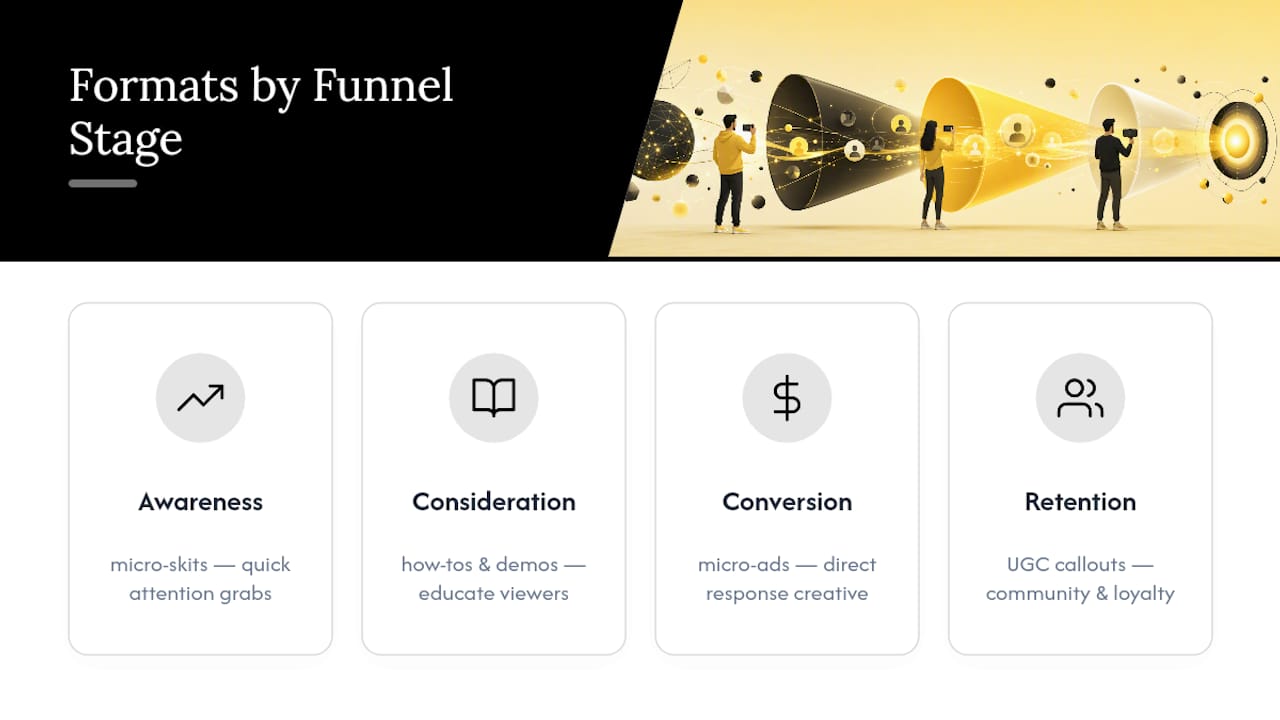
Awareness formats: get discovered by strangers
Trend participation still works when you bend the trend to your actual product instead of bolting your logo onto someone else’s joke. Micro-skits, thirty seconds or under, that dramatize a customer’s problem before you solve it, perform especially well because they front-load conflict, which is a built-in hook. Founder personality clips, someone on camera stating an unpopular opinion about your industry, tend to outperform polished brand statements because they read as a real person, not a marketing department.
Try a hook like “Nobody tells you this about [your industry] until it’s too late,” then cut to the reveal. Micro-essays, a single claim delivered straight to camera with on-screen text reinforcing the key line, work well when you have a genuinely contrarian take worth 20 seconds of someone’s attention.
Consideration formats: earn a second look
This is where educational how-tos, product demos, and social proof do their heaviest lifting. A quick how-to that solves one narrow problem in under 30 seconds builds more trust than a five-minute tutorial nobody finishes. Product demos work best shot from the customer’s point of view, hands doing the thing, not a presenter narrating from a distance.

“One tip” teardowns, where you critique a common mistake in your category and show the fix, perform well because they position your brand as the expert without sounding like an ad. Before-and-after formats need a strong establishing shot of the “before” so the payoff actually lands. Shoot the transformation moment tight and close, and let the contrast do the talking.
Conversion formats: turn attention into revenue
Micro-ads, 15 seconds, one product, one price, one deadline, still convert when the offer is genuinely time-boxed. Limited-time offer clips work harder when the countdown appears as on-screen text, not just spoken. Testimonial snippets, five to ten seconds of a real customer saying one sharp sentence, beat polished testimonial reels almost every time, because authenticity reads faster than production value.

UGC callouts with a direct CTA, “duet this with your own version,” give you free content while converting participants into your best advocates. If you can’t source real UGC yet, seed it: send product to five small accounts and ask for their honest reaction, unscripted.
Retention and community formats: keep people coming back
A weekly series with a consistent format, same intro beat, same rough length, same day of the week, trains your audience to expect you. Reply and duet content, where you respond to a comment or another creator’s clip with your own take, keeps your account feeling alive between bigger production pushes. AMAs shot in short segments, one question per clip, work better than a single long Q&A because each clip is its own discoverable entry point. Customer spotlight clips, featuring a real client using your product, double as testimonials and retention content at once.
Cross-cutting formats worth stealing
Repurposed podcast clips: pull the most quotable 20 seconds and add captions.
X-thread reads: turn a strong text thread into a voiceover with on-screen text matching each beat.
Blog-stat reels: take one surprising number from a long-form post and build a visual around it.
Challenge formats: invite a specific, easy action (not a dance) tied to your product’s use case.
If you run a small business, don’t overlook the simplest ideas: behind-the-scenes footage, staff features, and customer interaction clips consistently outperform anything that looks like a commercial.
Pro Tip: Write your hook line before you shoot anything else. If you can’t say why someone would stop scrolling in one sentence, the idea isn’t ready to film yet.
How To Turn an Idea Into a Finished Video Fast
Most short-form ideas die in the gap between “good concept” and “actually shot.” A tight micro-brief closes that gap in under five minutes.
Write the micro-brief. One sentence for the hook, one line for the payoff, one CTA, plus your target platform and aspect ratio (vertical, 9:16, always).
Shoot three essential frames. The hook frame (whatever stops the scroll), the close-up result shot (the transformation or payoff), and the product-in-use shot (hands or face interacting with it naturally).
Record clean audio first. A cheap lavalier mic beats an expensive camera with bad sound every time; viewers forgive soft video before they forgive muffled audio.
Edit caption-first. Build your on-screen text before you fine-tune cuts, since most viewers watch with sound off for the first few seconds.
Frame natively. Shoot vertical from the start rather than cropping horizontal footage after the fact; cropped video looks amateur in a way audiences notice instantly.
End on a loop-friendly beat. If your last frame connects visually or narratively to your first frame, the platform’s algorithm reads replays as a strong signal.
Pro Tip: Keep most clips between 21 and 34 seconds. Longer formats only work when there’s a real reason to rewatch, like a punchline that lands better the second time.
Our complete guide to video production breaks this workflow down further if you’re building a repeatable in-house process.
Repurposing One Video Across TikTok, Reels, and Shorts
A video that wins on TikTok isn’t automatically ready for Reels or Shorts. Repurpose the concept, not the raw file, and you’ll protect performance instead of tanking it.
Re-record the first 0.4 to 1 second of any repurposed clip to strip the original platform’s watermark and reframe for native display.
Keep original audio when the platform allows it. Overlaying a new voice track often kills the authenticity that made the clip work in the first place.
Trim runtime to match each platform’s sweet spot rather than posting the identical cut everywhere.
Test on your origin platform first, then adapt your top three performers to the other two platforms within 48 to 72 hours, while the concept is still fresh.
Never repost a watermarked video outright. Platforms actively suppress reach on clips carrying a competitor’s branding.
Our guide to creator workflows covers a fuller repurposing cadence if you’re managing multiple platforms with a small team.
What Metrics Actually Tell You About a Video’s Performance
Views tell you almost nothing on their own. Watch these five instead:
Completion rate: the percentage who watch to the end; a low rate usually means your hook oversold the payoff.
Average watch time: raw seconds watched, useful for comparing videos of different lengths.
Sends and saves: the strongest signal that content earned real value, since people don’t save what they don’t plan to revisit.
Click-through rate: how many viewers acted on your link or CTA.
Follower growth per post: a slower but honest measure of whether a video built your audience, not just your view count.
High views with low completion usually means your hook overpromised. High saves with modest views often means you found a niche audience worth doubling down on.
Quick test-and-scale loop: write one hypothesis, produce 3 to 5 variants of the same concept, publish as a batch, then scale whichever variant wins on completion rate and sends within a week.
Where Vainnewyork’s Perspective Comes From
Vainnewyork operates as a creative media and technology company built around making the ordinary extraordinary through content, collaboration, and culture. That means the ideas in this guide come from production experience, not theory pulled from a trend report.
Our content marketing strategy guide covers how to sequence formats across a full campaign calendar.
The Best Creator Tools for US Creators guide lists the specific gear and apps that make same-day production realistic for lean teams.
Our media and entertainment trends coverage tracks the platform shifts that change which formats are worth your time.
Our Take on What’s Worth Shooting This Month
Our priority this month is repeatable series with original audio over one-off viral swings. A single hit video teaches you almost nothing repeatable; a weekly series teaches your audience what to expect and teaches you what actually converts, week over week.
Try this micro-brief today: hook line, “The mistake most people make with [your category].” Three shots: you stating the mistake, a close-up of the fix in action, a final frame of the result. CTA: “Save this for later.” Film it before you second-guess the idea.
— Vain.
How Vainnewyork Turns Short-Form Ideas Into a Real Campaign
If the idea catalog above feels doable but the execution timeline doesn’t, that’s the gap Vainnewyork closes. We handle short-form strategy and production end to end, from format selection and scripting through shooting, editing, and distribution planning, so your team gets publish-ready assets without building an in-house video department from scratch.
A starter project usually begins with a working session to map your goals (awareness, consideration, or conversion) against the formats most likely to hit them, then a production sprint to shoot a batch of videos in one session rather than one at a time. That batching approach is exactly why brands come to us instead of hiring per-video freelancers: one shoot day can produce weeks of content built around your original audio and your actual product, not stock footage standing in for it. If you want a second set of hands on your short-form calendar, start a project with Vainnewyork and tell us which format from this guide you want to try first.
Sources
Recommended
Comments