Teams: Use Remit and KPIs to Hire a Creative Director, Not Portfolios


For most teams, the fastest, lowest-risk path is a consultancy-led placement: it gives you vetted senior talent without the six-month permanent search or the guesswork of an unmanaged freelance hire. Before you post a single job listing, define the remit and success metrics on paper. Vainnewyork’s managed placement model exists precisely for teams that want that clarity built in from day one.
TL;DR:
Managed consultancy placements offer a vetted senior creative leader with support structure, reducing mis-hire risk and offering flexible scope for urgent needs.
Clear remit definitions and measurable KPIs are essential before starting the search to prevent mismatched hires and guide candidate evaluation effectively.
Using a structured candidate assessment combining portfolio relevance, real-world exercises, and leadership questions improves hiring accuracy over unstructured interviews.
Short-term freelance work provides quick results but sacrifices long-term continuity, making it ideal for defined projects with clear endpoints.
Triggering success early involves thorough onboarding, clear stakeholder alignment, and a concrete 90-day plan to ensure the creative director adds value swiftly.
Table of Contents
How Do You Decide Between In-House, Freelance, and Agency Hires?
The route you pick should follow from your timeline and how much brand ownership the role actually needs, not from habit or whichever option feels safest on paper. A permanent creative director builds institutional memory and owns your visual identity across years, but the search alone can eat three to four months, and a bad match costs you a full salary cycle to unwind. Freelance hires solve the opposite problem: you can have someone directing a campaign within two weeks, though you sacrifice continuity and the freelancer’s attention is split across other clients.
Managed consultancy placements sit in the middle, and that’s exactly why they’ve become the default for teams under pressure. You get a vetted senior creative leader, often with a support structure already built around them, without carrying the full weight of an unmanaged search or a solo freelance gamble.
Here’s how the three routes actually compare once you strip away the sales pitch:
Permanent hire: Best for long-term brand stewardship; highest cost commitment; slowest to fill (often 3 to 6 months); highest mismatch cost if it fails.
Freelance contract: Best for a specific deliverable or campaign; fastest to onboard; weakest institutional continuity; quality varies widely without a vetting layer.
Managed consultancy: Best for teams that need senior leadership fast without a permanent commitment; moderate cost; built-in vetting reduces mismatch risk; flexible scope as needs shift.
Cost, control, and risk move together across these three options. A permanent hire gives you the most control over culture and long-term direction, but that control comes locked into a fixed cost structure regardless of whether the workload justifies it. Freelance gives you the least control, since the person answers to their own client roster, but you only pay for the hours or deliverables you actually need. Consultancy splits the difference: you get a managed relationship with accountability built in, and you can scale the engagement up or down as your creative needs change.
If your team is choosing between an agency partnership and a direct hire, it’s worth reviewing what digital product agencies typically offer versus what an embedded creative director owns, since the two solve different problems even though they sound similar on a proposal.
What Should the Creative Director Actually Own?
Skip this step and you’ll interview a dozen talented people who are all wrong for the job, because “talented” was never the actual criterion. The single biggest hiring mistake teams make is failing to define what the creative director will own before the search starts, and that ambiguity is what produces mismatched hires months into the job.
Start by deciding where the boundaries sit. Does this person own brand identity, hands-on production, product design decisions, or the relationship with your outside agencies? Most companies need some blend, but the blend has to be explicit, because a candidate who’s spent a career directing production teams will approach the job completely differently than one who’s spent a career managing agency relationships and stakeholder decks.
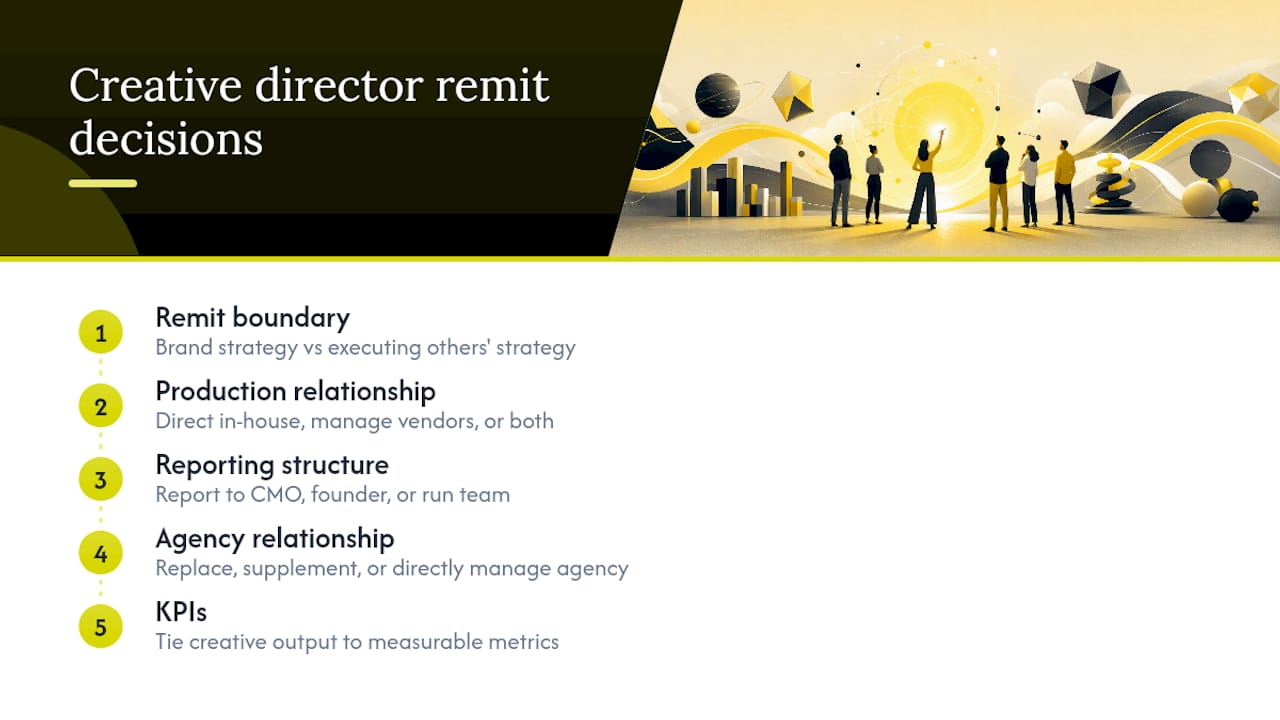
1. Decide the remit boundary. Will the creative director own brand strategy end to end, or execute someone else’s strategic vision?
2. Decide the production relationship. Does this person direct in-house production, manage external vendors, or both?
3. Decide the reporting structure. Will they report to a CMO, a founder, or run their own small team with budget authority?
4. Decide the agency relationship, if one exists. Will they replace an outside agency, supplement it, or manage it directly?
5. Set the KPIs before you write the job posting. Tie creative output to something measurable: campaign engagement lift, conversion rate on redesigned assets, retention of freelance contributors, or speed from brief to launched asset.
Elite creative directors distinguish themselves by balancing taste and creative instinct against commercial constraints and stakeholder relationships, not by having the most polished portfolio in the room, according to the IED’s profession overview. That balancing act is exactly what your remit document needs to test for later.
Role variants matter here too. A “brand lead” candidate should show a track record of shaping how a company is perceived across channels. A “production head” candidate should show operational fluency: budgets, timelines, vendor management. A candidate coming from an agency background will likely be strong on client-facing polish and weaker on internal team development, since agencies rarely ask creative directors to manage long-term reports.
Pro Tip: Write the remit document before you write the job posting, and have two stakeholders sign off on it. Disagreement here now is far cheaper than disagreement six months into the hire.
What Belongs in the Job Posting and Sourcing Brief?
A vague job posting attracts vague candidates, and a creative director search is one of the worst places to let that happen, because senior talent self-selects out of postings that read like a template. The posting should function less like an ad and more like a filter.
Include these fields at minimum:
The specific remit boundary (brand, production, product, or agency management) decided in the previous step.
Two or three concrete KPIs the role will be measured against in year one.
Clear portfolio submission instructions: what kind of work you want to see, and whether you want case studies or raw creative samples.
Team structure: who reports to this person, and who this person reports to.
Whether the role is remote, hybrid, or requires relocation, stated plainly rather than buried in a benefits paragraph.
If you’re routing the search through a staffing agency, headhunter, or freelance platform, the brief you hand them needs to be tighter than a public job posting, not looser. Recruiters and consultancies can widen your reach into senior talent pools you wouldn’t otherwise access, but only if the brief gives them something specific to search against. A brief that says “looking for a strong creative leader” produces a stack of generalist resumes. A brief that says “brand lead for a DTC apparel company, owns visual identity across three channels, reports to the CMO, six-month engagement with option to extend” produces candidates who already know whether they fit before the first call.
A simple three-channel sourcing plan works for most searches:
1. Referral first. Ask your existing network, including agencies you’ve worked with, for two or three names before opening the search publicly. Referred candidates arrive pre-vetted on reputation, which cuts your evaluation time meaningfully.
2. Headhunter or consultancy for senior roles. For permanent or high-stakes hires, a specialized recruiter or a managed consultancy typically surfaces stronger shortlists than an open posting, because they maintain relationships with passive candidates who aren’t actively job hunting.
3. Curated freelance shortlist for shorter engagements. If you need someone within weeks rather than months, a freelance platform or a network with pre-vetted senior talent narrows the search faster than sorting through open applications yourself.
Teams sourcing shorter freelance engagements often find it useful to review how to hire a freelance business for creative projects before committing to a full search, since the vetting standards differ meaningfully between platforms.
Pro Tip: Ask every agency or platform you’re working with to show you two examples of senior creative director placements they’ve made in the last year, along with how long each placement lasted. Turnover data tells you more about a sourcing channel’s quality than its marketing page ever will.
Which Sourcing Channel Actually Fits Your Search?
Every sourcing channel promises access to top talent, but each one is genuinely better suited to a different kind of search, and picking the wrong one wastes weeks you don’t have.
Headhunters work best when you need a specific, hard-to-find profile: someone with a rare combination of industry experience and leadership track record who isn’t actively browsing job boards. Expect a headhunter to present a small, curated shortlist rather than a flood of resumes. Recruitment agencies and consultancies can expand your reach and speed up senior creative hiring meaningfully, and most searches through this channel land on two to three finalist candidates before an offer goes out, according to Ad Culture’s breakdown of the creative director recruitment process.
Managed consultancies work best when you want the sourcing, vetting, and onboarding support bundled together rather than handled piecemeal. This route tends to suit teams that don’t have an internal recruiter dedicated to creative roles, or teams that have been burned before by a freelance hire who looked great on paper and fell apart under real deadline pressure.
Curated freelance networks work best for defined, shorter-term engagements: a campaign, a rebrand sprint, a product launch. The tradeoff is that you’re trading long-term continuity for speed, so this channel fits situations where the deliverable has a clear endpoint.
Industry communities and referral networks work best as a supplement to any of the above, not a replacement. A warm introduction from someone whose judgment you trust will almost always outperform a cold application, but communities rarely produce enough volume to run a full search on their own.
Whichever channel you use, ask for the same three things before you invest real evaluation time:
Case studies relevant to your role variant. A candidate’s best work should map to the remit you defined, not just look impressive in isolation.
Results from a role-relevant exercise, if the channel offers pre-screening. Some consultancies run a lightweight brief-response test before presenting candidates, which saves you a round of interviews.
References who can speak to leadership and team development, not just creative output. A reference who only talks about the work, never the working relationship, is a signal worth noting.
Balancing speed against quality is the real tension in every channel decision. Moving fast through an open posting risks a shallow pool; moving slowly through an exhaustive headhunter search risks losing a strong candidate to a competing offer. The practical fix is running two channels in parallel, an internal referral push alongside a managed search, rather than committing fully to one before testing whether it produces results.
How Do You Evaluate Candidates Beyond Their Portfolio?
A polished portfolio tells you almost nothing about whether someone can lead a team or defend a creative decision to a skeptical CFO, and that gap is where most hiring processes quietly fail. Hiring managers routinely overvalue portfolio polish and under-test a candidate’s ability to connect their aesthetic choices to measurable business results, according to Norman Consultants’ hiring guide. The fix is a structured, three-part evaluation that treats the portfolio as one input among several, not the whole decision.
1. Portfolio review, scored against your remit. Don’t just look at whether the work is beautiful. Ask what business problem each project solved, what the candidate’s specific contribution was versus the team’s, and whether the scale of the work matches what your role actually requires. A candidate whose best work is a single hero campaign for a Fortune 500 brand may not be the right fit for a scrappy startup that needs someone building systems from scratch.
2. A brief-response exercise using a real problem your brand actually faces. Give the candidate an abbreviated version of an actual creative challenge and ask for their strategic approach, not a full execution. Brief-response challenges combined with portfolio review reveal strategic depth and role fit far more reliably than conversation alone, and a recent analysis of creative leadership turnover in luxury brands points to exactly this gap: candidates who talk well in interviews but can’t translate that talk into a workable creative direction under real constraints. Use a genuine brand problem rather than a generic hypothetical, since a real problem surfaces fit faster than an abstract one.
3. Structured interview questions that probe leadership and commercial thinking, not just creative philosophy. Useful questions include: “Tell me about a time a creative decision you championed got rejected by leadership. What did you do next?” and “Describe a team member who was underperforming creatively. How did you develop them?” Toptal’s interview question bank includes situational leadership prompts and questions specifically about translating creative work into measurable outcomes, which are worth adapting for your own rubric.
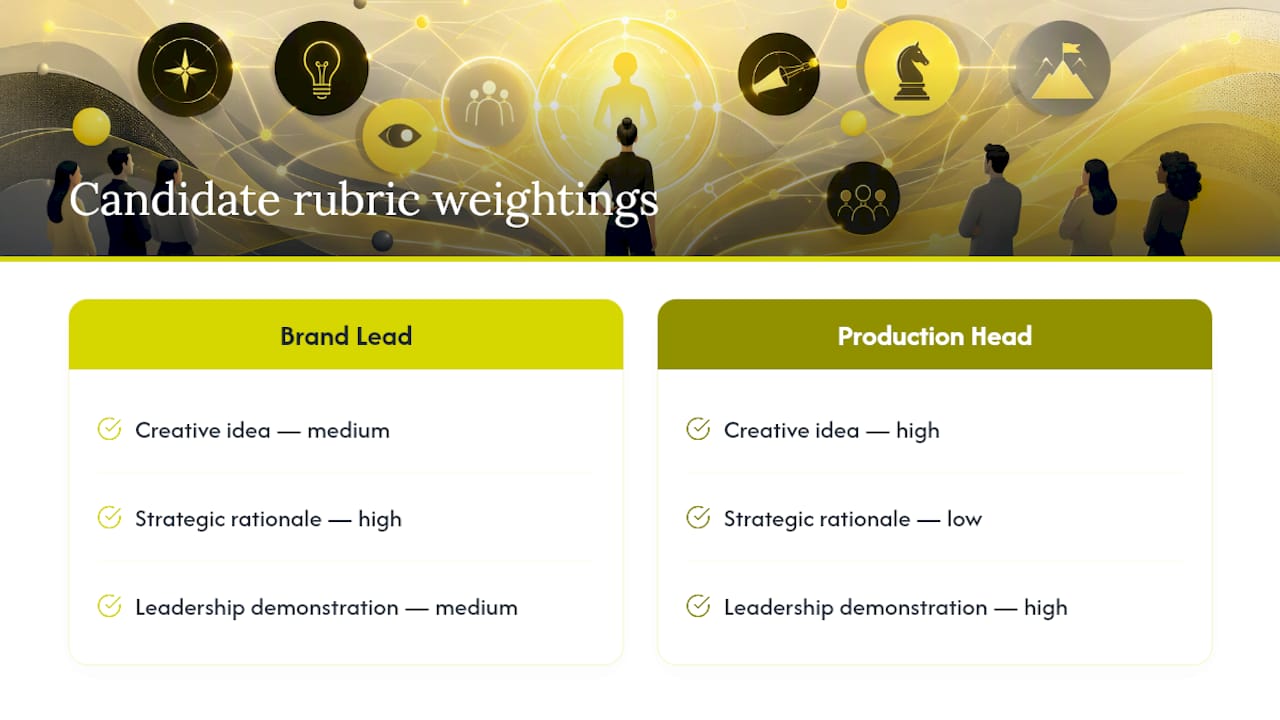
Weight your scoring rubric across three axes rather than one: creative idea quality, strategic rationale, and leadership demonstration, adjusting the weighting depending on whether you’re hiring a brand lead or a production head. For a brand lead, weight strategic rationale heavier. For a production head, weight execution and team leadership heavier. For high-stakes hires, pair the brief-response exercise with a live portfolio defense where the candidate presents their work and explains the business reasoning behind key decisions, since that format separates genuinely strategic thinkers from people who talk a good game in a first-round call.
A reliable hiring process combines portfolio review, leadership assessment, and structured interview questions that probe both strategic thinking and team management, per Workable’s guide to creative director interviews. Role-specific tests covering creative ability, leadership, and brand strategy produce more reliable matches than unstructured conversation, according to Testlify’s hiring guide, and structured rubrics carry a second benefit beyond accuracy: they make your final offer decision defensible to stakeholders who weren’t in the room for every interview.
What Should You Budget, and How Long Will Hiring Take?
Compensation for a creative director varies enormously by market, industry, and scope, so treat any number you see quoted online as a rough starting point rather than a fixed figure. As a rule of thumb, permanent salaries scale with the size of the team and budget the role controls, freelance day rates scale with the urgency and specificity of the deliverable, and consultancy fees typically bundle sourcing, vetting, and a management layer into the total cost.
The real cost drivers aren’t the title on the job posting, they’re the specifics of scope:
Ownership scope: A creative director owning full brand strategy across multiple channels commands more than one executing a narrower production mandate.
Deliverable clarity: Open-ended engagements (“help us improve our brand”) cost more to negotiate and staff than a tightly scoped project with a defined endpoint.
Urgency: Rushed timelines push freelance day rates and consultancy fees up, since you’re competing for availability against other clients.
Team leadership requirements: A role that includes managing and developing a team costs more than a purely individual-contributor creative role, because you’re paying for a second skill set on top of the creative one.
On timeline, most permanent creative director searches through a headhunter or consultancy land on two to three finalist candidates before an offer, according to Ad Culture’s recruitment process breakdown, and that shortlisting stage alone typically takes several weeks once you factor in scheduling around a senior candidate’s existing commitments. A freelance engagement through a curated network can move considerably faster, sometimes within two to three weeks from brief to start, since you’re not managing a full interview loop against a permanent offer.
The single biggest lever for speeding up either timeline is having your remit document and KPIs finished before the search opens. Every week spent clarifying scope after candidates are already in the pipeline is a week you’re paying a recruiter, a consultancy, or your own team’s time to sit idle.
How Do You Set Up a Creative Director for Early Success?
The first 90 days determine whether your new hire becomes a genuine asset or a expensive misfire, and the difference usually comes down to whether you give them structure early or let them figure out the org chart on their own.
1. First week: orientation and access. Get them into every relevant Slack channel, shared drive, and stakeholder meeting immediately. Schedule one-on-ones with every person or team they’ll be directing.
2. First 30 days: audit and quick wins. Have them audit existing creative output against the KPIs you defined during the remit stage, and assign one small, visible project they can ship within the month. This builds credibility with the team before they’re asked to lead a bigger initiative.
3. First 90 days: first full creative initiative and measurement checkpoint. By day 90, they should have led one complete project end to end, and you should have a concrete read on whether early output is moving the KPIs you set. If it’s not moving the needle, this is the point to course-correct, not month six.
Schedule a stakeholder alignment meeting in week one and again at the 30-day mark, pulling in whoever the creative director reports to and whoever they’ll be collaborating with on the production or agency side. Skipping this step is how creative directors end up sidelined by teams that never got clear direction on how to work with them.
Pro Tip: Assign the quick-win project in week two, not week one. Give them a few days to actually understand the team and the existing work before asking them to produce anything, or you risk getting a rushed first impression that doesn’t reflect their real capability.
For teams integrating a new creative director into existing production pipelines, it helps to map their entry against your current creator workflows so the first assignments don’t collide with work already in motion.
How Does Vainnewyork Approach Creative Director Placement?
Vainnewyork sources senior creative leadership through a consultancy-led model built around the same principle this guide has argued for throughout: define the remit precisely, then evaluate candidates against it rather than against a generic notion of talent. That means every placement starts with a structured conversation about what the role will actually own, brand, production, or both, before a single candidate is presented.
Assessment follows the same three-axis structure covered above: a portfolio review scored against business relevance, a brief-response exercise built around a real challenge the client is facing, and a structured interview that probes leadership history alongside creative judgment. For clients hiring into ownership-heavy roles, Vainnewyork also recommends a live portfolio defense, where the candidate walks through the business reasoning behind key past decisions rather than simply presenting finished work.
The onboarding layer carries through past placement day. Vainnewyork works with clients to set the same 30-and-90-day milestones outlined earlier in this guide, so a new creative director isn’t left to define their own success metrics after the fact. That combination, structured sourcing, outcome-linked evaluation, and follow-through onboarding, is what separates a managed placement from a resume forwarded by a generic staffing list.
The Real Reason Creative Director Hires Fail
Most hiring teams don’t fail at finding talented people. They fail at defining what “talented” means for their specific role, and then they hire for portfolio polish because it’s the easiest thing to evaluate on a Friday afternoon between meetings. That’s the pattern behind nearly every creative director hire that looks great on paper and falls apart within six months: nobody wrote down what the person was actually supposed to own before the interviews started.
The policy fix is deceptively simple. Before you post a single job listing, run a 30-minute remit workshop with the two or three stakeholders who’ll actually work with this hire. Force a decision on brand versus production versus agency ownership. Write down two KPIs. Then mandate a brief-response exercise before any candidate advances to a second-round interview, no exceptions, even for the candidate whose portfolio made everyone in the room go quiet.
That one policy change does more to prevent a bad hire than any amount of additional interview rounds or reference checks. It forces the evaluation to happen against your actual problem instead of against an abstract sense of talent. If your team hasn’t run that workshop yet, that’s the place to start, not the next job posting.
— Vain.
Ready to Bring in Senior Creative Leadership?
If you’ve read this far, you already know the two paths available: run the sourcing, evaluation, and onboarding process yourself using the framework above, or hand the execution to a team that runs this process daily. Vainnewyork exists for hiring managers who want the second option: a managed placement built around the remit clarity and outcome-linked evaluation this entire guide has argued for, without the internal bandwidth cost of running a full search alone.
Vainnewyork’s consultancy services cover the parts of this process that eat the most internal time: candidate screening against your defined remit, brief-response exercise design tailored to your actual business problem, and structured onboarding support through the first 90 days. You get a creative director who’s already been tested against your KPIs before they walk in the door, not one who simply interviewed well.
If your team is also building out digital marketing capability to support a new creative hire, the digital marketing professional course is worth a look for staff who’ll be collaborating closely with the role. To move forward on the hiring side, get in touch with Vainnewyork to scope your creative director search and see what a managed placement looks like for your team.
Sources
Recommended
Comments