Marketers: Gain 30–41% More AI Citations with Citation First GEO


Generative engine optimization (GEO) is the practice of shaping content so AI answer engines like ChatGPT, Perplexity, Claude, and Gemini quote and cite it directly. The core KPI is citation probability, not organic rank. The immediate priority for any content team: build extractable answer capsules and confirm AI crawlers can actually reach and render your pages.
TL;DR:
Prioritize creating answer capsules with clear, direct responses, attributed statistics, and named quotations to increase citation probability in AI answer engines.
Ensure your content is technically accessible by allowing AI crawlers to fetch and render pages, avoiding JavaScript-only rendering and keeping sitemaps updated.
Focus on proprietary data, short analysis, and named tools rather than long guides, as these generate higher citation rates from generative AI models.
Measure AI search visibility through crawl success, citation frequency, and sentiment, updating these metrics every six to twelve weeks due to rapid citation turnover.
Allocate GEO resources mainly to high-traffic, data-rich pages, and integrate structural fixes into your regular content workflow for sustained citation growth.
Table of Contents
What Is Generative Engine Optimization, Exactly?
GEO targets a different unit of selection than traditional search. Where SEO optimizes a whole page to rank in a list of ten blue links, generative engines pull individual passages, often just two or three sentences, and weave them into a synthesized answer. This is the mechanic behind retrieval-augmented generation (RAG): a model retrieves candidate passages from indexed content, then generates a response using whichever fragments best answer the question.
That changes what “optimized” means. A page can rank poorly yet still get cited, if one paragraph inside it is cleanly extractable and directly answers the query. Third-party corroboration matters here in a way link-building never fully captured. When your claim shows up phrased similarly across a few independent, named sources, engines treat it as more trustworthy and more likely to be surfaced.
Three things make a passage citable:
It answers one question in one to two sentences, with no throat-clearing before the point.
It carries a specific, attributable number or named source rather than a vague claim.
It sits under a heading that echoes the question a searcher would actually type.
How Does GEO Differ From Traditional SEO?
The signals overlap less than most marketers assume. SEO rewards backlinks as a proxy for authority. GEO cares more about how often your brand or data point gets mentioned, even without a link, because engines are pattern-matching across corroborating sources rather than counting weighted votes. A widely cited statistic with no backlink can outperform a heavily linked page that nobody else references.
Freshness also behaves differently. Organic rank can hold steady for years once a page earns authority. Citation eligibility decays faster. If your data point is superseded by a more recent figure elsewhere, an engine will often drop your source in favor of the newer one within weeks, not years.
What carries over from SEO, and what doesn’t:
Keep: crawlability, structured data/schema, fast page rendering. Google’s own guidance on optimizing for generative AI features still treats technical accessibility as a prerequisite.
Keep: clear topical authority built over time.
Downgrade: exact-match anchor text and backlink volume as primary levers.
Downgrade: long, keyword-dense how-to guides. Practitioner analysis across ten sites and 150,000 pages found how-to content underperformed for LLM citations, while original data and short analysis pieces dominated.
Add: engine-by-engine tracking, since retrieval indexes for ChatGPT, Perplexity, Claude, Gemini, and Copilot behave differently, according to comparative LLM SEO research.
What Tactics Actually Improve Your Citation Odds?
The Princeton-rooted research on generative engine optimization tested specific interventions against a control group and measured the lift, providing practitioners with useful direction on effective tactics.
Build the answer capsule first. Open each major section with a 120 to 150 word block that answers the implied question directly, one claim per sentence, before adding nuance. This structural pattern is one of the strongest predictors of extraction in replicated GEO studies.
Add three to five attributed statistics. Every number needs a source name and a date. “Conversion rates rose” is unusable to a model. “Conversion rates rose 18% according to a 2025 HubSpot benchmark” is exactly the kind of fragment an engine lifts wholesale.
Insert short, named-source quotations. A single sentence attributed to a real, named person or organization boosts verifiability. Controlled testing found quotation addition among the highest-leverage tactics measured, alongside statistics addition.
Use inline citations sparingly but precisely. Link the specific claim, not the paragraph around it. Engines seem to reward pages that show their work without burying readers in reference clutter.
Mark up facts with schema. FAQ schema, Article schema, and structured data around key facts give retrieval systems a machine-readable shortcut to your claims.
Name your tools and interactive assets clearly. A calculator or screener with a specific, searchable name gets treated as its own citable entity, separate from the surrounding article.
The controlled experiments behind this research reported citation lifts in the 30 to 41% range for individual tactics like statistics addition and source citation, with the largest effect on pages that started out mid-ranked rather than already dominant.
Pro Tip: Write your answer capsule last, after you’ve drafted the full section. It’s far easier to compress an argument you’ve already made than to write a tight summary before you know what you’re summarizing.
Can AI Crawlers Even Reach Your Content?
Most GEO failures aren’t strategic, they’re technical. If an AI crawler can’t fetch and render your page, none of the capsule work matters.
Check your robots.txt for explicit allowances for AI crawlers like GPTBot, PerplexityBot, and ClaudeBot, and consider publishing an llms.txt file alongside it.
Avoid JavaScript-only rendering for anything you want cited. AI crawlers rarely execute JavaScript the way a browser does, so server-side rendering or prerendering key content is the dependable fix, not an optional upgrade.
Keep sitemaps current and use IndexNow where your CMS supports it, so freshness signals reach engines faster than a standard crawl cycle.
Watch fetch success in your server logs, not just Google Search Console. That’s where you’ll see whether GPTBot or ClaudeBot actually completed a request.
Run a raw-HTML fetch test on your priority pages, the same way a crawler would see them, stripped of JavaScript. If your answer capsule isn’t visible in that raw fetch, no engine is reading it.
Pro Tip: Pull a week of server logs and filter for known AI crawler user agents before you touch a single word of content. You’ll often find the real problem is access, not writing.
How Do You Measure AI Search Visibility?
Treat AI visibility as its own channel with its own instrumentation, using three layers, according to practitioner measurement frameworks: crawl, citation, and recommendation.
Crawl layer: confirm bot fetches are succeeding via server logs, not assumptions.
Citation layer: count how often named sources, including yours, appear in AI-generated answers for target queries.
Recommendation layer: track sentiment, whether the engine frames your brand favorably when it does mention you.
Set up GA4 to isolate LLM referral traffic separately from generic direct or organic traffic, since most default configurations lump them together.
Run prompt tests on a six to twelve week cadence rather than once. Citation half-life is short. What got cited in January may be replaced by fresher data by spring.
Marketing teams already tracking analytics on a 90-day cycle have a natural home for this cadence.
Which Content Types Earn the Most Citations?
Original data wins over advice. Interactive tools with a clear, searchable name often out-cite entire articles because they answer one specific question completely.
Prioritize proprietary data, short analysis pieces, and named calculators or screeners over generic explainer posts.
Convert existing long-form guides into capsule-ready fragments: pull the single best sentence from each section and rewrite it as a standalone answer.
Use citation trackers, prompt-testing harnesses, and server-log analyzers to see what’s actually getting pulled versus what you assume is working.
Teams repurposing existing libraries can lean on frameworks for content creation built specifically around turning long assets into extractable pieces.
How Does Vainnewyork Approach a GEO Engagement?
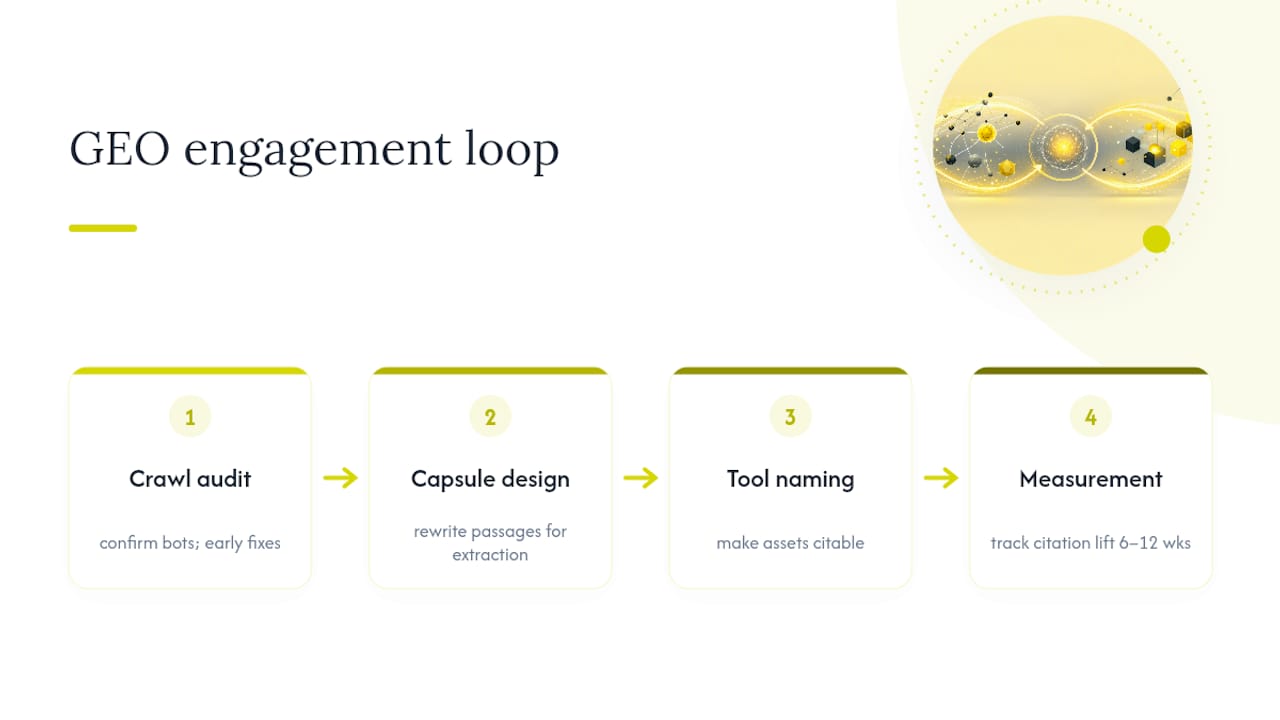
GEO work runs as a four-step loop: a crawl audit to confirm AI bots can reach priority pages, capsule design to rewrite key passages for extraction, tool naming to make interactive assets citable on their own, and a measurement loop to track citation lift over six to twelve weeks. Realistic engagements show early crawl and structural fixes within the first month, with citation movement following the slower cadence data itself imposes. Teams building this into an existing plan often start from a content strategy framework already built to prioritize pages by value.
Where Should You Actually Put Your GEO Budget?

GEO deserves priority on pages that already carry proprietary data or a genuine point of view, pages that are wasted on generic SEO if left as dense how-to guides. Pure informational pages competing on broad keywords are usually better served leaving SEO fundamentals intact and layering GEO fixes second.
Start with your five highest-traffic or highest-intent pages before touching the long tail. Assign clear ownership for refresh cadence, since a page cited today can fall out of rotation within weeks if a competitor publishes fresher numbers. Watch crawl logs monthly. Everything else follows from those two habits.
— Vain.
How Can Vainnewyork Help With Your GEO Strategy?
The answer capsules, statistics, and crawler fixes this playbook describes can be built into content and brand work, rather than treating GEO as a bolt-on service.
If your team is publishing content that ranks but never gets quoted by ChatGPT or Perplexity, the gap is usually structural: no capsule, no attribution, sometimes no crawler access at all. Production and strategy work builds those fixes in from the first draft rather than retrofitting them later, which is the difference between hoping for a citation and engineering one. Get a consult on your current content library and priority pages at Vainnewyork.
Sources
Recommended
Comments