What Explainer Video Animation Actually Costs in 2026


Budget a range of prices for a professionally produced animated explainer video, with many brands targeting a moderate budget for a polished 60-second piece. Style, runtime, and creative complexity drive the swing between those numbers far more than the studio you hire. What follows breaks down exactly where that money goes, so you can build a number you can defend in a budget meeting.
TL;DR:
Most professional 60-second explainer videos fall into the mid-range cost tier of $3,000 to $15,000, where scripting, storyboarding, and custom animation are standard.
Animation accounts for over half of the total cost, with styles like 2D motion graphics being more affordable than character-driven 3D or elaborate art direction.
Key cost factors include animation style, voiceover talent, script quality, and revision policies, which can cause quotes to vary by thousands of dollars.
Simplifying scene complexity, reusing assets, and focusing on strong scripting can significantly reduce expenses without harming video quality.
Regional studio location influences prices mainly due to overhead, with remote or international talent offering substantial savings compared to big-city studios.
Table of Contents
How Much Do Animated Explainer Videos Cost by Tier?
Think of pricing in three honest bands, each buying a distinct level of craft and attention.
Budget tier ($30–$2,000): AI-assisted tools and templates dominate this cost range, offering scripts, stock or AI-generated visuals, and synthetic voiceover, with minimal to no custom illustration. Fine for internal training clips or rapid A/B testing of a message, risky for anything meant to represent your brand publicly.
Mid-range tier ($3,000–$15,000): This is where most professional 60-second explainers land, and where the median studio quote actually sits, around $5,000 to $8,000. Expect a written script, storyboard, custom motion graphics or simple character animation, professional voiceover, and two to three revision rounds.
Premium tier ($15,000–$50,000+): At this level, costs reflect character-driven storytelling, 3D animation, or heavily art-directed brand films including original character design, nuanced animation, senior animators, and dedicated producing.
AI and template options make sense when speed and cost matter more than originality: internal comms, quick concept tests, low-stakes social clips. For anything tied to a launch, a funding pitch, or your homepage, the mid-range tier is where the return on investment actually shows up.
What Drives the Line-Item Cost of an Explainer Video?
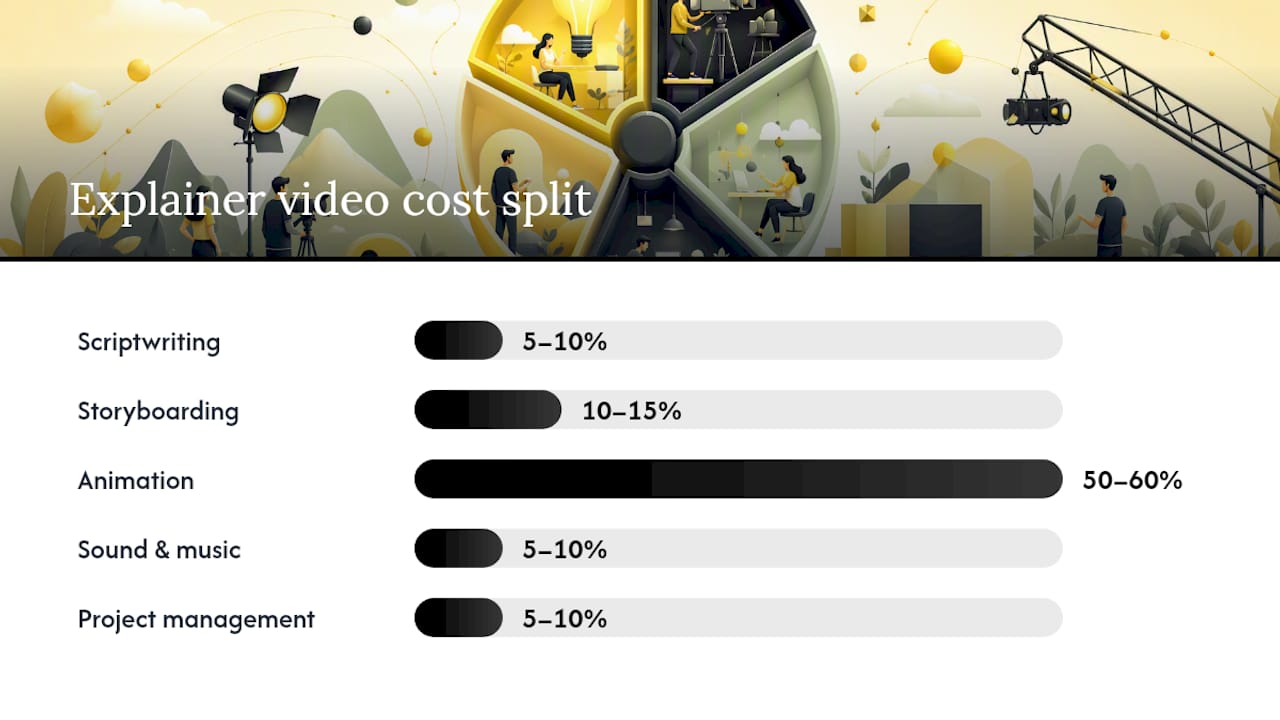
A quote isn’t one number. It’s a stack of line items. Understanding each one lets you negotiate intelligently instead of just asking a studio to “cut the price.”
A typical 60-second explainer takes roughly 150 to 200 hours of combined work, and animation alone eats up more than half of that time. Here’s how the budget usually splits:
Scriptwriting: 5 to 10% of total budget. Cheap relative to its impact, and the single biggest lever for a video that actually converts.
Storyboarding and style frames: 10 to 15%. This is where the visual direction gets locked before expensive animation hours begin.
Voiceover: roughly $200 to $1,200 for professional English narration, depending on talent tier and usage rights. AI voice options run far cheaper but carry a trust and quality tradeoff worth weighing against your brand’s tone.
Animation: 50 to 60% of the budget, and the biggest cost driver by far.
Sound design and music licensing: 5 to 10%, often quoted separately and easy to miss in a first estimate.
Project management and revisions: 5 to 10%, covering the coordination that keeps a multi-person production on schedule.
Statistic to remember: Key cost drivers like animation style, length, voiceover talent, and agency overhead can each swing a quote by thousands of dollars, which is why two studios quoting the same brief can land $10,000 apart.
Watch for common exclusions: source files (often $200–$500 extra), additional revision rounds beyond the included allowance, and alternate aspect ratios for social cuts, which studios frequently price as a separate add-on rather than folding into the base quote.
Does Animation Style Change the Price More Than Length?
Yes, and length behaves counterintuitively. A shorter video doesn’t cost proportionally less, because pre-production, scripting, and setup costs stay largely fixed regardless of runtime. A 30-second explainer can cost nearly as much per finished second as a 90-second one, since you’re still paying for a full script pass, a full storyboard, and full voiceover direction.
Style is the bigger lever:
Whiteboard animation: Simplest and cheapest, often the low end of the mid-range tier.
2D motion graphics: The default for most SaaS and B2B explainers; a 60-second piece from a mid-tier provider typically runs $3,000 to $8,000.
Character animation: Adds custom character design and rigging, pushing budgets well past $10,000 once you need consistent characters across multiple scenes.
3D animation: The most expensive category, since modeling, texturing, lighting, and rendering each add dedicated hours. Studios like Visualtrick that specialize in 3D pipelines can walk you through why that render time carries a real price tag.
AI-assisted graphics: The newest low-cost lane, capable of producing a talking-head or graphics-led video for $30 to $300, though character-driven storytelling still favors traditional studios.
Pro Tip: If your budget is tight, spend it on 2D motion graphics with a strong script rather than stretching for cheap 3D or character work. A well-written mid-tier video usually outperforms an underfunded premium one.
How Can You Reduce Explainer Video Costs Without Hurting Quality?
Cost control isn’t about finding a cheaper vendor. It’s about controlling scope before you ever request a quote.
Fund the script first. A stronger script tends to raise a video’s return on investment more than the same dollars spent polishing animation, since message clarity is what actually drives viewer action.
Limit character count and scene complexity. Fewer custom characters and simpler backgrounds cut animation hours directly, which is where most of your budget lives.
Batch assets for reuse. If you need multiple videos, design a visual system once and reuse illustrated elements across future projects.
Match the tool to the stakes. Use templates or AI tools for rapid message testing, then hire a studio once you know which script and concept actually work.
Ask pointed vendor questions in your RFP: how many revision rounds are included, what triggers rush fees, whether source files are included, and what the voiceover usage rights actually cover.
If you’re working with independent talent rather than a studio, hiring a freelancer for the animation work can shrink your budget, provided you’re clear about deliverables upfront.
Pro Tip: Send the same one-page brief to three vendors and compare what each one includes in “revisions.” That single question exposes more price padding than any other line item.
What’s a Realistic Timeline for an Explainer Video Project?
Most 60-second explainers take four to eight weeks from kickoff to final delivery, with scripting and storyboarding eating the first two to three weeks alone. Rushing that front end is usually what causes expensive revision cycles later.
Standard revisions: Studios typically include two to three rounds in the base price; additional rounds run 15 to 25% of the base cost each.
Rush fees: Expect a 25 to 50% surcharge for compressed timelines, since it usually means paying animators overtime or pulling in extra hands.
Coordination tip: Consolidate feedback from every stakeholder into a single document before sending it to the studio. Split feedback is the fastest way to burn through your included revision rounds.
Good production management practices, like a single feedback owner and a locked script before animation starts, prevent most of the scope creep that turns a $6,000 quote into a $9,000 invoice.
What Does Vainnewyork’s Production Experience Show About Realistic Budgets?
Vainnewyork works across video, audio, and animation production for brands, artists, and organizations who need creative work that actually performs, not just looks polished in a pitch deck. That range of work, from full commercial production to leaner project-based engagements, gives a useful reference point for what different budgets actually deliver.
A $5,000 project typically includes a finished script, 60 seconds of 2D motion graphics, professional voiceover, and two revision rounds. A $15,000 project adds custom character design, more complex scene transitions, and often a dedicated producer managing the schedule. Neither number is arbitrary. Both map directly to the hours and skill level required to hit that quality bar.
How Do Regional Market Rates Affect Explainer Video Pricing?
Where a studio is based shapes its overhead, and overhead shapes its quote. Studios in major creative hubs like New York or Los Angeles often carry higher base rates than remote-first teams, simply because senior animator salaries and office costs run higher in those markets. That doesn’t always mean better output. It often just means a higher starting number for comparable work.
Remote and distributed studios have narrowed that gap significantly. A talented animator working from a lower cost-of-living market can produce the same 2D motion graphics piece as a big-city studio for meaningfully less, since the labor itself, not the address, is what’s being priced. International freelance talent adds another layer: rates from animators based outside the United States can undercut domestic studio pricing substantially, though language nuance, time zone coordination, and revision turnaround speed become real factors worth weighing against the savings.

The practical takeaway: don’t assume a New York or San Francisco quote reflects “the market rate” for explainer videos generally. It reflects that market’s overhead. Get quotes from at least one local studio and one remote-first team before settling on a number, since the spread between them is often wider than buyers expect.
Should You Hire an Animation Agency or a Freelancer?
Agencies and freelancers solve different problems, and the right choice depends on what you’re actually optimizing for.
A full-service studio brings a built-in team: a scriptwriter, storyboard artist, animator, sound designer, and project manager working from one contract with one point of accountability. That coordination costs more, but it removes the burden of managing five separate relationships yourself. It also tends to produce more consistent quality, since the team has worked together before.
The tradeoff is that you become the project manager. You’re the one chasing down the illustrator when the storyboard artist is running late, and you’re absorbing the risk if one contributor drops off mid-project.
For a single, low-stakes video, a skilled freelancer is often the smarter financial call. For a brand-defining piece, a launch video, or anything with a hard deadline tied to a funding round or major campaign, the coordination an agency provides tends to justify its premium. Vainnewyork’s model splits the difference deliberately, running project-based engagements with the coordination of a studio but the lean structure that keeps pricing closer to freelance territory than big-agency retainers.
Why Most Explainer Video Budgets Get Allocated Wrong
The conventional advice tells you to spend more on animation polish. That’s backwards. The research is clear that script quality moves the needle on performance more than a few extra thousand dollars of animation gloss ever will, yet most first-time buyers do the opposite: they chase the flashiest demo reel and treat scripting as a rounding error in the quote.
The second miscalculation is treating a 30-second video as automatically cheaper than a 60-second one. Fixed pre-production costs mean that math rarely holds, and buyers who shrink the runtime to save money often end up disappointed by the quote they get back.
If you’re building an RFP right now, prioritize in this order: script quality first, revision policy second, animation style third. Everything else, the studio’s location, its portfolio glossiness, its office address, matters less than those three factors. A $6,000 video with a sharp script and a clear revision policy will outperform a $20,000 video built on a mediocre one almost every time.
— Vain.
Get an Accurate Quote for Your Animated Explainer
Vainnewyork gives you what most animation quotes don’t: a real project team, script-first thinking, and pricing built around what your video actually needs rather than a fixed package that forces you to overspend or underdeliver.
Where template tools and freelance marketplaces leave you managing five vendors and guessing at revision policies, Vainnewyork runs it as one accountable production, from script through final sound mix, with the transparency to tell you upfront where your budget is going. That matters most if this video represents your brand publicly, not just an internal training clip.
If you already have a project brief or even a rough idea of your budget range, start a conversation with Vainnewyork about what a realistic quote looks like for your specific length, style, and timeline.
Sources
Recommended
Comments